 Guide On Map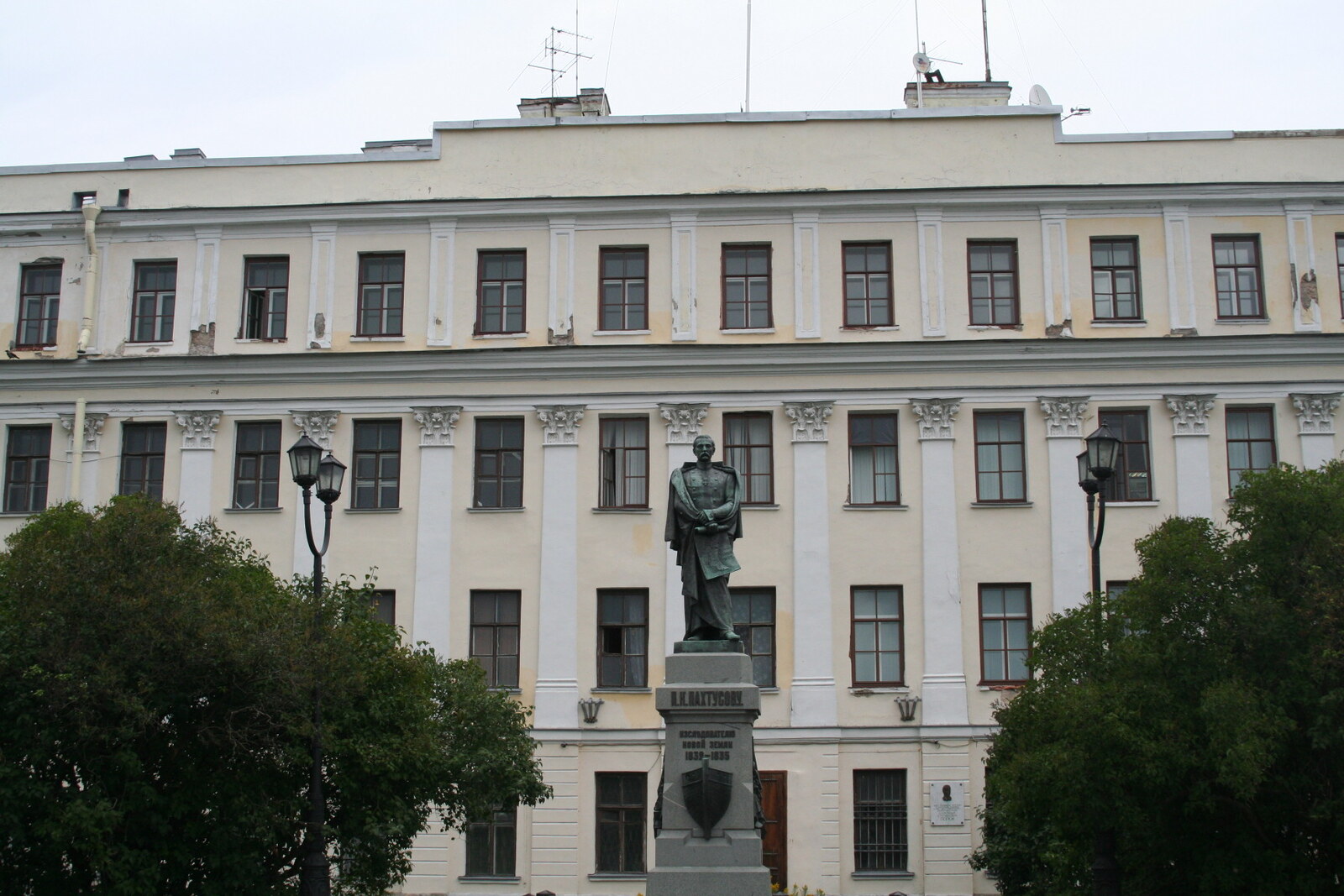
Look around first
What to notice
- The granite walls of the pond
- The facade of the Italian Palace
- The road between the palace and the water
The story of the place
The granite walls of Italian Pond hold the water of the former sheltered harbor. Merchant ships waited out the winter there, cargo was removed from their decks, and state passenger boats took people aboard. The facade of the Italian Palace on the opposite shore once faced directly onto the water, until the road cut it off from the basin. Italian Pond took its name from the palace, but historians have not established exactly when or why the palace received that name.
On November third, eighteen fifteen, Charles Baird, owner of a St Petersburg ironworks and engineering plant, took a vessel fitted with a steam engine out into the Gulf of Finland. He intended to earn money carrying passengers between the capital and Kronstadt, through which most of Russia's foreign trade then passed. Successful trials on the Neva River still proved nothing: the engine had to cross the open gulf in late autumn and then return against the wind.
Baird chose Merchant Harbour and Italian Pond as his destination. This body of water was dug as an inner harbor basin: merchant ships wintered here, goods were unloaded, and state passenger boats—sailing-and-rowing vessels for carrying people—departed. Passengers took provisions with a generous reserve. A fair wind made it possible to reach St Petersburg in a day; a headwind could carry a boat off toward Oranienbaum or Lisiy Nos.
Baird's steamer left the factory wharf at six fifty-five in the morning. After three and a quarter hours, it reached Kronstadt Military Harbour; another twelve minutes later, Merchant Harbour. Admiral Fyodor Moller, the port's chief commander, decided to test the new vessel in his own way. He set Kronstadt's best rowing cutter against the engine. Under normal rowing, the cutter fell behind; the sailors could draw level with the steamer only when they pulled at the oars with all their strength.
The real test began on the return journey. The wind strengthened and blew head-on; in such weather, rowing cutters hardly put out into the gulf. The steamer kept going and returned to the St Petersburg guardship—a watch vessel at the entrance to the port—in five hours and twenty-two minutes. The entire outward and return passage took eight hours and thirty-seven minutes. Baird proved that schedules could now be tied to the engine rather than to a fair wind.
In the following navigation season, his steamer was already carrying passengers between St Petersburg and Kronstadt. In eighteen seventeen, Baird added a second vessel, began carrying mail, and towing cargo boats. Sailings began to run twice a day, and the industrialist received the exclusive right for ten years to build and operate steamships on the Gulf of Finland and most of the country's waterways. Italian Pond became the Kronstadt station of Russia's first regular steamship line.
The palace on the opposite shore appeared earlier. In seventeen twenty, Aleksandr Menshikov, the St Petersburg Governor-General, ordered a ceremonial residence to be built here to a special design. The architect was the German Johann Braunstein, and the work was supervised by the German Georg Schadel. The main facade faced directly onto the harbor basin; the present-day street between the building and the water did not yet exist.
Menshikov lost the palace almost immediately after the work was completed. In seventeen twenty-seven, he was arrested, sent into exile with his family, and the residence was transferred to the treasury. The name “Italian Palace” took hold later: it appears in documents only from seventeen forty-five. The popular version about Italian craftsmen is not supported by documents. Perhaps contemporaries meant the ceremonial residence's Italian character; historians have not been able to establish exactly who first gave it this name and why. The pond then took its name from the palace.
After a fire at the Naval Cadet Corps in St Petersburg, Empress Ekaterina II ordered the cadets transferred here. The building began to be rebuilt to provide classrooms, dormitories, and service quarters; it was then occupied by navigation and naval engineering schools. These alterations almost concealed the palace depicted in an engraving from seventeen twenty-seven. Part of the building is now occupied by an exhibition of the Central Naval Museum.
At the end of the eighteenth century, part of the pond was filled in, and a road appeared in front of the palace. Baird's steamship pier is gone as well. What remains of the first Kronstadt passenger station is the granite basin itself—Italian Pond.
Useful on site
Kronstadt Fortress branch: 10:00–18:00, ticket office until 17:15; Monday and Tuesday are days off.
Checked: June 24, 2026. Check the official source before visiting.You can hear the story of the pier and the educational building from outside. Treat entry to the palace as a separate museum visit and check in advance whether it is possible to get inside.