 Guide On Map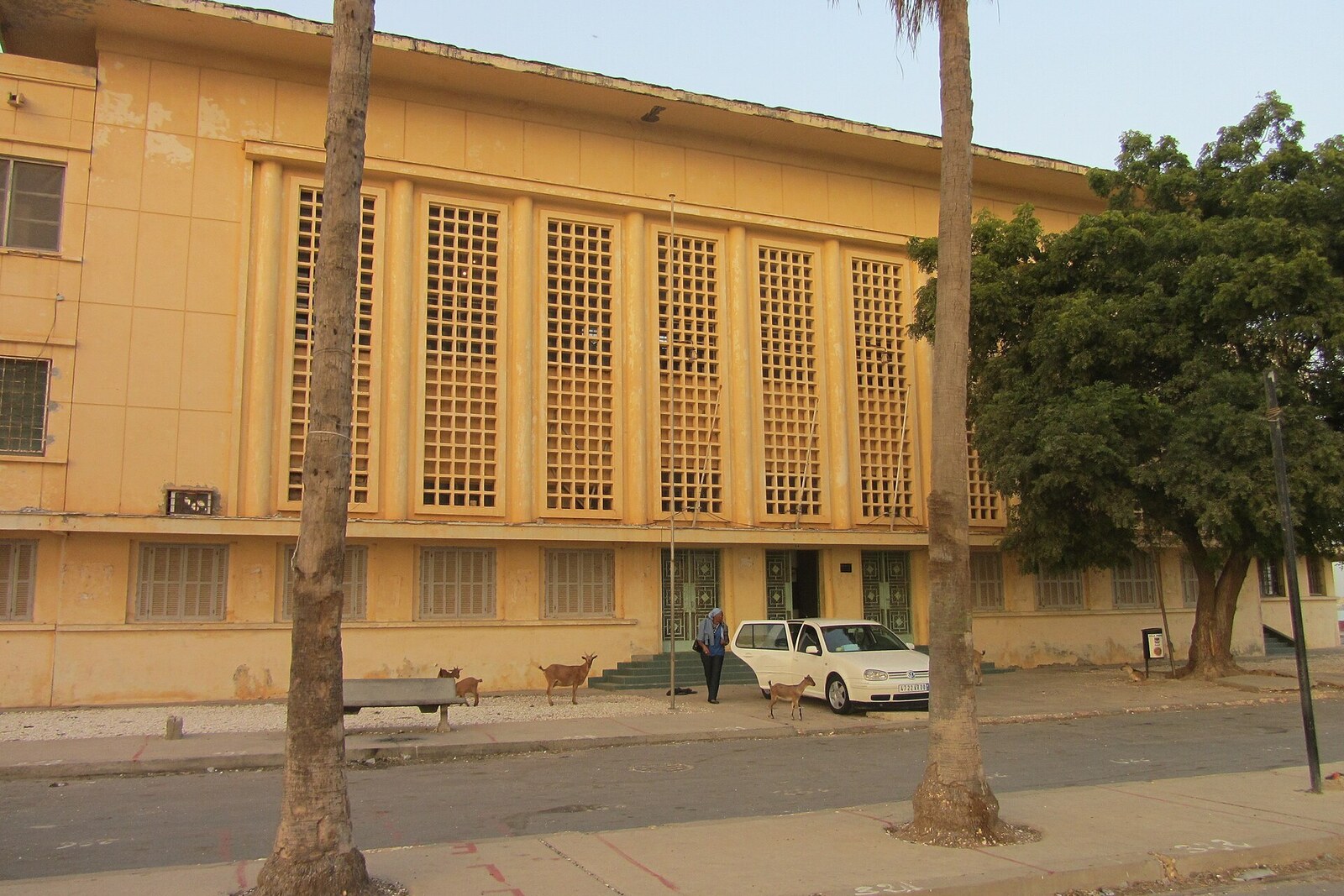
Look around first
What to notice
- The center building
- The southern tip of the island
- The riverbank
The story of the place
Photographs from research trips were brought to the photo laboratory of the local branch of the French Institute of Black Africa (IFAN). A separate building for the center was constructed by the river in nineteen fifty-four. The collection was also expanded with photographs of Saint-Louis itself: official visits, houses, fishermen, families, and urban fashion. The museum, research library, photo collection, and records of the colonial court now stand side by side here.
In nineteen ninety-three, Fatima Fall was appointed here—a former art teacher who became the curator of the museum collections. The building was being renovated, and she had to sort out the photo collection from scratch. Reference materials listed about twenty thousand images, but there was no reliable inventory. The negatives needed new envelopes, furniture, and protection from insects. Until a photograph is described and linked to an author's name, date, and place, it is almost useless in an archive.
Photographs had been accumulating here since nineteen forty-three. That year, a branch of the French Institute of Black Africa (IFAN), serving both Senegal and Mauritania, opened in Saint-Louis. Its director, Georges Duchemin, set up a laboratory before similar facilities appeared in many other branches of the institute. Researchers brought in photographs from their trips, and Duchemin added his own negatives. In nineteen fifty-four, this building was constructed for the center at the southern tip of the island.
After Duchemin, the photo collection was expanded by Adama Sylla, a museum curator who wanted to leave documentary evidence of a changing Saint-Louis. On a UNESCO scholarship, he studied at the Musée de l'Homme in Paris, then returned here. Sylla photographed presidential visits and city buildings, accompanied ethnographers on their trips, and developed film in the local laboratory.
The museum was his main job. In the evenings and on holidays, Sylla opened his own studio in Guet Ndar. People came there to be photographed in a new outfit, preserve a family event, or commemorate a gathering of friends. Clients paid him for these portraits; for the institute, he photographed what the researchers required. As a result, official ceremonies, monuments, fishermen, families, and the urban fashion of the nineteen sixties and nineteen seventies ended up side by side. Among the twenty-five authors in the present-day photo collection, the largest bodies of work belong to Duchemin and Sylla.
Fatima Fall received help only two years after her appointment. The center's adviser, Guy Thilmans, found funding in New York; envelopes and furniture were bought for the negatives, and the premises were treated with a special insect-resistant paint. Fall received training in preserving museum photographs and devoted her graduation thesis to this collection. She then secured a new grant from the West African Museum Programme and the Getty Foundation. In nineteen ninety-nine and two thousand, staff and interns counted the holdings: instead of the expected twenty thousand, they found about thirty-five thousand documents. Fall began asking families and acquaintances to bring in old originals before they disappeared during moves or after their owners' deaths.
The museum, research library, and photo collection now operate in the building; the records of the colonial court are also kept here. By nineteen ninety-two, Sylla had retired, and his photographs later began to be shown in international exhibitions. In twenty twenty-three, Fall brought in another nearly fifteen thousand donated digital images, and the center's collection grew to about ninety-five thousand documents.
The center's official name includes that of Yoro Dyao Boly Mbodj. He was one person—a Senegalese chronicler from Waalo who recorded his father's stories and the stories of griots about the past of the Wolof peoples. In eighteen sixty-four, he submitted for publication a history of the damels, as the rulers of Cayor were called. Some of the originals of his later notebooks disappeared, and the texts have survived in revised publications. Since twenty eleven, the institution has borne his name; its staff still accept family photographs and sort them by author, place, and date.
Useful on site
the Centre de Recherche et de Documentation du Sénégal (CRDS) social channel announced 9:00–13:00 and 14:00–20:00 in May 2026; confirm before visiting
Checked: June 24, 2026. Check the official source before visiting.Check access to the collections in advance; if the doors are closed, the stop remains meaningful from outside.