 Guide On Map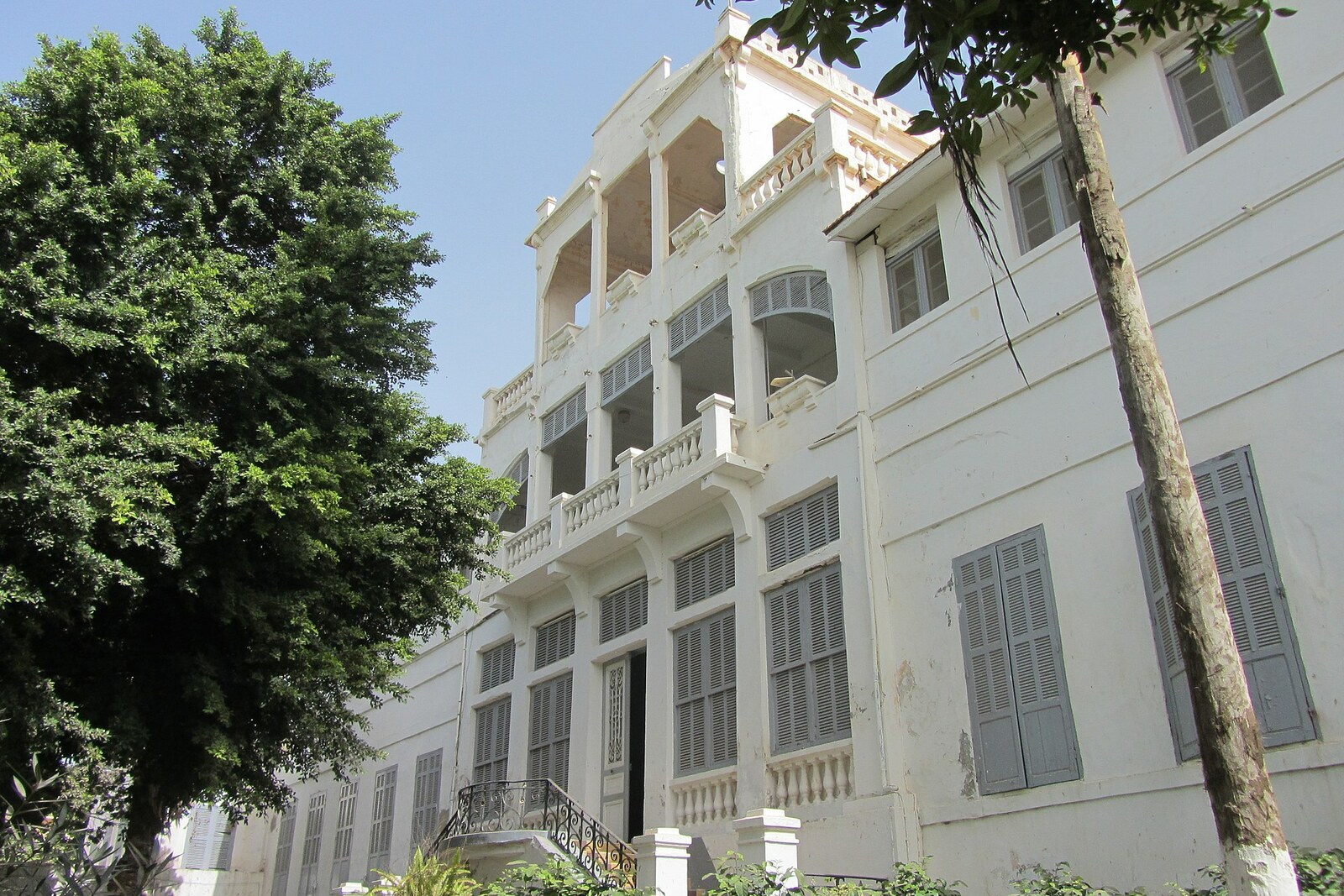
Look around first
What to notice
- The facade of the governor's palace
- The thick foundations of the old walls
- The space between the palace and the square
The story of the place
At the bottom of the facade on the Mille-Lacroix Street side, unusually wide foundations of the old walls have survived. A fortified house of the French trading post once stood on this site: under its protection were living quarters, warehouses, a chapel, and a room for adjudicating matters. In the early nineteenth century, officials used the remains of the fort for the governor's residence. Thus, the palace came to stand on a site where a trading fortification gave way to the island's main administrative building.
On September fifth, eighteen ninety-five, the arrested Sheikh Ahmadou Bamba was brought to this palace before the council under the governor. The council was an administrative meeting of officials, not an ordinary court. Acting governor Louis Mouttet sought to have Bamba removed from Senegal and separated from his disciples.
Bamba was a Muslim scholar and the founder of Muridiyya, a Sufi brotherhood. He established settlements where disciples studied the Quran and cultivated shared fields. In Darou Salam, they built a school and a mosque, and cleared land for millet and corn. These fields fed the community. After the defeat of the former states, peasants, former slaves, and supporters of defeated rulers came to the sheikh. To French officials, hundreds of people around an independent religious teacher looked like a possible army.
Leclerc, the administrator of the Saint-Louis district, reported a gathering of about seven hundred men. At the same time, he acknowledged that he did not know Bamba's exact words and could name nothing objectionable in his speech. The suspicions proved sufficient. The council unanimously resolved to send the sheikh to Gabon, until the “agitation” caused by his teaching had been forgotten in Senegal.
That decision was made here precisely because the palace occupied the island's oldest administrative site. In sixteen fifty-nine, French traders built a fortified house on this spot. Inside were living quarters, warehouses, a chapel, and a room for adjudicating matters of the trading post. In the early nineteenth century, officials built the governor's palace on the remains of the fort. On the Mille-Lacroix Street side, the especially thick foundations of the old walls are still visible.
Murid tradition recounts that before the council, Bamba performed two rak'ahs in the governor's office—two complete cycles of Muslim prayer with bows and prostrations. For some of his followers, this was an open challenge to the officials; for others, an ordinary voluntary prayer by a man who, before the verdict, turned only to God. The colonial protocol confirms the meeting and the decision on exile, but says nothing about the prayer. It is preserved in the testimony of disciples and later Murid tradition.
Bamba was sent to Gabon, where he spent seven years. When the sheikh returned in nineteen oh two, the number of his followers had grown, and the exile had become the central event in Murid memory.
Since the nineteen seventies, Murids have gathered at the former governor's palace every September fifth. A large tent is erected between the building and the square; some pilgrims are allowed into the courtyard, where they pray near the place that tradition associates with Bamba's two rak'ahs. The officials' decision remained in the protocol, while the worshippers themselves bring back here each year the prayer absent from it.
Useful on site
viewing from outside; the building is administrative, and interior access is not intended
Checked: June 24, 2026. Check the official source before visiting.This is an active official building: remain in public space and do not try to enter without permission.