 Guide On Map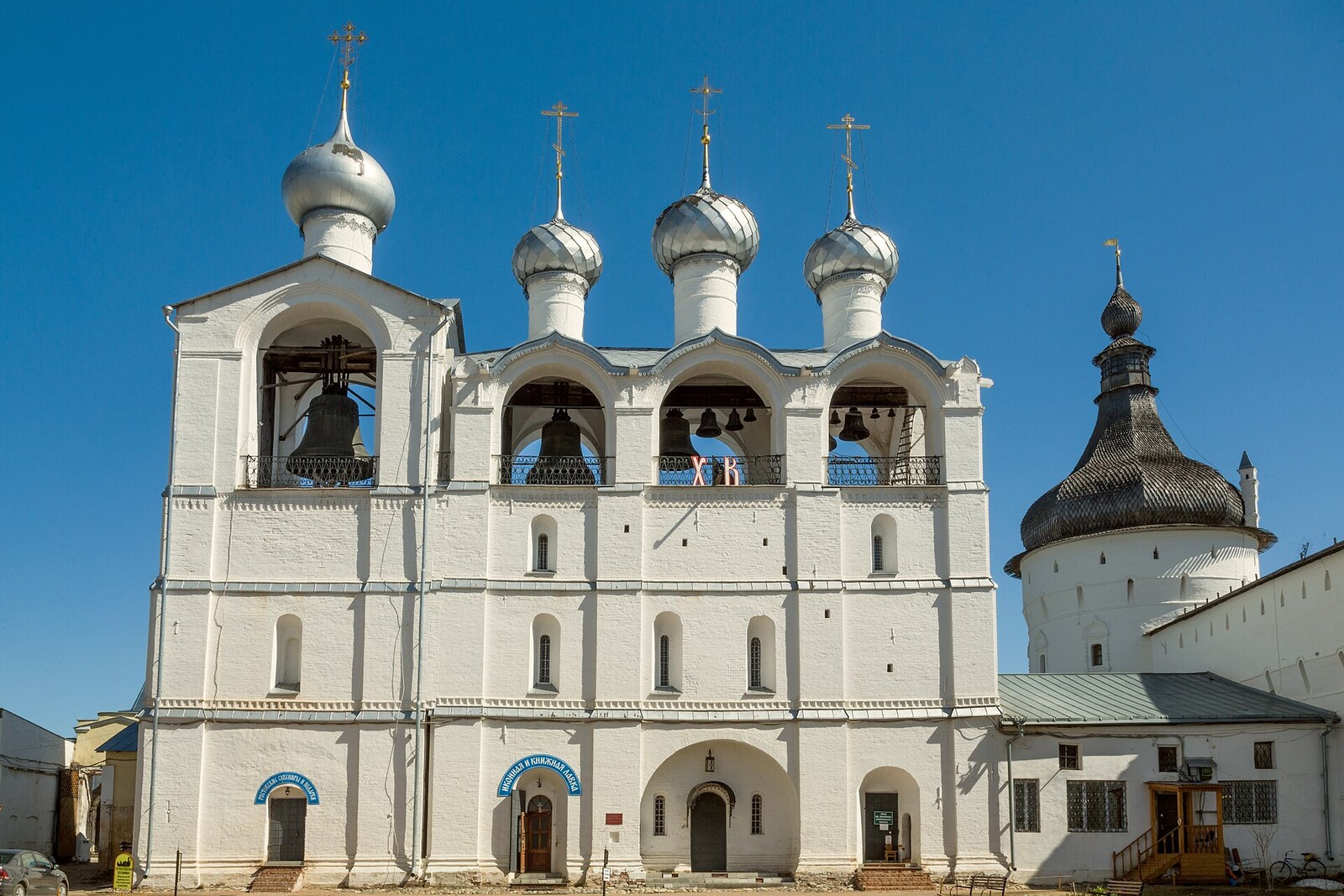
Look around first
What to notice
- The belfry's four openings
- A row of fifteen bells
- The large bell Sysoy
The story of the place
Along the wall of Dormition Cathedral stretches an open tier with four archways, where fifteen bells are suspended one after another. It was commissioned for the cathedral at the end of the seventeenth century, and its layout allowed several bell ringers to maintain a shared pattern without losing one another by ear. The heaviest bell, Sysoy, needed a separate place: it weighs as much as thirty-two tons. Here the bells are not swung as a whole; their clappers are moved with pull rods, so a festive peal becomes the work of an entire team.
On March fifteenth, nineteen sixty-three, Alexander Butylin climbed up here again for the first time in several decades to lead the bell ringers. He was over seventy. He earned his living as an accountant, lived in a small house near the Rostov Kremlin, and had known the Rostov Veliky peals from the days when they were performed during cathedral services. Now Butylin had to prove that the interrupted performance could still be restored.
Regular ringing here stopped in nineteen twenty-eight. The bells remained in their places, but a Rostov Veliky peal could not be produced simply by pulling the ropes in the right sequence. The large bells are fixed in place: the bell ringers swing their clappers with pull rods. A festive peal requires at least five people. One keeps the measured part of the heavy bells, while the others weave in the strikes of the medium bells and the rapid pattern of the small ones.
This long open gallery was built for such work. In the sixteen eighties, Metropolitan Iona Sysoyevich, head of the Rostov Eparchy, commissioned it for Dormition Cathedral—hence the name Cathedral Belfry. The bells were arranged in a row, from small to large, so that the bell ringers could hear one another along the entire length of the tier. When the bell founder Flor Terentyev cast the thirty-two-ton Sysoy in sixteen eighty-eight, a separate fourth opening had to be added for it. The bell was named in memory of Metropolitan Iona's father.
By nineteen sixty-three, this structure alone was not enough. The architect-restorer Vladimir Banige, responsible for the safety of the recording, inspected the old beams and the bells themselves. The writer Yefim Dorosh, who was seeking permission to bring back the ringing at least for a sound recording, gave explanations at Moscow institutions. The main question remained whether people remembered how to operate the whole system.
Butylin gathered those who had trained before the long break. Among them was Mikhail Uranovsky: his father first brought him here when he was a boy of ten, and later the son filled in for his father, performed the everyday peal, and struck the hours at night. When there were not enough old performers, Butylin assigned individual parts to people from entirely different professions. Alongside experienced bell ringers stood a piano tuner, a printing-house worker, a locksmith, and a driver.
The first recording was technically weak. The bell ringers were given almost no time to rehearse, the pull rods needed adjustment, and the metal fittings had rusted. This failure did not end the work. In June of that same year, the crew of Sergei Bondarchuk, who was filming War and Peace, came here. Now the performers were allowed as much preparation time as was needed. Butylin's team recorded seventeen versions of the peal; later the sound recordings were used in the film, and in nineteen sixty-six they were released on a record.
After the replacement of the load-bearing beams in nineteen eighty-seven, the peals resumed at a belfry already in operation. In its four openings, the full set of fifteen bells still hangs—including that very Sysoy, whose clapper was controlled in nineteen sixty-three by Butylin and the Rostov Veliky bell ringers he had gathered.
Useful on site
Regular access to climb and a guaranteed ringing time in a published schedule are not advertised; concerts and classes at the Bell Art Center take place by advance arrangement.
Checked: June 24, 2026. Check the official source before visiting.The set can be clearly seen from below, even if the climb is closed. Do not count on hearing the full peal without a special program; ask separately about climbing up and a demonstration of the bell ringers' work.