 Guide On Map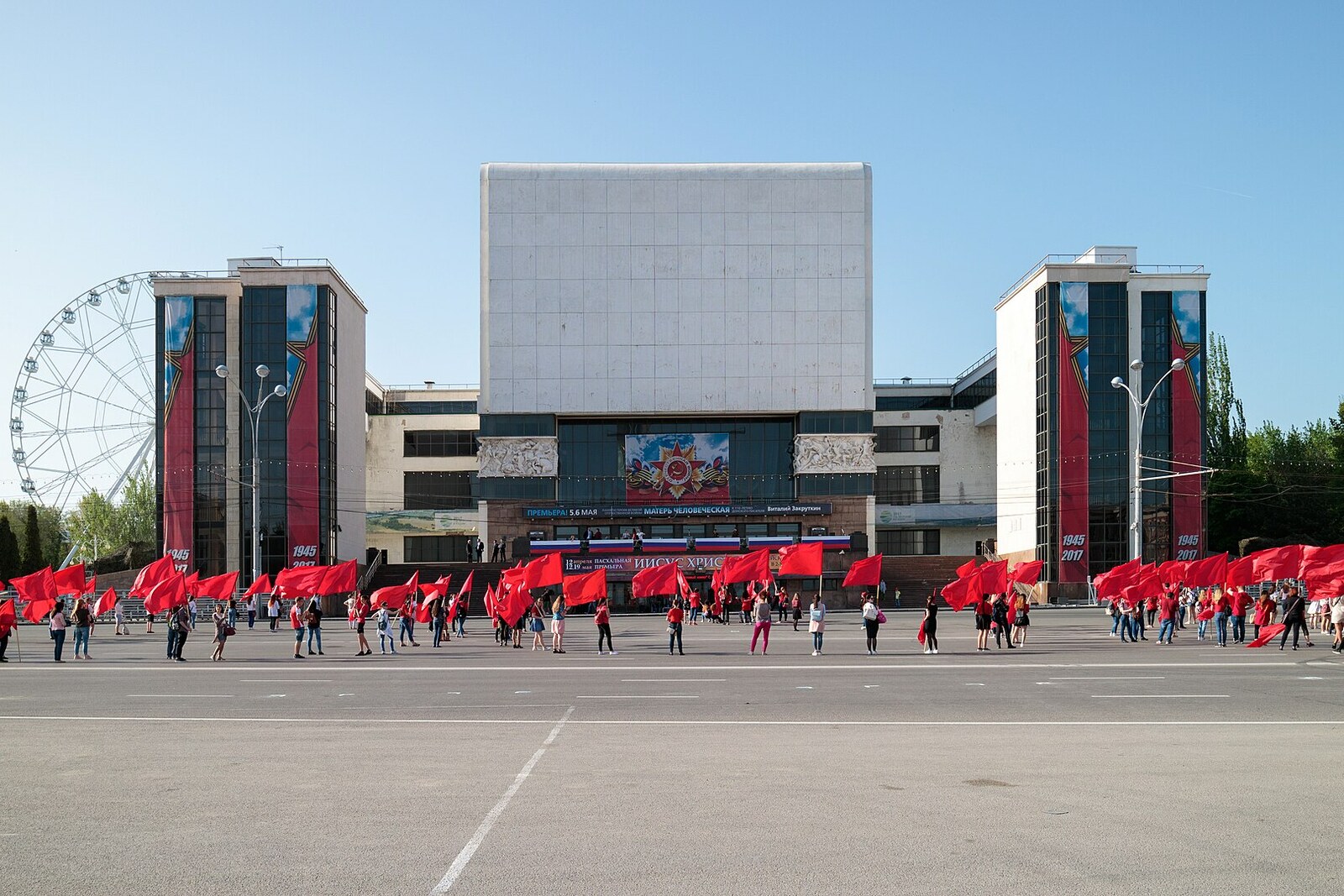
Look around first
What to notice
- The theatre's concrete façade
- The outline of the “tractor” building
- The theatre's name on the façade
The story of the place
The heavy concrete façade deliberately suggests the silhouette of a tractor, while behind it survives a stage nearly the size of a house: twenty-three meters wide, twenty-two meters deep, and the same in height. It was conceived for mass productions that could bring cavalry, an automobile, and multilevel sets onto the stage; the original auditorium held about two thousand three hundred people. The former interior was lost, and for many years the troupe performed in what is now the Rostov Philharmonic. After reconstruction, the auditorium was made nearly half as large and the sound was improved, but the scale of the main stage was retained.
In nineteen thirty-six, the Moscow director Yuri Zavadsky was offered the chance to leave for Rostov with his theatre studio. At the time, young companies from the capital were being moved out of Moscow, merged with other troupes, or closed. Several directors refused to relocate, and their theatres soon ceased to exist. Zavadsky agreed: he hoped this would preserve both his studio and his students. The already well-known actors Vera Maretskaya, Nikolai Mordvinov, and Rostislav Plyatt went with him.
In Rostov, a stage designed for an entirely different kind of theatre awaited them. The auditorium held about two thousand three hundred people. Five revolving stages and lifting platforms were powered by one hundred fifty motors. At the building's opening in late nineteen thirty-five, Mutiny, based on Dmitry Furmanov's novella, was performed here, with cavalry brought onto the stage. The new theatre was expected to present mass spectacles that could accommodate automobiles, three-story sets, and dozens of performers.
Zavadsky, however, was used to a basement studio in Moscow, where a quick glance or turn of the head already became part of a role. Here, such details disappeared in the space, and actors at opposite ends of the stage sometimes could not hear their scene partner. Plyatt recalled that they agreed to signal the end of a line to one another with a gesture: the movement remained visible even when the words were lost. For a theatrical skit, he composed a song: “We know of no other stage where a person is heard so poorly.”
Zavadsky could not make the auditorium smaller, so he changed the acting. He gathered the troupe for weekly discussions, brought his students together with Rostov actors, and worked toward a unified style designed for the enormous distance to the audience. In Love Yarovaya, the artist Yuri Pimenov placed a three-story Rostov courtyard with galleries and staircases on the stage. The curtain opened, and the audience recognized the houses on the slopes down to the Don.
On this same stage, Zavadsky produced Enemies and Philistines. Their author, Maxim Gorky, was the literary pseudonym of Alexei Peshkov, a playwright who wrote about people forced to defend their place in the family and in society. The city drama troupe bore his name even before the move to the new building: Philistines was first performed in Rostov in nineteen oh two, and Enemies in nineteen nineteen. The name on the façade continues this repertory tradition.
After successful tours in nineteen thirty-eight, Zavadsky tried to bring the company back to Moscow. Konstantin Stanislavsky and Vladimir Nemirovich-Danchenko, the leaders of the Moscow Art Theatre, supported the petition, but the Committee for Arts ordered the company to continue working in Rostov. The director stayed for another two years. In nineteen forty, he became head of the Mossovet Theatre; Maretskaya, Mordvinov, and his other students followed him and formed the core of its celebrated troupe.
The original auditorium behind the façade is gone. In nineteen forty-three, the building burned down and was destroyed, and Rostov actors performed for twenty years in the building of what is now the Rostov Philharmonic. During reconstruction, the auditorium was reduced by roughly half, to one thousand one hundred sixty-five seats, and the acoustics were improved. The enormous stage remained: twenty-three meters wide, twenty-two meters deep, and the same in height. Behind the concrete façade of the “tractor” theatre, the Main, Small, and Experimental Stages now operate; on the main stage, lines no longer have to be conveyed by gesture.
Useful on site
The square and façades are accessible from outside; the interior is accessible with a ticket for a performance or on a separately announced tour. Check the box-office schedule with the theatre.
Checked: June 24, 2026. Check the official source before visiting.The building's form is easy to make out from outside; plan a performance and a visit to the interior separately.