 Guide On Map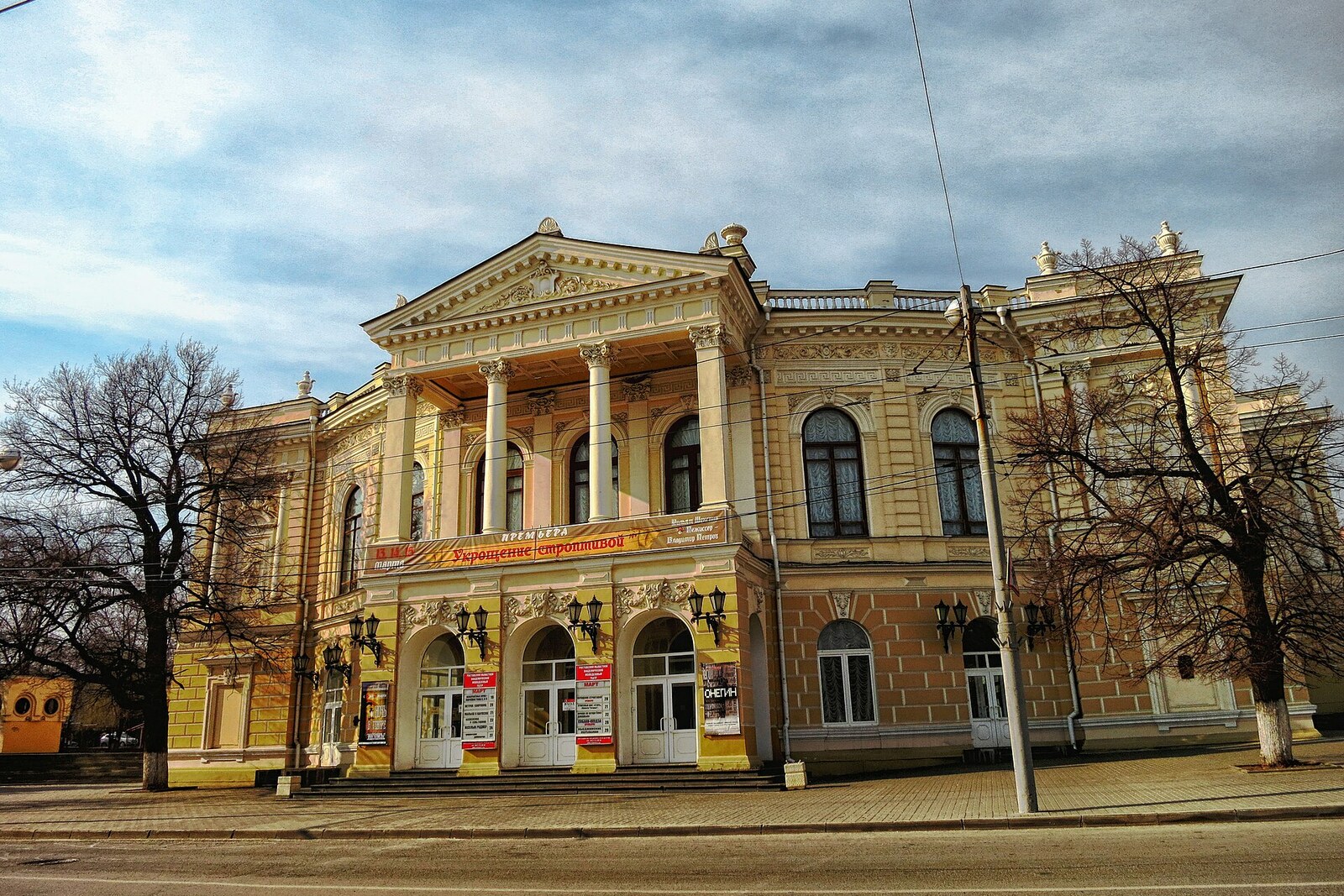
Look around first
What to notice
- The façade of the pre-revolutionary theatre building
- The main entrance
- Freedom Square in front of the theatre
The story of the place
The main entrance on Freedom Square leads into the pre-revolutionary Nakhichevan-on-Don theatre, where performances are still given today. It was conceived from the outset for several municipal needs: alongside the auditorium, the plan was to house a club, public institutions, and a library. The auditorium was initially meant to have eight hundred seats, but the upper tier had to be removed, leaving about seven hundred. The orchestra-floor level could be raised into a flat surface, so after a performance, a ball or meeting could be held here.
In eighteen eighty-two, eighteen-year-old Georgy Chubarov became head of the Nakhichevan-on-Don Society of Amateur Dramatic Art. Nakhichevan-on-Don was then an independent city next to Rostov-on-Don. Chubarov wanted to give local performers a stage of their own: productions in Russian and Armenian had to be performed in the hall of the Commercial Club. The theatre did not provide Chubarov with a living—later, he supported himself through legal practice, sat on the city duma, wrote plays, and appeared on stage himself as an amateur.
The society staged charity performances and saved money, but by eighteen ninety-four it had collected about five thousand rubles. Another nine thousand lay in the city theatre fund. The future building was estimated at nearly one hundred thousand, and in their petition to the duma, the actors admitted plainly: they could not build it with their own funds.
Minas Balabanov, the city head—the elected leader of Nakhichevan-on-Don—proposed paying back the construction costs with future rental income. The Commercial Club promised to pay three thousand rubles a year if it received premises for its meetings. The Society of Amateur Dramatic Art was prepared to contribute another thousand and put in its accumulated capital. The plan was to include the city administration, the duma, the orphan court, and the library, which were themselves renting rooms at different addresses. Balabanov calculated that the entire building could bring in about six thousand rubles a year. The city borrowed the missing money against land collateral from the Kharkov Land Bank.
A site for the theatre was assigned between the girls’ gymnasium and the city school on what was then Boulevard Square, now Freedom Square. The city architect Nikolai Durbakh began building an auditorium here for eight hundred spectators. There was still not enough money: the upper tier was removed, the number of seats was reduced to about seven hundred, and the finishing work continued after the opening.
On December sixteenth, eighteen ninety-nine, the theatre was consecrated according to the rites of the Armenian Apostolic and Russian Orthodox Churches. Nikolai Sinelnikov’s troupe performed Leo Tolstoy’s comedy The Fruits of Enlightenment, and in the allegorical prologue that preceded it, Durbakh himself came on stage. Then the sloping auditorium floor was raised to a horizontal position and a ball was held—the arrangement, conceived for various city gatherings, proved useful on the very first evening.
Chubarov continued to lead the Society of Amateur Dramatic Art until nineteen twenty. The troupes and names then changed many times, but the stage remained in the same place. The Rostov Academic Youth Theatre now operates here—the only surviving pre-revolutionary theatre building in Rostov-on-Don where performances are still given.
Useful on site
The façade is accessible from the square; the interior is accessible with a performance ticket or through the theatre’s program. The box office and schedule change with the repertoire.
Checked: June 24, 2026. Check the official source before visiting.The amphorae and the floor mechanism cannot be seen from the street; access inside depends on the current theatre program.