 Guide On Map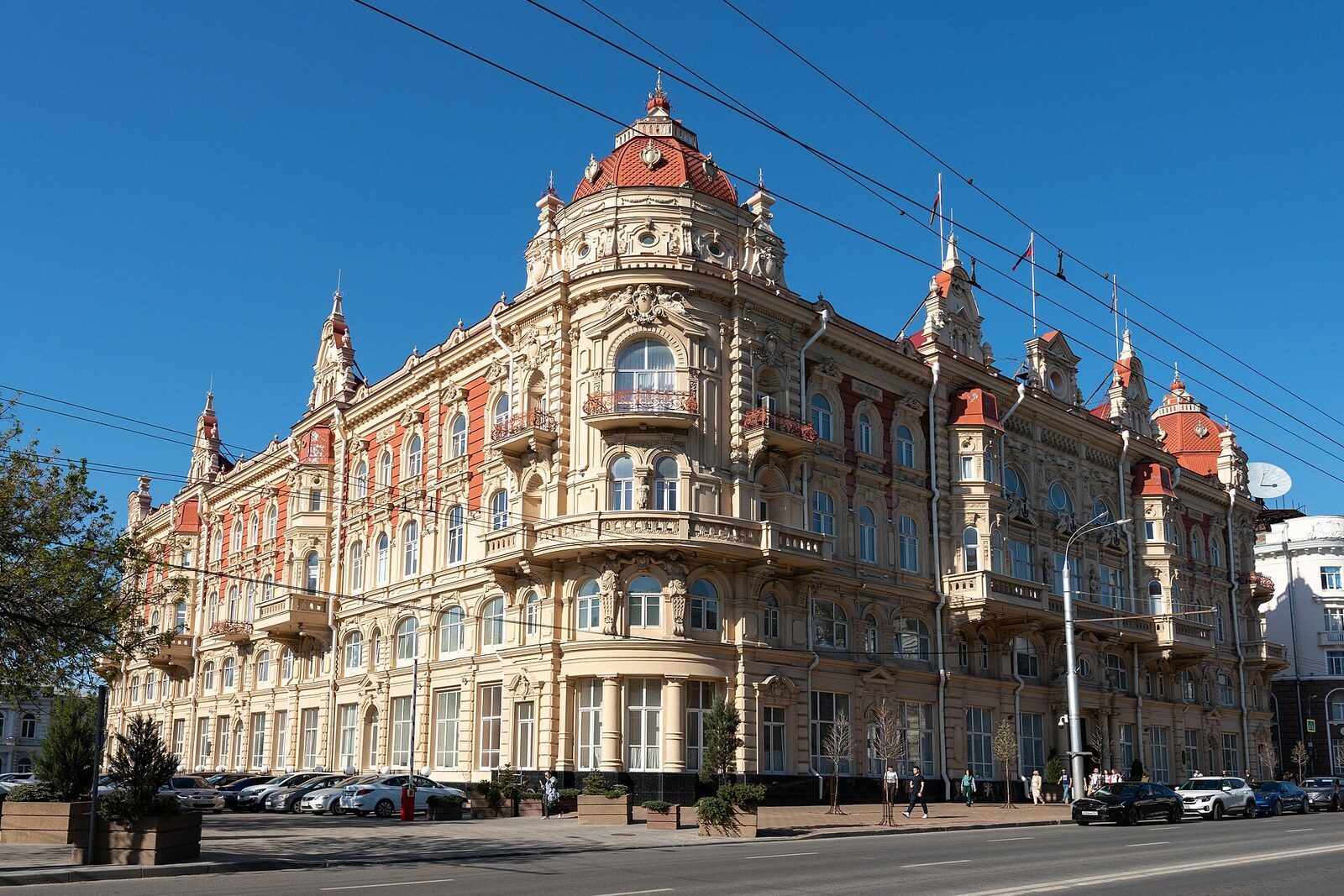
Look around first
What to notice
- The seahorse on the roof of Gench-Ogluev House
- The balconies of the corner facade
- The facade of Rostov City House opposite
The story of the place
On the corner stands the city's first multistory rental house. Trade took place below, while the upper premises were leased for offices and housing; across the intersection, shops also operated in Rostov City House, with the Duma meeting and the city administration working above them. Before Rostov City House, a wooden theater stood on this plot, which is why the intersection was called the Historic Theatre Square Intersection. Above the corner facade, a seahorse sits in place of the lost tall tower; it appeared during the postwar remodeling for the fishing trust.
In the late eighteen seventies, the Nakhichevan merchant Stepan Gench-Ogluev commissioned the young Alexander Pomerantsev's first major independent building. For the merchant, it was money earned over fifteen years of rising from a “boy”—a junior clerk in a wholesale haberdashery—to a co-owner of the firm. He made his living trading in ribbons, lace, gloves, expensive fabrics, and imported perfume. By the time the house was completed, his bank credit had grown to thirty thousand rubles. The tenants were meant to repay the investment.
In eighteen eighty-three, Pomerantsev completed the corner house, with shops below and offices and apartments above. This accounts for the two definitions in its name: the commercial house earned profit by selling goods, while the rental house earned it by leasing premises. The client was a firm owned by two Nakhichevan Armenians, Gench-Ogluev and his partner Ivan Shaposhnikov, so both are named in old documents. The modern short name retained only Gench-Ogluev's name.
The calculation paid off: the premises were leased by a bank, the printing house of Priazovsky Krai, fur merchants, confectioners, and manufacturers of cigarette-paper tubes. It was Rostov's first multistory rental house. Gench-Ogluev died six years after it opened, but his sons inherited the business and kept their father's surname on the firm's sign. After the Rostov commission, Pomerantsev designed the Upper Trading Rows on Red Square—today's Moscow GUM.
In eighteen ninety-six, the Rostov city government invited the now-famous architect to build Rostov City House on the other side of the intersection. The Duma, an assembly of elected townspeople, made decisions and approved expenditures; the city administration handled day-to-day municipal affairs. Before that, both had been housed in someone else's Maximov House. The new plot was freed after the demolition of a wooden theater on what was then known as the Historic Theatre Square Intersection—this was the name of the intersection.
Pomerantsev's first design connected it with Gench-Ogluev House opposite: he proposed a three-story municipal building with a glazed commercial courtyard. The city government rejected this version and approved a more ornate building. The architect calculated the cost down to the kopeck—five hundred eighty-six thousand one hundred seventy-six rubles and sixteen kopecks. The deputies tried to save money and cut the estimate by almost eighty thousand. Additional expenses arose during the work, and the final sum exceeded six hundred thousand rubles.
After its consecration in eighteen ninety-nine, shops occupied the first floor: they sold fabrics, bicycles, gramophones, wallpaper, sweets, and weapons. The Duma and the city administration worked above. Townspeople were admitted to open sessions: two hundred places were arranged for the public in the galleries and another forty behind the barrier in the hall. The commercial arrangement of Gench-Ogluev House was repeated across the street in a municipal building.
The Rostov City Duma and the administration still work in the house they commissioned. After wartime damage, part of the balconies and the former tall tower were not restored on Gench-Ogluev House. In nineteen forty-nine, architect Grigor Kalaydzhyan completed it with a seahorse: the house had then been transferred to a fishing trust, and a shop called “Fish” opened below. The seahorse remains on the roof above Rostov's first multistory rental house, whose tenants have been changing for nearly a century and a half.
Useful on site
The facades are accessible from the street around the clock; the route does not include entry to the administrative building.
Checked: June 24, 2026. Check the official source before visiting.Both buildings are easy to compare from the street; there is no need to go inside to hear about their dialogue.