 Guide On Map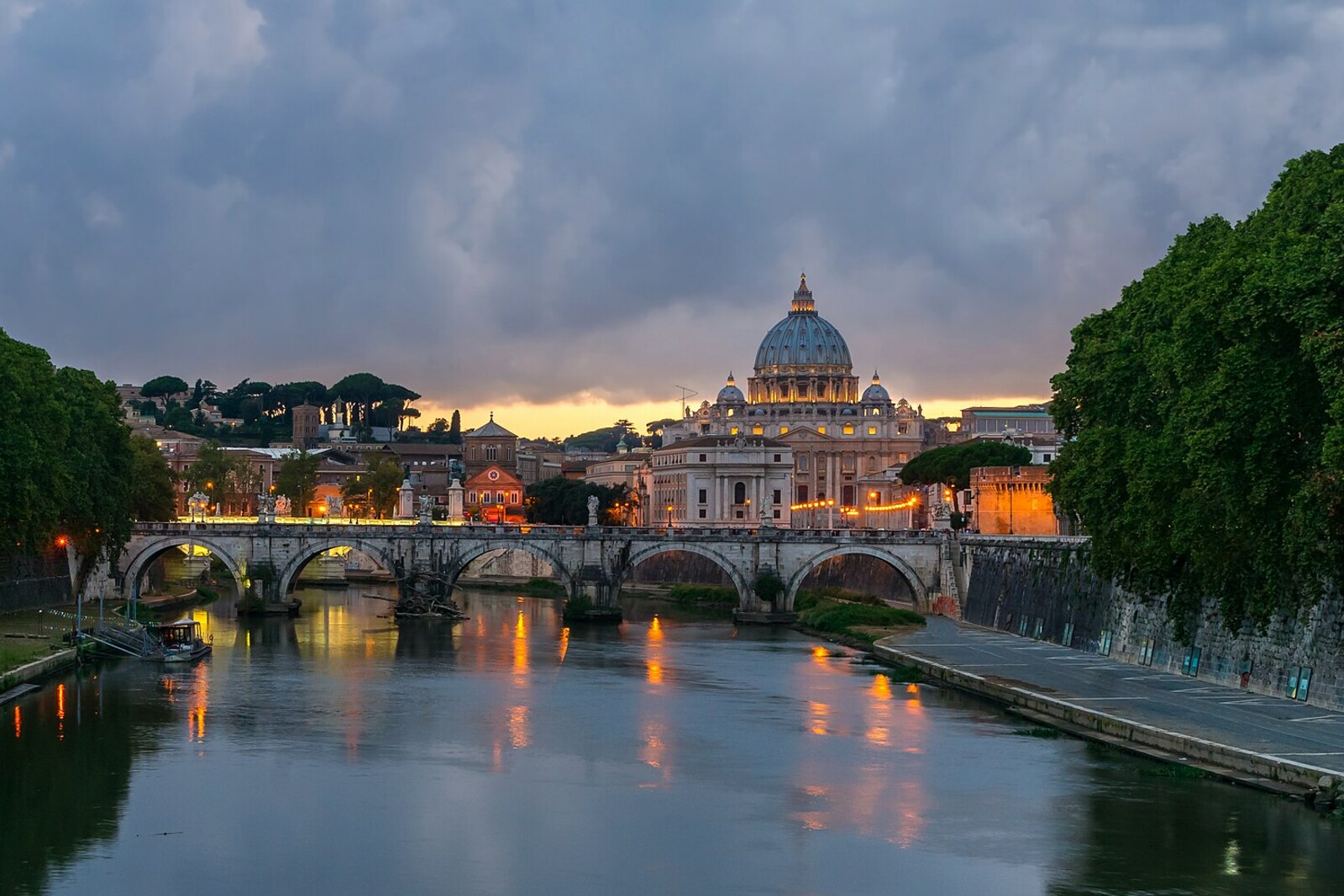
Look around first
What to notice
- Statue of Saint Peter with keys
- Statue of Saint Paul with a sword
- Ten marble angels
- Instruments of the Passion of Christ in the angels' hands
The story of the place
Ten marble angels extend along both parapets, bearing a cross, nails, scourges, a spear, a sponge, and a crown of thorns. This crossing of the Tiber originally led to Emperor Hadrian's tomb on the opposite bank; then it was known by a different name connected with the emperor's family. Later, the ancient tomb became a fortress, and the bridge became part of the route used by those heading to Rome's principal shrine. The marble procession appeared here at Bernini's design: two figures on the bridge reproduce his works, while the originals are kept in the church of Sant'Andrea delle Fratte.
On December nineteenth, fourteen fifty, thousands of pilgrims were returning from St Peter's Basilica to their lodgings on the other bank of the Tiber. A Holy Year proclaimed by Pope Nicholas V was underway: believers came to Rome for an indulgence—release from punishment for sins already forgiven. The only bridge that led directly from the medieval center to Borgo and Saint Peter stood here.
Emperor Hadrian built it in the second century as a passage to his own tomb, now Castel Sant'Angelo. Originally, the bridge was called Pons Aelius, after the emperor's family name, Aelius. The tomb became a fortress, pilgrims began making their way to the Tomb of Saint Peter, and the ancient crossing took on a flow of people it had not been designed for.
On that December evening, movement stopped in the middle of the bridge, yet people continued pressing from behind. The chronicles differ in the details. One names as the cause a mule with baskets that began kicking; others describe a crush that arose before people had time to understand what had happened. One modern tally counts one hundred seventy-two dead, four horses, and that very mule. People were suffocated and trampled, part of the parapet collapsed, and some fell into the Tiber. Other chroniclers put the death toll at about two hundred.
After the disaster, Nicholas V ordered the city approach to the bridge cleared. The owners of the crowded shops and stalls here were evicted, but they were paid from the jubilee collections: those places were their livelihood, and the clearance deprived them of customers. A broad roadway appeared before the bridge. A few years later, the pope placed two octagonal chapels at its entrance, dedicated to Saint Mary Magdalene and the Holy Innocents. Pilgrims passed between them, and the dedication recalled those who had died.
After the Sack of Rome, which was already discussed at the castle, Pope Clement VII ordered the chapels demolished: the military considered them an obstacle to the defense of the fortress. The memorial chapels themselves are no longer here. In their place, on the side of the old center, stand Saint Peter with keys and Saint Paul with a sword. These two figures appeared at the entrance before the marble angels and mark the bank where Nicholas V placed a memorial to the victims of the crush.
The bridge's present name is explained by a medieval legend. In five hundred ninety, Rome was suffering an epidemic. Pope Gregory the Great, seeking its end through prayer and repentance, led a procession toward Saint Peter. According to the legend, when the people approached Hadrian's mausoleum, Gregory saw Saint Michael the Archangel on its summit, sheathing his sword. This was taken as a sign that the disaster was ending. The story of the angel gave a new name first to the fortress, and then to the bridge leading to it.
More than a thousand years later, Pope Clement IX commissioned Gian Lorenzo Bernini to set that name in marble. In sixteen sixty-nine, ten angels bearing the instruments of the Passion of Christ—the cross, nails, scourges, a spear, a sponge, and a crown of thorns—were placed along the new parapets. Those walking toward Saint Peter passed between instruments of suffering from the Gospel story.
Bernini directed the entire project, while his assistants carved most of the figures. The master himself made two angels—one with the crown of thorns and one with the tablet nailed above the head of the crucified Christ. Clement IX decided that these statues were too valuable for rain and river dampness, and did not allow them to remain outdoors. Of the ten angels on the bridge, two figures are copies. Bernini's originals are in the Roman church of Sant'Andrea delle Fratte.
Useful on site
The pedestrian bridge is open around the clock; during peak hours, keep your belongings close to you.
Checked: June 25, 2026. Check the official source before visiting.Look at the sculptures along the sides without blocking the middle of the passage. Bernini's two originals are not here: replacements made for them stand on the bridge.