 Guide On Map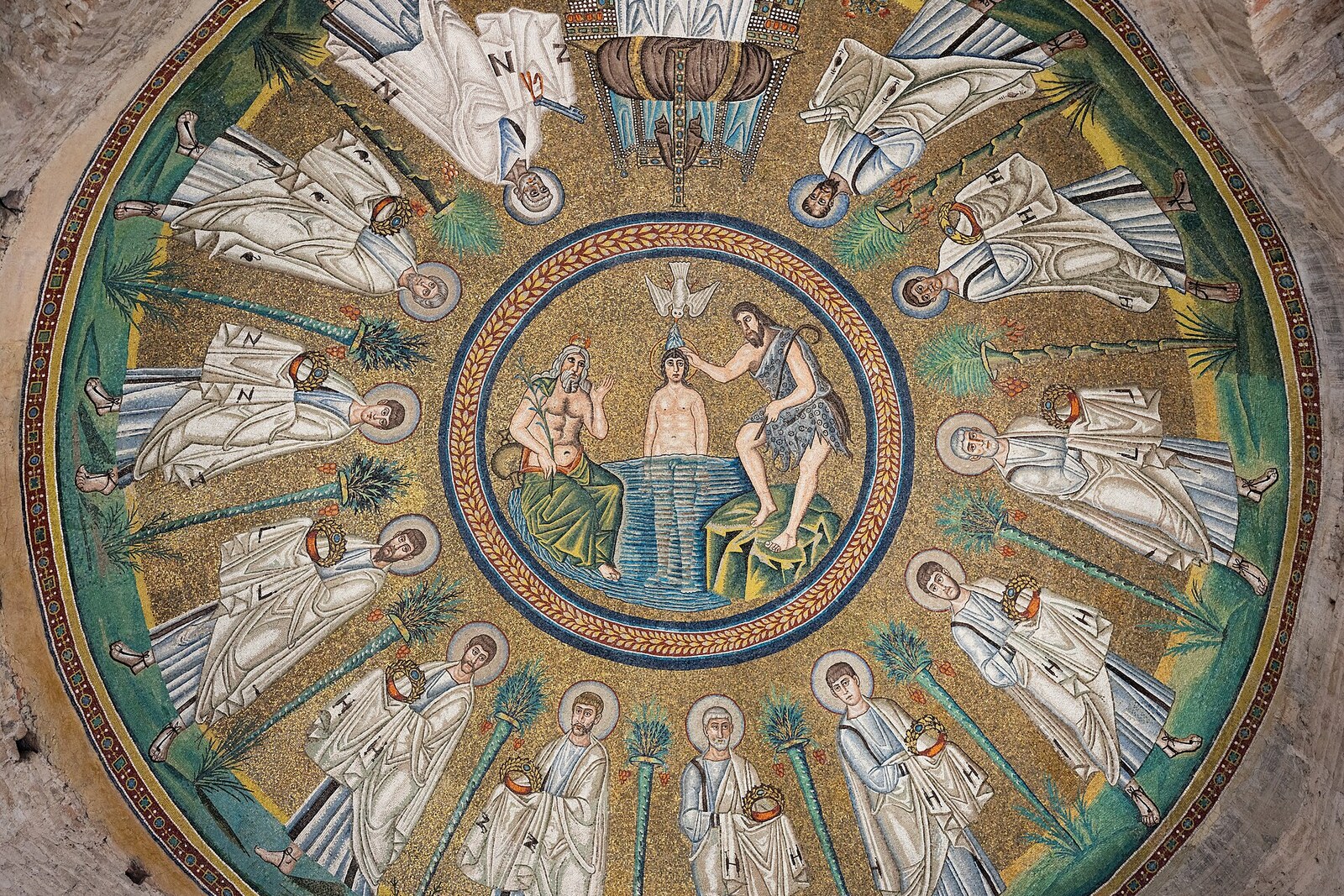
Look around first
What to notice
- The octagonal brick baptistery
- The baptism mosaic beneath the dome
- The procession of apostles
- The paving stones of Piazzetta degli Ariani
The story of the place
The name Piazzetta degli Ariani points to the Christian community that occupied this quarter at the beginning of the sixth century. The present Church of the Holy Spirit was its cathedral, the bishop's palace stood beside it, and the octagonal brick building served as its baptistery. The community was called Arians after Arius, an Alexandrian priest who taught that the Son came into being by the will of the Father and was therefore not equal to Him in eternity. Nicene Christians regarded the Father and the Son as equal and consubstantial; to them, Arius's teaching was heresy.
The Ostrogothic king Theodoric brought this dispute to Ravenna. In four hundred ninety-three, he conquered Italy and made the city his capital. The king relied on the Ostrogothic army, yet left taxes, courts, and civil administration in Roman hands. The Romans professed Nicene Christianity; Theodoric himself, his warriors, and many courtiers adhered to the faith their ancestors had received from Gothic preachers.
Theodoric needed to preserve the loyalty of the armed Goths without driving the Roman majority into resistance. He did not take the Nicene cathedral complex or the Neonian Baptistery from the Nicene Christians. For the Goths, the king established a second complex here, with its own bishop, cathedral, and font. A person baptized beneath this dome entered the Gothic church community. Within a few dozen meters stood everything it needed to manage without Nicene clergy.
The division ended after the defeat of the Ostrogoths. In five hundred forty, the troops of Emperor Justinian occupied Ravenna, and fourteen years later they defeated the last Gothic armies in Italy. Justinian sought a single Nicene confession and transferred the Gothic sanctuaries, together with their possessions, to the Church of Ravenna. These included revenue-producing lands, property, and dependent people, whose labor supported the churches and clergy.
The recipient was Agnellus, the Nicene bishop of Ravenna. He reconsecrated the former Arian buildings. The baptistery ceased to receive new members of the Gothic church and became a Catholic chapel of the Virgin Mary called Santa Maria in Cosmedin. The Arian bishop's palace disappeared, while the neighboring cathedral, after numerous rebuildings, received its present dedication to the Holy Spirit.
Under the dome, Agnellus did not order the destruction of the central scene of Christ's baptism, created under Theodoric. In the middle of the sixth century, mosaicists almost completely relaid the surrounding procession of apostles, but the young Christ in the waters of the Jordan River, John the Baptist, and the river god remained from the original design. It is difficult to determine the creed of the patrons from these figures: Nicene Christians depicted the same Gospel scene, and scholars still debate which differences between Ravenna's two domes are truly connected with theology.
Nothing remains here of the bishop's palace. Sections of walls and later buildings no longer allow the enclosed church courtyard of Theodoric to be reconstructed, and the baptistery's floor lies about two and a half meters below the present pavement. From outside, it is still called the Arian Baptistery, and the square's sign bears the name of the community that Agnellus removed from here.
Useful on site
From April 26, 2026: Monday–Thursday 9:00–12:00; Friday–Sunday and holidays 9:00–12:00 and 14:00–17:00. Last entry 15 minutes before closing.
Checked: June 24, 2026. Check the official source before visiting.First, view the piazzetta as a single ensemble. Inside, do not look for one magical sign of “heresy”: compare the composition with the Neonian Baptistery.