 Guide On Map
Mosaic Ravenna: Churches and the Palace Quarter
From Basilica of San Vitale through the episcopal center and Piazza del Popolo to Basilica of Sant’Apollinare Nuovo
Guide On Map on your phone
Open the walk like a regular app
It takes about 10 seconds to install. No app store needed.
The whole path
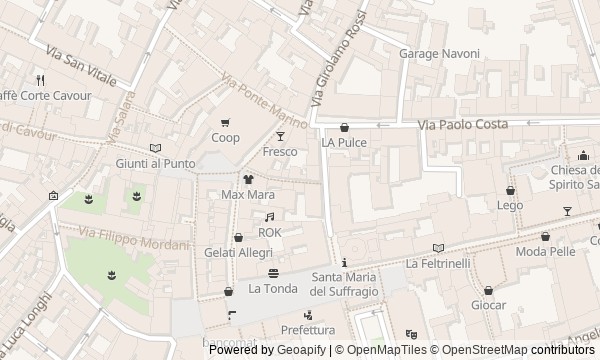
Route map
About the walk
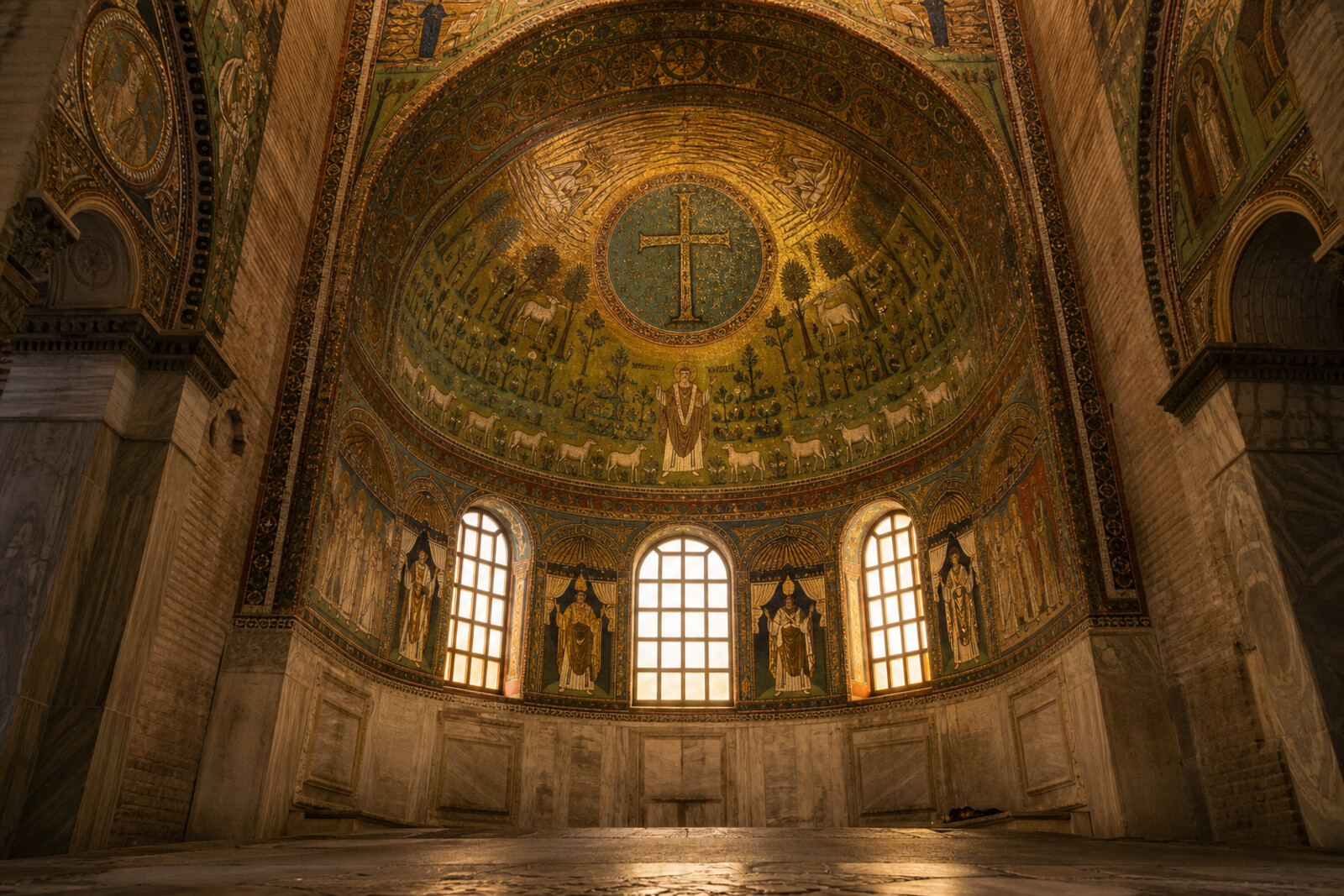
You will cross central Ravenna from Basilica of San Vitale and a small brick chapel to the episcopal quarter, the city square, and Theodoric’s former palace district. Inside, there will be golden processions, two baptism scenes, and white columns with hands that have survived where you would not expect them to.
This is not a walk through the “best mosaics.” It follows the marks left by changing power. One bishop will take someone else’s place in an almost finished church. Children carrying candles will leave behind evidence, but not an answer. On neighboring domes, one rite will become the sign of two different communities. And in a former palace basilica, people will disappear, though the craftsmen will not erase them completely.
The story will stay with documents, inscriptions, and caveats: where a fact is known, where tradition remains, where a name misleads. By the final basilica, you will read Ravenna’s mosaics as an amended list of those allowed to remain in the city’s history.
Why this order
Basilica of San Vitale sets the route’s central question: who gets the right to remain on the wall. Just behind the basilica, the Mausoleum of Galla Placidia tests the same question through a sarcophagus: the name is better known than the burial. From there, the road to the episcopal residence narrows the scale to a private chapel, while the neighboring Neonian Baptistery shows the rite of entering a larger community. After the font, the route reaches Piazza del Popolo, where townspeople gave a new name to urban space itself. Next, Piazzetta degli Ariani preserves the name of a community removed from here. From its baptistery, Via di Roma leads to the site of a vanished palace, and neighboring Basilica of Sant’Apollinare Nuovo completes the route inside the palace church: the consequences of the court’s fall remain visible in its mosaics.
Those who want to understand mosaics, not just look at them Fans of late antiquity and early Christianity Those interested in disputed attributions and traces of alteration
Those expecting an overview of all Ravenna’s main sights Those who need a route without church interiors Those who prefer a quick exterior-only visit
Before you go
Check access to each monument for your chosen day in advance: the main part of the story depends on mosaics that cannot be seen from the street, and individual buildings may have their own visiting arrangements. Do not plan to rush through the interiors—your eyes need time to adjust to the dim light and make out the upper registers. Bring headphones, and leave pauses between audio sections to look around on your own. The route puts noticeable strain on your neck and attention, so it helps to lower your gaze now and then, step back to a wall, and rest. In active church spaces, speak quietly and do not disturb services or other visitors.
When to go
Start while your attention is still fresh: Basilica of San Vitale and the mausoleum demand an especially focused look. Piazza del Popolo makes a natural pause before three small but dense interiors. Before setting out, check access to Theodoric’s so-called Palace; if it is restricted, do not rebuild the whole walk around it. Save your energy and enough time for Basilica of Sant’Apollinare Nuovo: the finale is best taken in tier by tier, not in one sweeping glance.
Backup plan
If an individual interior is unavailable, keep the route’s order and use that stop as an exterior commentary. At Basilica of San Vitale and the mausoleum, compare the severe brickwork with the description you have heard of the light inside; in Piazzetta degli Ariani, consider the relationship between the baptistery, the church, and the former quarter. Theodoric’s so-called Palace can be discussed in front of its facade: its doubtful name is part of the story. Compare missed dome scenes with the next available baptistery, without treating it as an exact substitute. If the final basilica is closed, end the walk outside with the story of the palace, the port, and the erased figures, and leave the interior for a separate return.
Route conditions
Surface. Paved — 1.9 km (data covers 86% of the route)
Facilities. Toilets — 5; drinking water — 1
Elevation. Ascent — 15 m; descent — 19 m
OpenStreetMap extract of July 4, 2026: database data, not a check on the ground. Data © OpenStreetMap contributors, ODbL licence
Walk plan
Open in maps ↗- 1
Basilica of San Vitale
Here, for the first time, the route will connect the splendor of imperial mosaics with the struggle for the episcopal seat of Ravenna. - 2
Mausoleum of Galla Placidia
Here, a local legend will collide with evidence that confirms the fire but not the name of the person buried. - 3
Archiepiscopal Chapel
This small prayer room shows how a bishop responded to the royal court's faith without openly breaking with it. - 4
Neonian Baptistery
Here, the mosaics will be read as a scheme of transition from catechumens to the full community. - 5
Piazza del Popolo
The square will shift the conversation from a church dispute to the postwar choice of how to organize the country. - 6
Arian Baptistery and Piazzetta degli Ariani
This stop shows that a change of creed meant the transfer of an entire quarter, its property, and its people. - 7
Theodoric’s so-called Palace
Here the story will reconstruct an event connected with the vanished palace and explain the caution of the modern name. - 8
Basilica of Sant’Apollinare Nuovo
The finale will bring together the visible traces of the church’s alteration and the dispute over whose name it is entitled to bear.
Route features
Everything you need stays in the browser
Progress, saves and your trip plan are stored on this device.
Add Guide On Map to your home screen so the walk opens outside the browser.
How we handle sources, maps and corrections: our editorial standards