 Guide On Map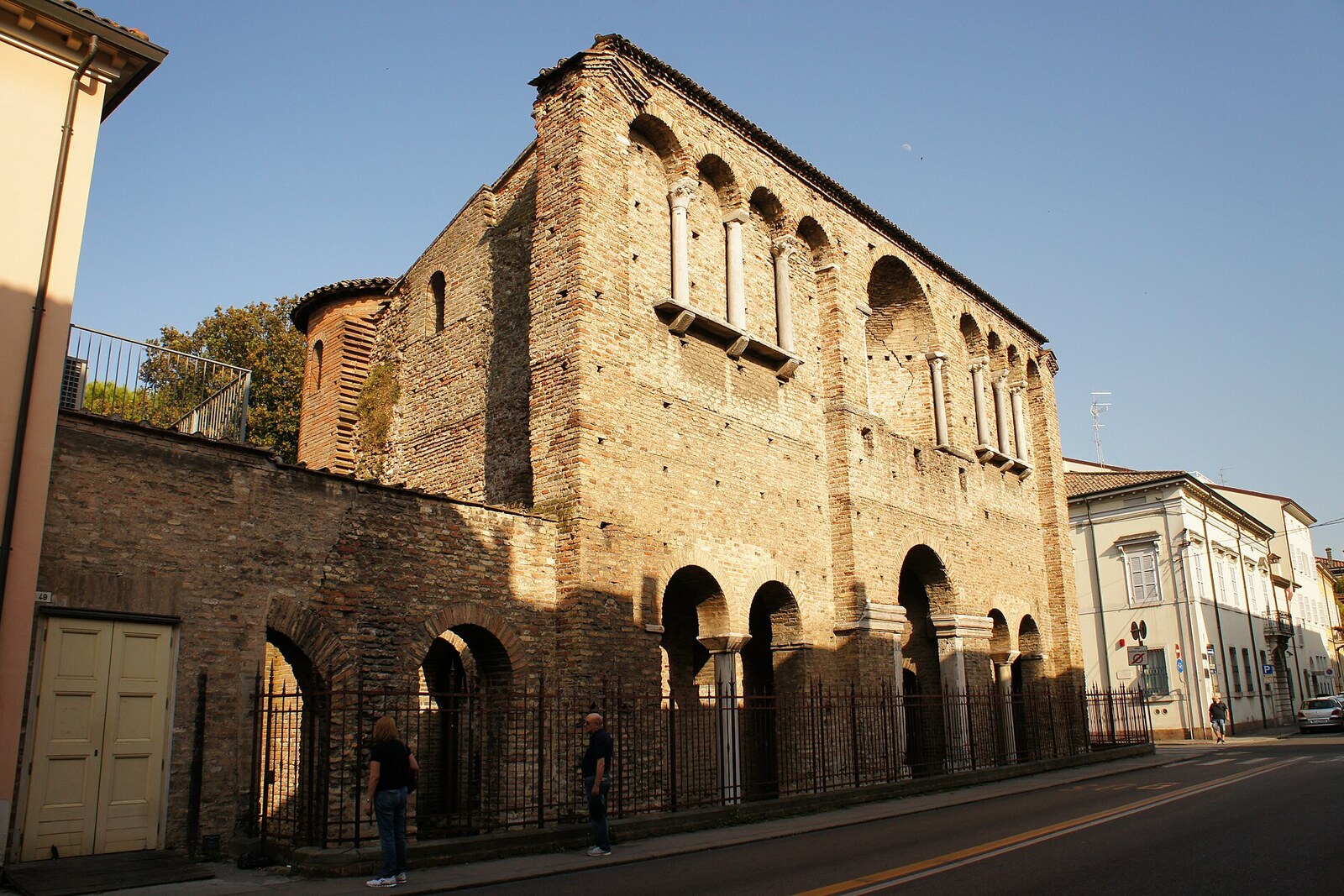
Look around first
What to notice
- Stone facade with arches
- Upper gallery
- Fragments of mosaic floors
The story of the place
In March four hundred ninety-three, Odoacer, the military king of Italy, came to the imperial palace in this part of what is now Via di Roma. Theodoric was waiting for him here—the king of the Ostrogoths, sent by the Eastern Roman emperor Zeno to depose Odoacer and take his place.
Odoacer relied on the army. Seventeen years earlier, soldiers had proclaimed him king after he secured land for them in Italy. Defeated by Theodoric, Odoacer took refuge with them in Ravenna. The siege lasted three years; a measure of wheat rose in price to six gold coins. Odoacer led men out beyond the walls several times, and each time returned with losses.
At the surrender, he gave up his son as a hostage and received an oath that his blood would not be spilled. The rivals agreed to rule Italy jointly. That is why Odoacer agreed to meet at the palace then called Ad Lauretum—“At the Laurels.”
The most detailed account of the scene was written down a century and a half later by John of Antioch, so it cannot be treated as an exact record. According to his account, two of Theodoric’s men approached Odoacer, posing as petitioners, and took hold of both his hands. Armed conspirators emerged from side rooms but did not dare to strike. Then Theodoric himself cleaved Odoacer’s collarbone with a sword.
An earlier Ravenna chronicle tried to justify Theodoric by claiming that Odoacer was preparing a conspiracy of his own. Yet it, too, reports the essential point: Theodoric personally killed his rival in the palace, then ordered his relatives and soldiers destroyed. Being held hostage did not save Odoacer’s son. Without waiting for the consent of the new emperor in Constantinople, the Goths proclaimed Theodoric king of Italy. He ruled for another thirty-three years, completed the palace complex here, and surrounded it with porticoes.
The stone facade facing the street appeared in the eighth century, three centuries after the murder. Researchers consider it the entrance and narthex of the vanished Church of San Salvatore ad Calchi—the church of the Savior by the palace gates. The residence that Theodoric occupied and enlarged stood nearby, behind this structure and on both sides of the ancient street. Hence the cautious name: “Theodoric’s so-called Palace.”
Above, part of the mosaic floors excavated by archaeologists from the ground behind the facade is now on display. They come from different buildings and span several centuries. No fragment can confidently be called the floor of the room where the two petitioners held Odoacer’s hands.
Useful on site
Monday 8:30–13:30; Tuesday–Sunday closed.
Checked: June 24, 2026. Check the official source before visiting.You can examine the facade from outside, but do not take it for a proven wall of the palace or connect Odoacer’s murder to any particular arch.