 Guide On Map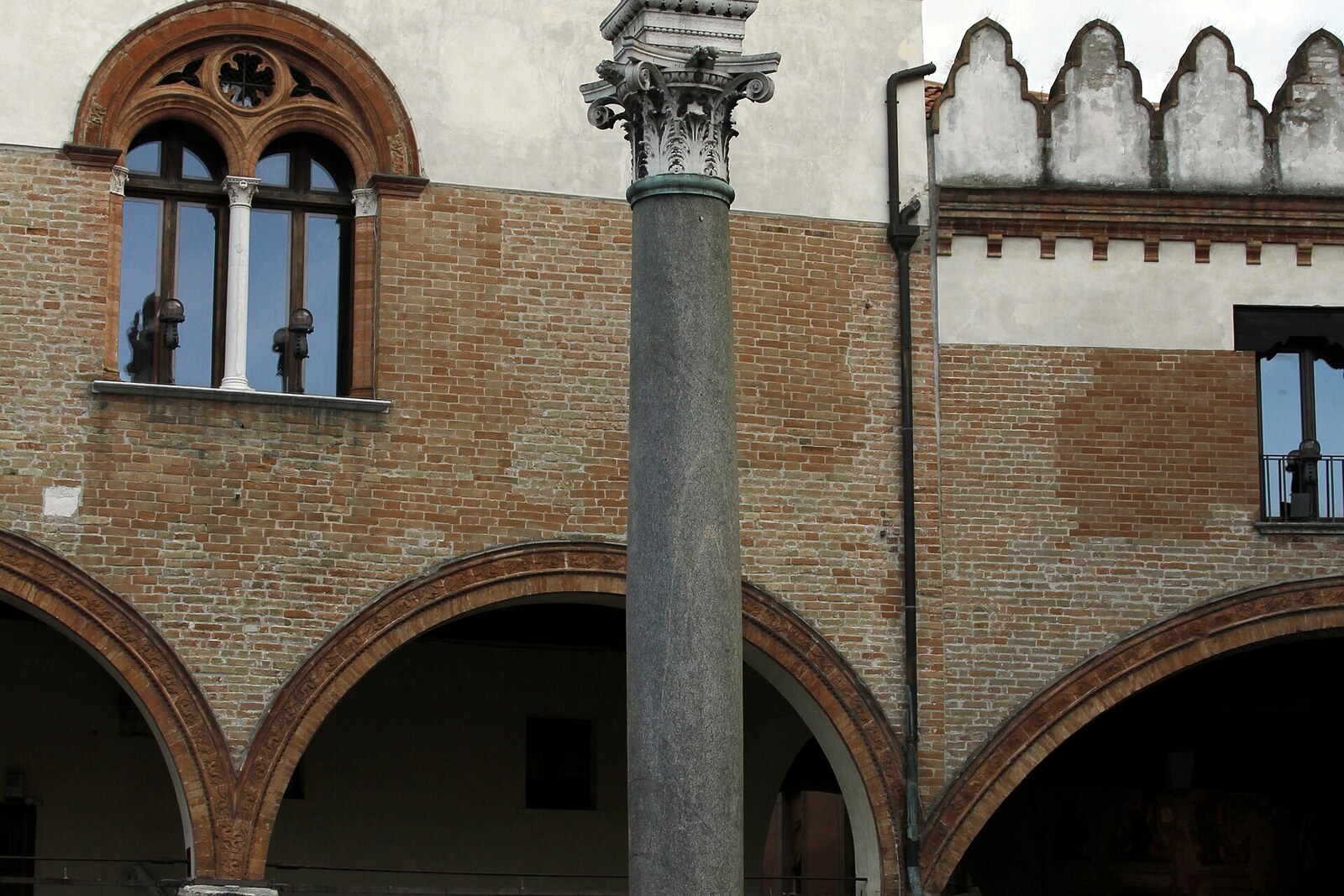
Look around first
What to notice
- Commemorative plaque bearing the voting result
- Crenellated façade of Palazzo Merlato
- Façade of the prefecture
- Square-name sign
The story of the place
In the second half of the thirteenth century, the city council was moved here from the archbishopric district, and the square began to take shape around it. Padenna once flowed here, with medieval residences standing along its banks. Today, one side is occupied by Palazzo Merlato, with municipal offices and the city council, while the prefecture stands opposite. The Palazzo’s tall crenellations are visible from the square, and the complex’s two corner blocks are linked by an arched passageway.
Until nineteen forty-six, this square bore the name of Victor Emmanuel II, the first king of united Italy. After the war, the royal name found itself at the center of a very practical dispute: who should now determine how the country was organized—the monarch or the voters.
Beneath the crenellated façade of Palazzo Merlato, Ravenna’s new mayor, Gino Gatta, was then at work. The son of agricultural laborers, he began as an assistant in a barbershop, was persecuted under the Fascist regime, and became a partisan during the war under the nickname Zalet. In the spring of nineteen forty-six, Gatta was elected the city’s first postwar mayor. He now had to hold a vote that could put an end to the monarchy.
The municipality of Ravenna had a vast rural territory. For the referendum, sixty-six polling stations were opened; officials considered some villages difficult to reach. Gatta arranged with a drivers’ cooperative to take staff and voting materials there. The war-ravaged city lacked funds, so the mayor asked the local savings bank to advance the municipality one million lire for the voting expenses.
On the second and third of June, residents chose between monarchy and republic. It was Italy’s first nationwide vote in which women took part. In Ravenna, almost nine out of every ten voters supported the republic. A few days later, townspeople held a procession in honor of the result, and the five parties of the local National Liberation Committee—an association of former opponents of the Fascist regime—issued a joint manifesto.
After the referendum, the king’s name was removed from the square. It became Piazza del Popolo—the square of the people, meaning those very voters whose ballots had been brought in from the sixty-six polling stations. Palazzo Merlato still houses the municipality, the prefecture stands opposite, and a commemorative plaque bearing the voting result is mounted on the city administration building. Its official address is Piazza del Popolo, number one.
Useful on site
Open urban space, accessible around the clock.
Checked: June 24, 2026. Check the official source before visiting.This is an outdoor stop: choose a place away from the main flow of traffic and take in the whole space, then move closer to the columns.