 Guide On Map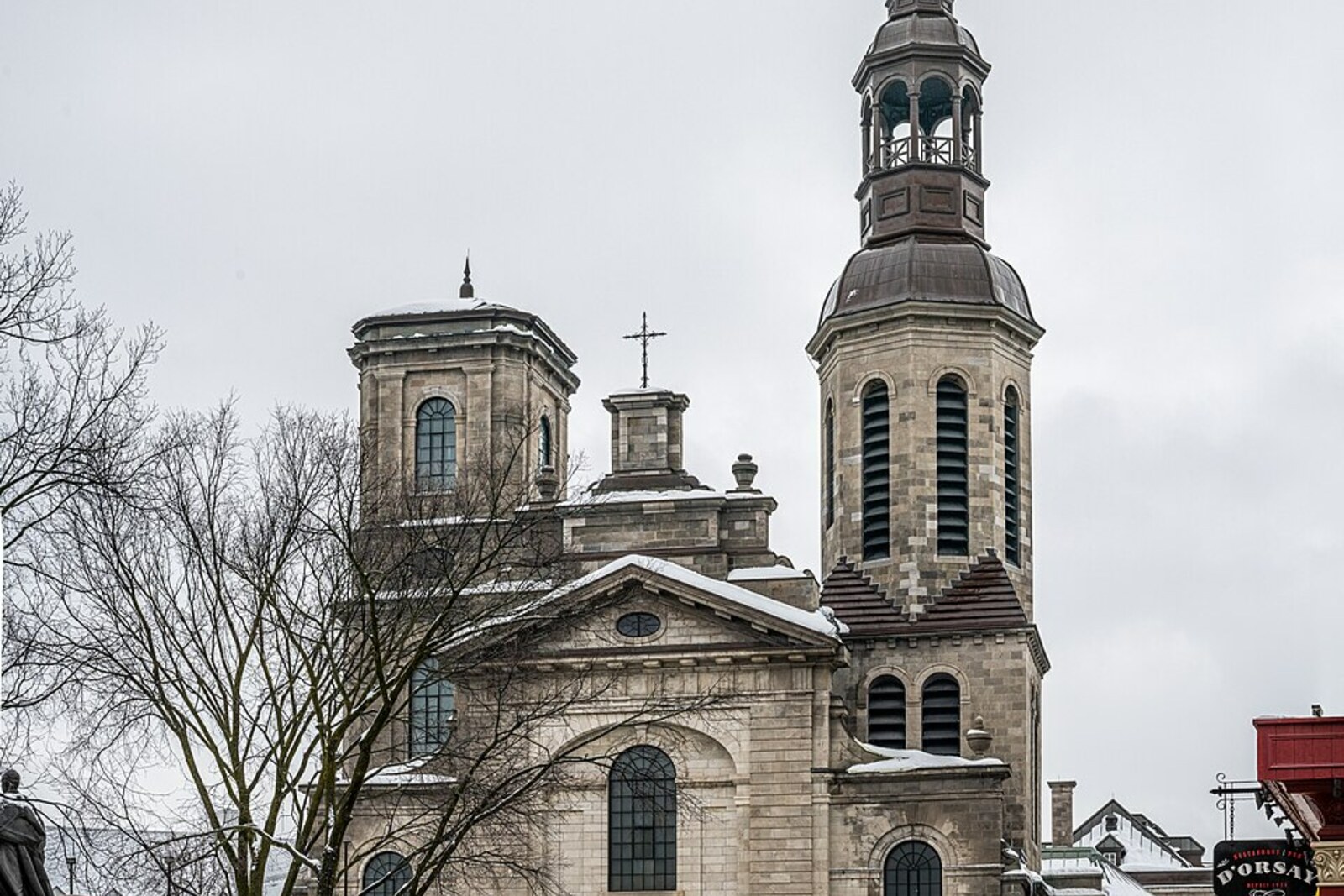
Look around first
What to notice
- The cathedral façade
- The square in front of the cathedral
The story of the place
A chapel first stood on the church property, and after it burned down, a stone church was built. When a permanent network of parishes was established in New France, it became the first canonically constituted parish: the priest received the tithe, kept records of the inhabitants, and was responsible for his territory. Later, the church was chosen as the bishop's principal church; its cathedra, the special chair inside, gave it cathedral status, and the pope added the honorary title of minor basilica. The façade faces the square, and the present building was rebuilt in the nineteen twenties after a fire that destroyed almost all of the former interior.
In July sixteen twenty-nine, Samuel de Champlain ran out of food and ammunition. Champlain commanded the French settlement of Quebec City and sought to keep it as France's stronghold on the Saint Lawrence River. A trading company delivered his salary, provisions, and new settlers. The Kirke brothers, English privateers with royal authorization to capture enemy ships, intercepted its vessels and cut Quebec City off from supplies.
After a harsh winter, Champlain sent some of the inhabitants to the coast so that fewer mouths would remain in the settlement. When Thomas and Lewis Kirke brought three ships to Quebec City and demanded surrender, there was nothing with which to resist. Champlain surrendered the fortification without a fight and left with his personal belongings. Most of the French were taken away, and the Kirke brothers occupied the settlement.
In France, Champlain began seeking the return of the colony. At the same time, he made a vow to the Virgin Mary: if Quebec City were returned to France, he would build a church here in her honor. Negotiations took almost three years. Under the treaty of sixteen thirty-two, England returned Quebec City, and the following spring Champlain arrived here with one hundred fifty colonists.
With funds from the trading company, he immediately ordered the construction of Notre-Dame-de-la-Recouvrance Chapel near the fort. “Notre-Dame” means “Our Lady,” the name Catholics use for the Virgin Mary. The addition “de-la-Recouvrance” can be translated as “Return” or “Regained”: the name directly recalled the return of Quebec City. The chapel stood on the church property now occupied by the cathedral, and it became the main place of worship for the settlement's inhabitants.
Champlain used it for only two years. In the autumn of sixteen thirty-five, he was struck by paralysis. In his will, he made special bequests to the Jesuits and the chapel, and he died at Christmas. He was first buried in a temporary grave, then moved to an annex of Notre-Dame-de-la-Recouvrance Chapel.
The first chapel burned down. In sixteen forty-seven, the Jesuits built the stone Notre-Dame-de-la-Paix Church here—Our Lady of Peace. It was this church that François de Laval, the papal representative in New France, chose for the next step. Laval wanted to replace scattered missions with a permanent network of parishes, where a priest received support from the tithe, kept records of the inhabitants, and was responsible for a defined territory.
In sixteen sixty-four, Laval established here the first canonically constituted parish in New France. The church was dedicated to Notre-Dame-de-l'Immaculée-Conception Church—Our Lady of the Immaculate Conception. In Catholic teaching, this name refers to the Virgin Mary herself: it concerns her conception without original sin, not Christ's birth. The parish in Quebec City remained the only one until sixteen seventy-eight; six years later, there were already twenty-five in the colony.
In sixteen seventy-four, Rome created the Diocese of Quebec, and Laval chose this church as his cathedral. Here, the word “cathedral” means the bishop's principal church: inside is his cathedra, a special chair from which the very term “cathedral” derives. Two centuries later, the pope granted the church the honorary title of minor basilica. This is how its present full designation came about—the Basilica-Cathedral of Notre-Dame de Québec.
The building facing the square was rebuilt in the nineteen twenties after a fire that destroyed almost all of the former interior. Nothing remains above ground of Champlain's chapel. Its foundations were found in this block, but the burial place of Champlain himself has been lost. More than nine hundred people rest in the cathedral crypt; among them, there is no reliably identified grave of the founder of Quebec City.
Useful on site
The parish page, as of the verification date, lists the Basilica-Cathedral as open: Monday—Friday 7:30—16:00, Saturday 7:30—17:30, Sunday 8:30—17:00; the museum and crypt are listed as closed. Access may change because of services.
Checked: June 29, 2026. Check the official source before visiting.Even if the entrance is closed, this stop works from outside. Do not consider a visit to the church, museum, or crypt guaranteed; check each one separately.