 Guide On Map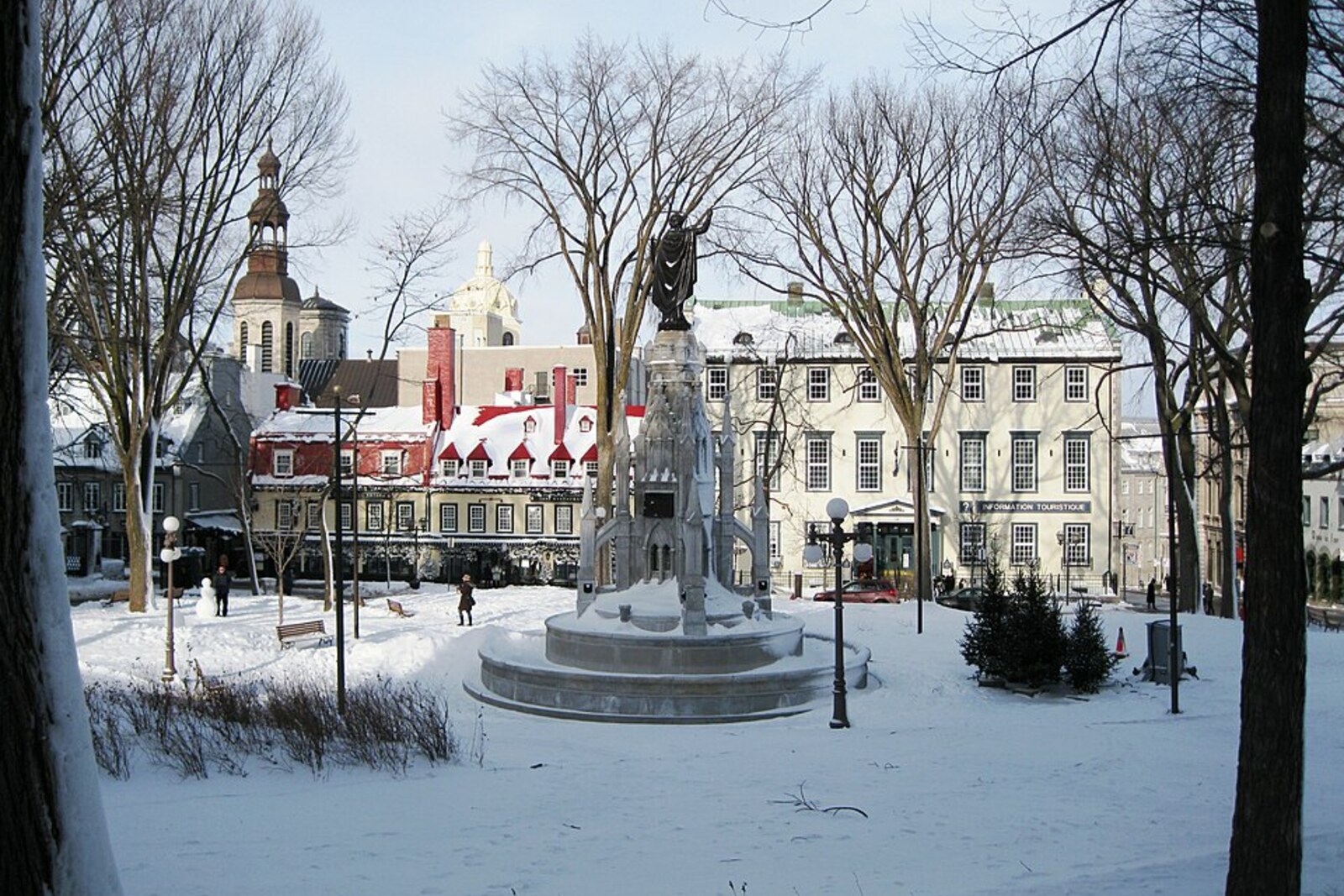
Look around first
What to notice
- The fountain with the figure of Faith
- Cathedral of the Holy Trinity
- Courthouse
The story of the place
On December ninth, seventeen seventy-five, Governor Guy Carleton, who commanded the defense of Quebec City, ordered every city bell rung and the muster sounded. Armed townspeople rushed here, to the square then called both the Grand Square and Place d’Armes. When the people had formed up in front of the Recollects’ monastery, Carleton admitted that the alarm had been false. He wanted to find out how many defenders would actually report when called. A real attack, the governor warned, should be expected soon.
He needed the test because of the makeup of the garrison. The American colonies had rebelled against Great Britain, their Continental Congress had sent troops to occupy the Province of Quebec, and Montreal had already surrendered. Few regular soldiers remained in the capital. Carleton had to put French- and English-speaking townspeople, ship’s sailors, and tradesmen working on the fortifications into the ranks. Many had previously earned their living through trade or crafts and had not intended to become soldiers. The governor ordered those who refused to take part in the defense expelled from the city: neutrality meant losing shelter behind the walls in the middle of a winter siege.
On December thirty-first, the alarm was real. Colonel Benedict Arnold, commander of one of the American columns, led his men into the Lower Town. He expected to break through the barricades, join the second column, and climb into the Upper Town. It was important for the defenders to hold Sault-au-Matelot Street: from there, the road led to the Côte de la Montagne ascent, and this square stood at the top.
Carleton assembled the general reserve here. Several young townspeople stationed at the barricades managed to break out of the American-occupied part of the street and run to the square with news that the enemy was already inside the Lower Town. From the people gathered here, Carleton selected two hundred men and sent them through Palace Gate to the rear of Arnold’s column. Other defenders continued to hold the last barricade from the front.
The Americans were trapped in the narrow streets. About four hundred men surrendered; Arnold was wounded and put out of action. The assault failed, although the siege continued for several more months. On May sixth of the following year, British ships carrying reinforcements arrived at Quebec City, and the remaining American units withdrew.
The square’s name describes precisely this kind of muster. In old French usage, the word “arms” could also mean an army or a soldier. Governor Charles Huault de Montmagny set this space aside for military exercises as early as the sixteen forties: Château Saint-Louis, the governor’s residence, stood nearby, and the main link between the Upper Town and the Lower Town ran along the slope. French units, then British ones, formed up here. After the Citadelle of Québec was built, the military moved its drills there, and in eighteen sixty-five the square was made into a public park. Tour groups now gather here.
The Recollects’ monastery, in front of which Carleton staged the false alarm, no longer exists. It burned down in seventeen ninety-six; three years later, the ruins were cleared away, part of the land was added to the square, and the Cathedral of the Holy Trinity and a courthouse were built nearby. The fountain with the figure of Faith at its center was installed later in memory of the Recollects. It recalls the order before whose vanished monastery the townspeople waited for Carleton’s signal to go to the barricades.
Useful on site
Open city square. Access may change because of events, city work, and tour-group boarding.
Checked: June 29, 2026. Check the official source before visiting.View the monument from several sides: the main narrative details are on the reliefs, not only at the top.