 Guide On Map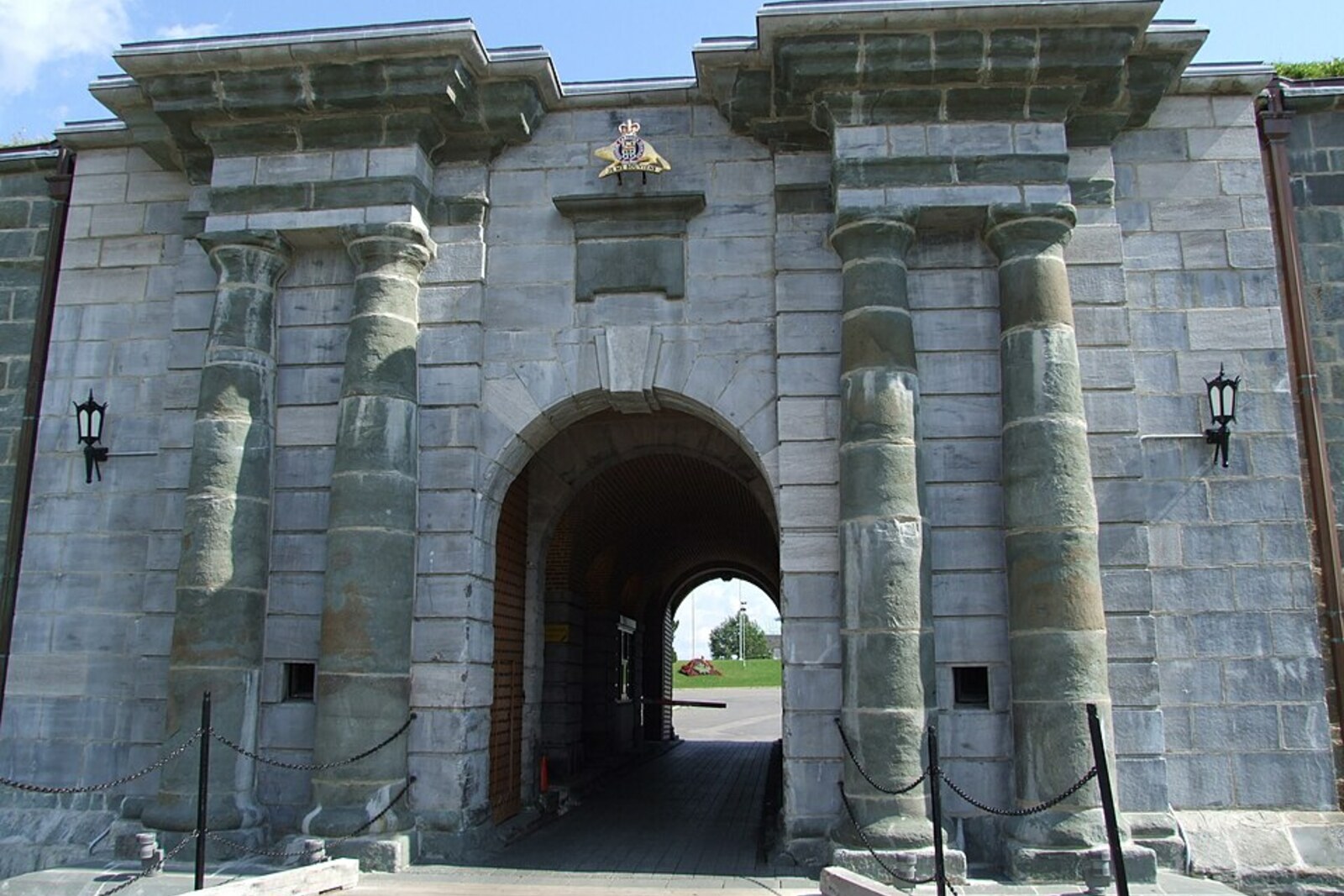
Look around first
What to notice
- Stone walls of the Citadel of Québec
- Earthen ramparts
- Gates of the Citadel of Québec
- Commemorative plaques
The story of the place
The stone walls here support high earthen ramparts, behind which an active military unit is still stationed. The Royal 22nd Regiment, a French-speaking unit of the Canadian Army, is based on this site, and nearby stands the second official residence of the Governor General of Canada. Commemorative plaques by the gates recall that the fortifications also hosted two Quebec Conferences of Allied governments.
The military used the word citadel for a fortress where a garrison could retreat if an enemy captured the city. British engineers built the Citadel of Québec on Cape Diamond after the War of 1812. They feared both another invasion from the United States and an uprising within the conquered French-speaking colony, so some of the fortifications face Upper Town. The Citadel of Québec never experienced an attack.
A military base still stands behind the ramparts. Since nineteen twenty, the Royal 22nd Regiment has been based here—a French-speaking unit created during the First World War for Canadians wishing to serve in French. Inside the fortress is also the second official residence of the Governor General of Canada. It was this residence that turned the old Citadel of Québec into a site for secret negotiations in August nineteen forty-three.
At the invitation of Canadian Prime Minister William Lyon Mackenzie King, President of the United States Franklin Roosevelt and British Prime Minister Winston Churchill came here. Roosevelt stayed in the Governor General's residence. A separate telephone exchange and a direct telegraph connection to the White House were set up for his staff; the other participants were housed at the Château Frontenac hotel, which was closed to outsiders.
Churchill sought the return of British scientists to the American program to build an atomic bomb. The British had earlier shared calculations with their allies showing that such a weapon was possible. The Americans then launched the Manhattan Project with laboratories and vast industrial facilities and restricted the exchange of information. Great Britain could not replicate these plants at home and finish the bomb during the war. Churchill risked being left without access to the development his physicists had begun.
On August nineteenth, Roosevelt and Churchill signed an agreement at the Citadel of Québec on the project concealed under the codename Tube Alloys. The document consisted of four sheets with the printed heading “Citadel of Québec.” Both leaders pledged not to use the new weapon against each other, not to use it against a third country without mutual consent, and not to pass information to outsiders. Churchill gave up guaranteed British commercial benefits after the war. In return, the Americans resumed scientific cooperation; a Canadian minister also received a seat on the joint committee.
After the agreement, British specialists went to American laboratories. Nineteen of them worked on the bomb itself in Los Alamos. Japanese cities were not chosen at the Citadel of Québec, nor was the day of the strike set there. Here, a rule was established requiring British consent. Churchill gave it in July nineteen forty-five; on August sixth and ninth, atomic bombs were dropped on Hiroshima and Nagasaki.
The promised postwar cooperation proved short-lived. In nineteen forty-six, an American law again closed access to atomic data to the British. Great Britain began its own program and tested its bomb in nineteen fifty-two.
On the commemorative plaques installed here, William Lyon Mackenzie King is named alongside Franklin Roosevelt and Winston Churchill as the host of the two Quebec Conferences. On the four sheets bearing the Citadel of Québec heading, only two signatures remained beneath the atomic agreement—those of Roosevelt and Churchill.
Useful on site
The exterior circuit is freely accessible where the public passage is open. Entry into the Citadel of Québec is permitted only with a guide; the official website indicates daily operation, seasonally changing hours, and paid admission.
Checked: June 30, 2026. Check the official source before visiting.Do not expect a full view of the pentagonal plan from the street: concealment is built into the design itself. The Citadel of Québec functions as a military base; its interior buildings and regimental exhibitions may be visited only as part of an authorized separate visit.