 Guide On Map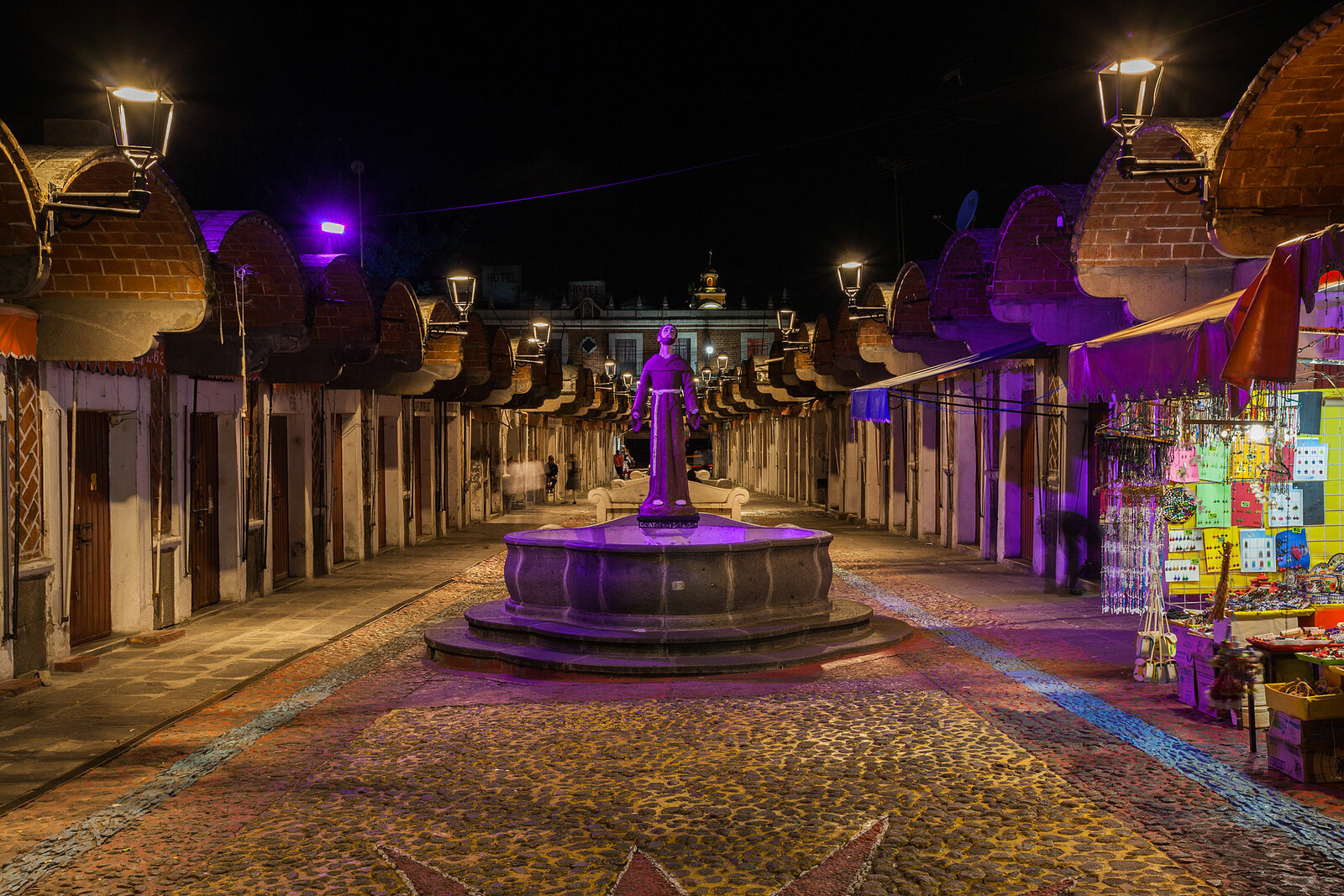
Look around first
What to notice
- Brick arches
- Talavera by the passageway
- Textiles and bags in front of the stalls
The story of the place
El Parián gathers trade into lockable stalls arranged along brick arcades, with warehouses behind them. It was built for craftspeople who wove cotton cloth and rebozos, made clothing, shoes, leather goods, and iron items in home workshops. Separate rows of shops gave these artisans a place where customers could look for their goods without wandering through the neighborhoods. Today, textiles, bags, and Talavera are laid out right by the passageways, and some of the brick arches are almost hidden by merchandise.
In seventeen ninety-six, a fire destroyed several market stalls on the main square—beside what is now Portal Morelos. Permanent stalls had stood on the Zócalo since seventeen fourteen. Food, textiles, and household goods were sold there; trash remained around them, and the crowding interfered with city ceremonies.
Manuel de Flon, the province’s chief royal administrator, had long wanted to remove daily trade from the square. After the fire, he ordered the market divided among several small squares: livestock was to go to one, grain and charcoal to others, and textiles and vegetables here, to Plaza de San Roque.
For the new market, the architect Antonio de Santa María Incháurregui drew up rows of lockable stalls, warehouses, and arcades. Construction began in eighteen oh one. Independent craftspeople were soon trading here: makers of rebozos and cotton cloth, tailors, leatherworkers, shoemakers, and ironworkers from Analco. A separate market was especially important to them. Many worked at home, away from the central streets, and could not wait for a customer to find their workshop on their own. Not all of them were willing to accept a wholesale middleman either: one took a share of their earnings.
The word “parián” entered Mexican Spanish from Tagalog in the Philippines and originally meant a Chinese market. It was used for permanent rows of shops in Manila, and later in the cities of New Spain. Puebla’s El Parián received this name along with the very idea of an organized market made up of separate stalls.
The former traders met the relocation with hostility. Their income depended on the familiar flow of customers on the Zócalo, and watchmen guarded their goods at night near the town hall. They called the small squares havens for thieves. El Parián had a drawback of its own: the stall doors were made narrow, and sellers were forbidden to hang goods outside or trade in the passageway. A customer had to enter each stall separately, rather than compare items while walking by.
The city council gave in and allowed the market to return to the main square on Thursdays and Saturdays. After independence, the stalls gradually took up more space there. El Parián lost some of its customers, while craftspeople complained about high fees, theft, and street vendors who did not need a stall. During the War of Independence, production in home workshops declined, and the market built especially for them began to empty out.
These rows of shops acquired their present role in nineteen sixty-one. Vendors of handicrafts were removed from the area around the Zócalo and the cathedral and placed in the old El Parián. José Flores Martínez, a future long-serving vendor at this market, was seven years old when his mother opened a family stall here in nineteen sixty-two. He remembered rows where an empty unit followed an occupied one. As the relocated traders settled into the new place, El Parián became a handicrafts market.
Now textiles and bags cover part of the brick arches, and Talavera is displayed right by the passageway. Goods that the first sellers were forbidden to place outside the narrow doors are set directly in front of them by today’s traders.
Useful on site
Daily from 10:00 to 20:00 according to the municipal tourism registry.
Checked: June 24, 2026. Check the official source before visiting.The market remains a place of trade: do not block the passageways, and ask permission before photographing sellers or their goods.