 Guide On Map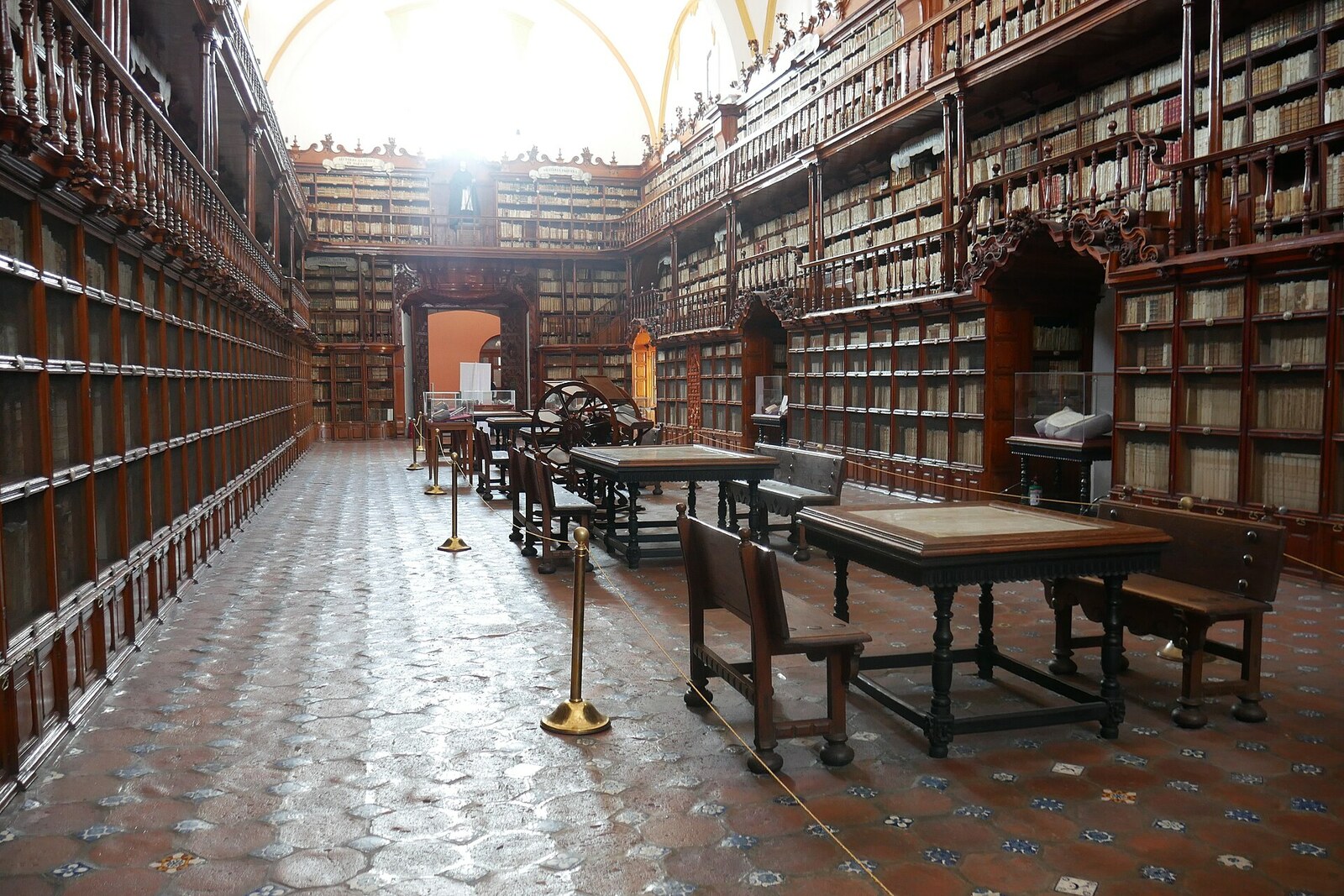
Look around first
What to notice
- Three tiers of wooden cabinets
- Closed book shelves
- Long gallery
The story of the place
On September fifth, sixteen forty-six, Juan de Palafox y Mendoza, Bishop of Puebla, signed a deed of gift for five thousand books of his own. The library dates its history from this document and is called the Palafoxiana Library after its donor.
Palafox had collected books ever since entering royal service. They were his working collection, accumulated over years of his official and ecclesiastical career. The bishop gave them away during his lifetime, with no right to demand them back. Along with the volumes, the colleges received globes, astrolabes, maps, and mathematical instruments.
Colegio de San Juan was already here and trained future parish priests, but its small library did not match Palafox's plans. He sought to ensure that an educated priest could reason about law, history, languages, and the workings of nature, rather than repeat a few familiar theological books. The collection was intended for seminarians, but the deed of gift included a condition that sharply expanded the circle of readers: admission was permitted to any resident of the city and the diocese who could read and wished to learn.
Literacy itself remained a high threshold in the seventeenth century. Yet rank, origin, and affiliation with the college no longer gave anyone an exclusive right to these books. Palafox wrote separately about poor people who had no volumes of their own. Reading hours were established for them in the morning and afternoon, and they were allowed to copy the pages they needed. This is why the Palafoxiana Library is considered the first public library in the Americas.
Open admission did not mean free lending. Books were expensive, and replacing a missing copy was often impossible. The librarian kept the key, handed the reader the requested volume, and returned it to its place. Taking books out was forbidden. In sixteen forty-eight, at Palafox's request, Pope Innocent X reinforced the ban with the threat of excommunication. The harshest punishment here was intended for an attempt to take a book away, not for the wish to read it.
When Palafox left Puebla, the collection remained at the college. He never saw the current long hall. More than a century later, another bishop, Francisco Fabián y Fuero, added his own books and ordered the expanded holdings moved to a new room at the same college. By seventeen seventy-three, craftsmen had created a forty-three-meter gallery and the first two tiers of cabinets made of cedar, ayacahuite—Mexican pine—and coloyote. In the nineteenth century, new donations no longer fit on these shelves, and carpenters added a third tier.
Now the old college building holds more than forty-one thousand books and manuscripts. The historic hall serves as a book museum, while a researcher who needs a particular volume submits a written request and comes at an appointed time. Visitors walk along three tiers of closed cabinets; the librarian still provides the requested book inside the institution, and it does not go beyond its doors.
Useful on site
Tuesday–Thursday 10:00–17:00, Friday–Sunday 10:00–18:00; general ticket — 48 Mexican pesos.
Checked: June 24, 2026. Check the official source before visiting.Access to the historic hall may be regulated. Do not touch the books or display cases; if the interior is closed, listen to the account at the entrance to the complex.