 Guide On Map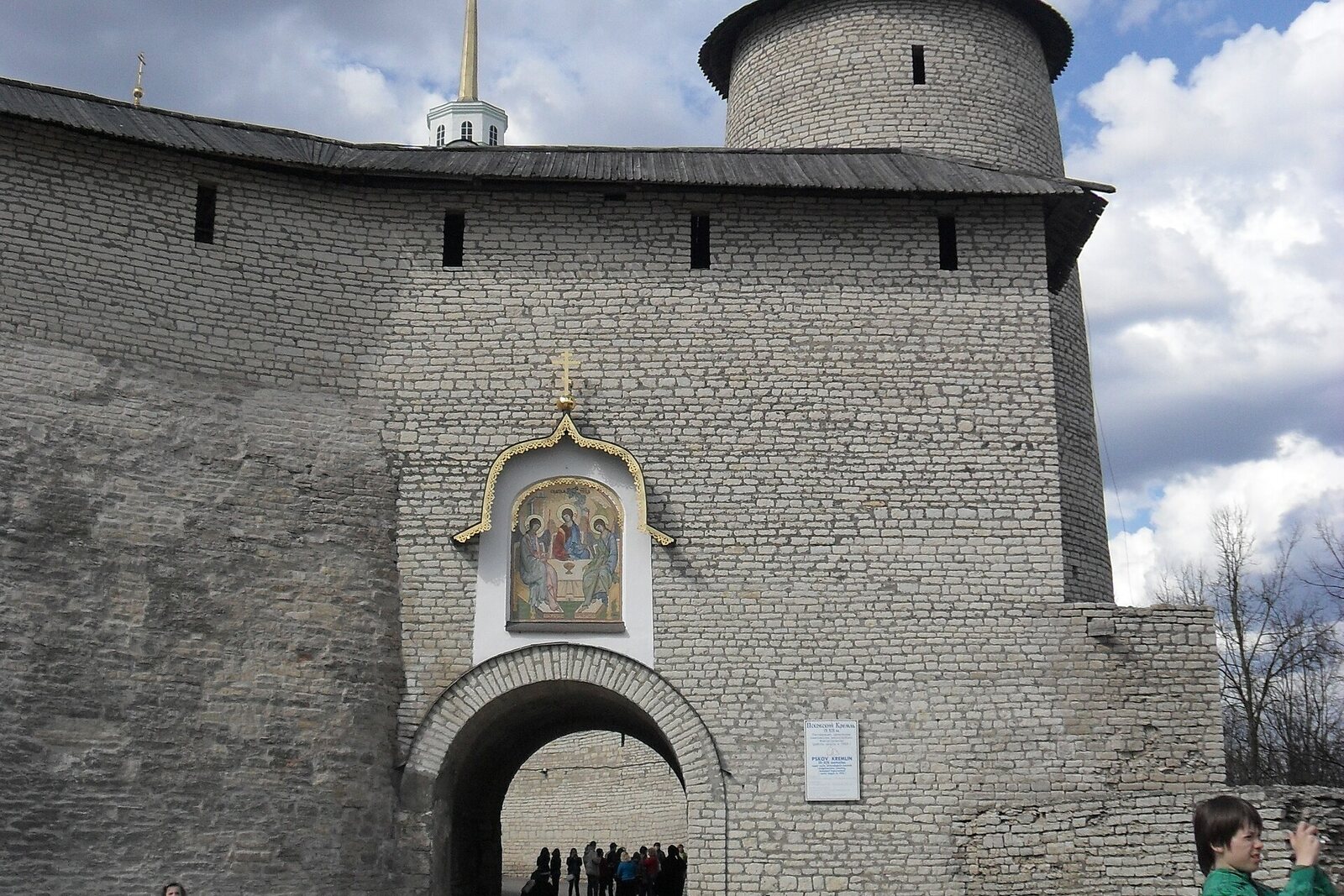
Look around first
What to notice
- The arch of the Great Gates
- The mosaic above the arch
- Trinity Tower
- The narrow corridor of the zakhab
The story of the place
Above the arch of the Great Gates, three angels sit at a table—a mosaic copy of Andrei Rublev’s Trinity. The mosaic itself is older than the present masonry of the gates and Trinity Tower: it was completed almost half a century before restorers reconstructed this passage.
The gates came to be called Great when they became the main entrance to the Krom. Beyond the arch begins the zakhab—a narrow defensive corridor between walls. A detachment that entered could not form up here and found itself under the defenders’ blows. The gates were given the name Trinity, as was the neighboring tower, after the cathedral to which the corridor leads. In the middle of the seventeenth century, the people of Pskov installed a city clock on the tower, and another name appeared—the Clock Tower.
In April nineteen forty-two, the Riga artist and restorer Evgeny Klimov entered through what were then the Trinity Gates. He came to Pskov, occupied by German troops, with the Pskov Orthodox Mission—clergy and laypeople reviving church life. Seeing an empty niche above the arch, Klimov asked what the gates were called. The answer suggested what belonged there: an image of the Trinity.
He measured the niche—one meter eighty high and one meter twenty wide. In Riga, he made a full-size sketch based on Rublev’s icon, then returned to Pskov and checked the drawing on site: some parts had to be made fainter, others stronger, so that the image could be seen from the ground. Paint was unsuitable for an exterior wall, so Klimov ordered a porcelain mosaic from a factory in Mettlach, Germany.
The artist paid for the work himself. It was a significant risk: after the change of regime in Riga, he was dismissed from his post at the art museum, and continued to earn money through teaching, drawings, and lithographs. The factory took about two years to fulfill the order. In the summer of nineteen forty-four, a crate weighing one and a half tons arrived in Riga. It was no longer possible to send it to Pskov by the former route. Klimov made an arrangement with the priest of Riga’s Church of Ioann Predtecha, left the mosaic in the church, and soon left Latvia.
Later, Trinity was nevertheless transported to Pskov, but the niche intended for it no longer existed. The gates Klimov had measured during the war were dismantled by restorers along with part of the wall rebuilt in the nineteenth century. The mosaic was placed inside Trinity Cathedral, and the name of its author was gradually forgotten.
By then, Klimov was living in Canada and for more than forty years did not know whether his work had survived. In the winter of nineteen eighty-six, a former student wrote to him that she had seen Trinity in Pskov Cathedral. The artist received confirmation from the cathedral’s warden: the mosaic had been consecrated, and candles were placed before it. Klimov lived long enough to learn that the one-and-a-half-ton crate had not disappeared, but he did not see the image return to the gates.
At the beginning of the nineties, restorers reconstructed Trinity Tower, the Great Gates, and the eastern wall of the zakhab. In two thousand three, the mosaic was moved from the cathedral to the niche above the gates. It is located where Klimov first measured the empty recess in April nineteen forty-two.
Useful on site
The territory of the Krom is open from 08:00 to 21:00; visitor entry and ticket sales are until 20:00. Changes are possible.
Checked: July 2, 2026. Check the official source before visiting.Do not stop in the middle of the passage if there are many people around. First examine it from outside, then go inside and compare how the view and sound change.