 Guide On Map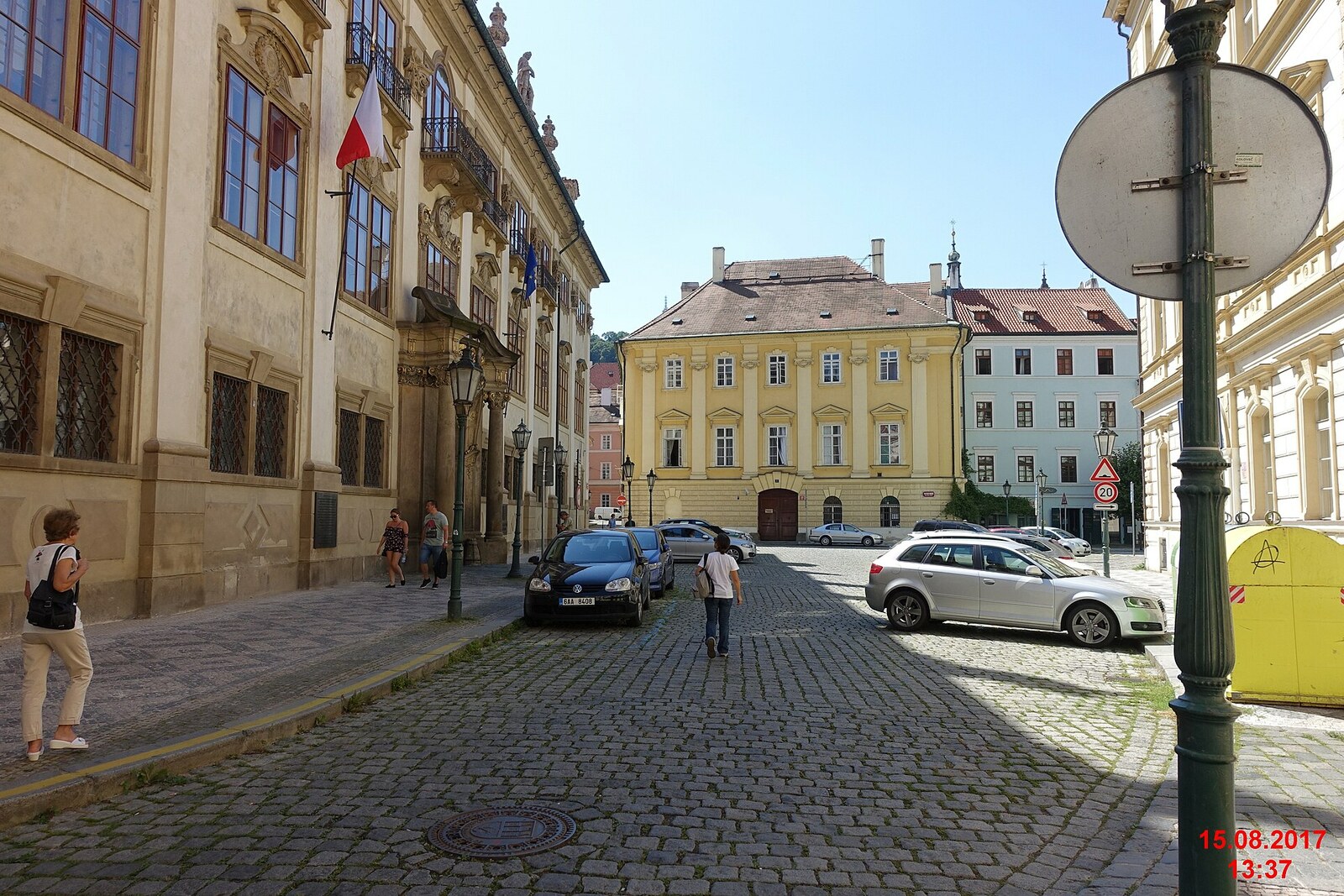
Look around first
What to notice
- John the Baptist with a banner
- A lamb at the saint's feet
- Three angels
- The church and the Grand Priory Palace
The story of the place
At the center of Maltese Square stands John the Baptist: a banner in his hand, a lamb at his feet, and three angels around him. He was the patron of the people after whom the square is named—the knights of the Order of Malta.
Around eleven sixty-nine, the Czech king Vladislaus II of Bohemia gave them land by Judith Bridge, the predecessor of Charles Bridge. The site was chosen beside what was then the most important crossing. The Hospitallers grew out of a brotherhood at a hospital in Jerusalem: they treated sick pilgrims and then began to escort them with weapons. On the Prague bank, the knights built a monastery, a church, a hospital, and service buildings. The commandery was enclosed by walls; later, the Lesser Town city wall adjoined its fortifications.
The king's gift provided the knights with land and income, which they used to maintain the hospital and their armed brethren. The sick received shelter beside the road and the bridge, while the bridge itself gained a fortified bridgehead. The square arose near this complex, between the Order's buildings and the roads leading to the crossing, the market, and Prague Castle.
The Hospitallers were called the Maltese much later. Their leadership successively lost its bases in Jerusalem and on Rhodes, until in fifteen thirty Emperor Charles V gave the island of Malta to the Order. The new name also reached the Prague commandery, founded nearly four centuries earlier. In eighteen seventy, the separate parts of this space were united under the common name Maltese Square.
The stone image of John appeared here after the last major plague epidemic in Prague. During the outbreak, a temporary altar stood in the square. When the epidemic ended, František Taufer of Rovino, administrator of the Order's local estates, paid for a permanent monument. Jan Brokoff's workshop received the commission, and his son Ferdinand Maxmilián Brokoff created the figures in seventeen fourteen and seventeen fifteen.
At first, John and the angels stood in the middle of a fountain. In the eighteen eighties, its basin was removed, while the sculpture remained. Behind it still stand the Order's church and the Grand Priory Palace, where the leadership of the Czech branch of the Order of Malta is based. Only individual fragments of walls remain from the former hospital and fortifications; the fountain's basin is gone. John the Baptist still stands on the site of the plague altar, at the center of a square named after a distant island unknown to the knights of his Order when they settled by the Prague bridge.
Useful on site
The square is open; the Church of Our Lady beneath the Chain: visits by arrangement or before Mass, regular Masses Sun 10:00 and Tue 17:30.
Checked: June 28, 2026. Check the official source before visiting.Much of the Order's life is hidden behind walls, so do not expect free entry to the courtyards. Visit the church interior only when access is open and without disrupting a service.