 Guide On Map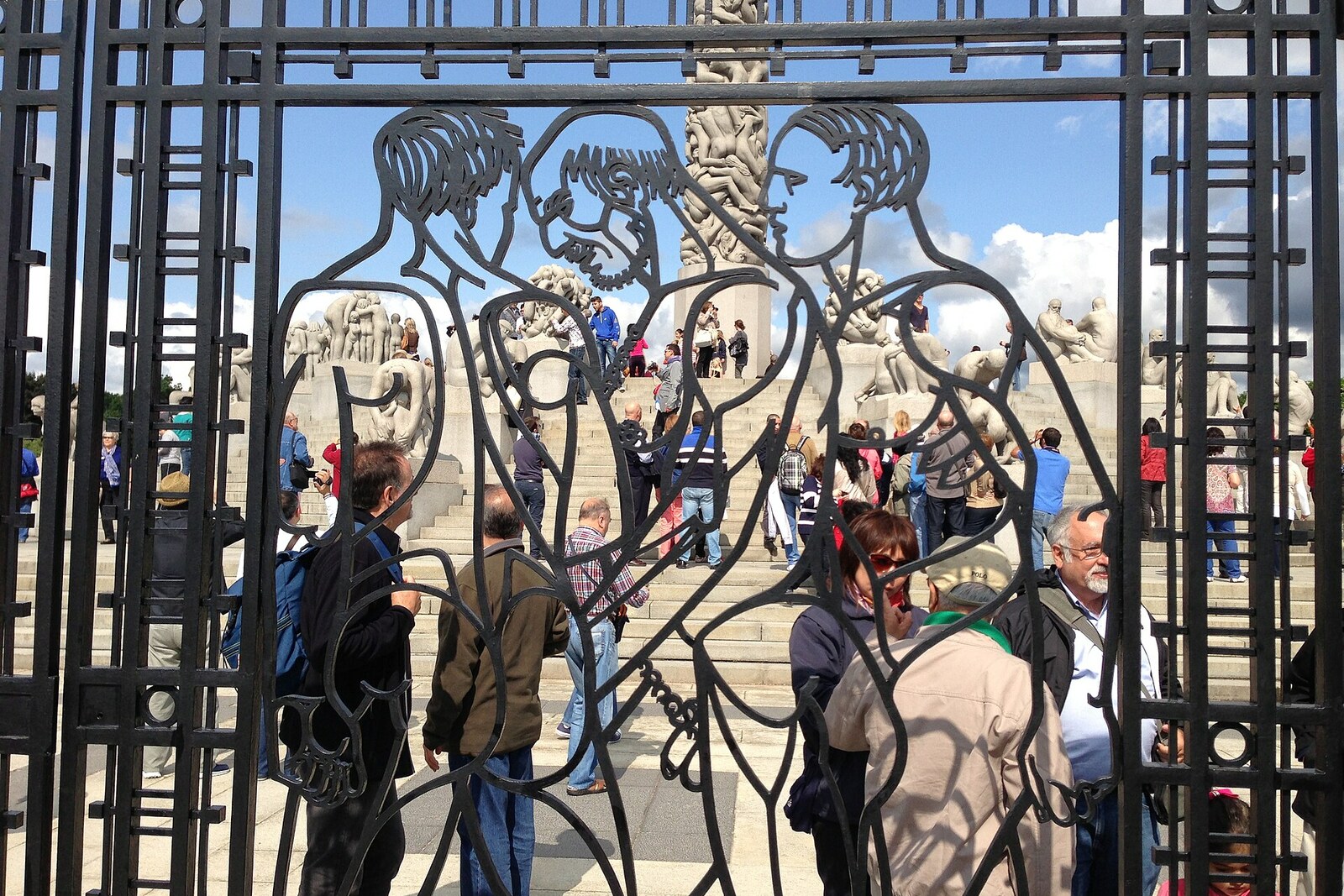
Look around first
What to notice
- Five large iron gate leaves
- Two narrow passageways
- Dragon medallions
- Granite pylons
The story of the place
Gustav Vigeland envisioned eleven entrance complexes around the perimeter of the park, but only this one was built. The black iron gate leaves, weighing several thousand kilograms, rest on hinges so precisely that they turn almost effortlessly and return to their place by themselves. After forging, they were hand-finished with a file and protected from rust, and now restorers annually remove marks left by strollers, bicycles, and everyday traffic through the gate.
Five large gate leaves and two narrow passageways between granite pylons form the eastern entrance from Kirkeveien. From here begins the park's long straight line, leading to Vigeland Bridge, Vigeland Fountain, The Monolith, and The Wheel of Life. In the round panels of the gate, dragons are bound with ropes, locked together, and tangled in their own bodies. This interlaced ornament recalls the carved portals of medieval Norwegian wooden churches.
Alfred Mikkelsen forged the first four dragon medallions. He had earned his living as a craftsman long before meeting Gustav Vigeland: he trained in a village forge in southwestern Norway, worked as a carriage and horseshoe blacksmith, and came to the capital in nineteen ten to master delicate iron grilles, leaves, and roses. Mikkelsen worked in a private workshop for twelve years. There, he was assigned to translate Gustav Vigeland's drawings into metal.
The sculptor Gustav Vigeland wanted to make the entrance the first work of his park ensemble and to control its execution down to individual joints. By April nineteen twenty-six, his drawings were ready. Mikkelsen made trial dragon panels, and in nineteen twenty-seven they were exhibited at the Museum of Decorative Arts and Design. On October third of that same year, Oslo Savings Bank offered to pay for construction of the gate. Oslo City Council approved the project, after which Gustav Vigeland secured the establishment of his own forge beside his studio.
On June first, nineteen twenty-eight, Mikkelsen was hired there as its first master blacksmith. His contract explicitly stated the task: to make the Main Gate under Gustav Vigeland's direction. The commission changed the rest of his life. Mikkelsen left his former workshop, hired assistants, and worked with them in the new forge for almost a quarter of a century.
Gustav Vigeland brought a composition drawn on graph paper at a scale of one to ten. The blacksmiths enlarged it to full size. The sculptor made corrections, after which the craftsmen transferred the approved lines onto tracing paper and prepared working templates. Heated standard iron strips had to be twisted and stretched to the limit specified by the drawing. A drilling machine and welding equipment stood beside the forge and anvil.
For Mikkelsen, welding became the condition on which the outcome of the entire commission depended. He later wrote that without it, many delicate details would have had to be made differently: the weld made it possible to preserve the drawing and gave the narrow elements the necessary strength. The large gate leaves were made of especially high-quality Norwegian iron, rolled at Spikerverket. After forging, the surfaces were finished with a hacksaw, chisel, and file, then sandblasted, coated with lead red primer against rust, and covered with black lacquer.
In September nineteen forty-one, the gate was installed on Kirkeveien. The work was completed in July nineteen forty-two. Each large gate leaf contained several thousand kilograms of iron, yet the city engineer who took delivery of the Main Gate claimed that it could be turned with one finger: the craftsmen had calculated the hinges and balance so precisely that the heavy grille returned exactly to its original position.
Gustav Vigeland died the following spring. The forge was preserved after his death: Mikkelsen's workshop carried out commissions for Oslo City Hall, city parks, and the service for protecting old buildings. Despite his worsening health, the blacksmith himself remained there until the forge closed in nineteen fifty-two.
Gustav Vigeland envisioned eleven entrance complexes around the perimeter of the park. Only the Main Gate was built. Maintaining its black iron now takes a total of about three working months each year: restorers remove rust and traces left by bicycles, strollers, and everyday traffic through the passageways. The dragon medallions with which the commission began still retain the form forged by the former carriage and horseshoe blacksmith Alfred Mikkelsen.
Useful on site
Always open, free access.
Checked: June 25, 2026. Check the official source before visiting.Stop in front of the gate leaves and examine the pattern from close range: this makes the repetitions and the differences in the thickness of the bars easier to notice.