 Guide On Map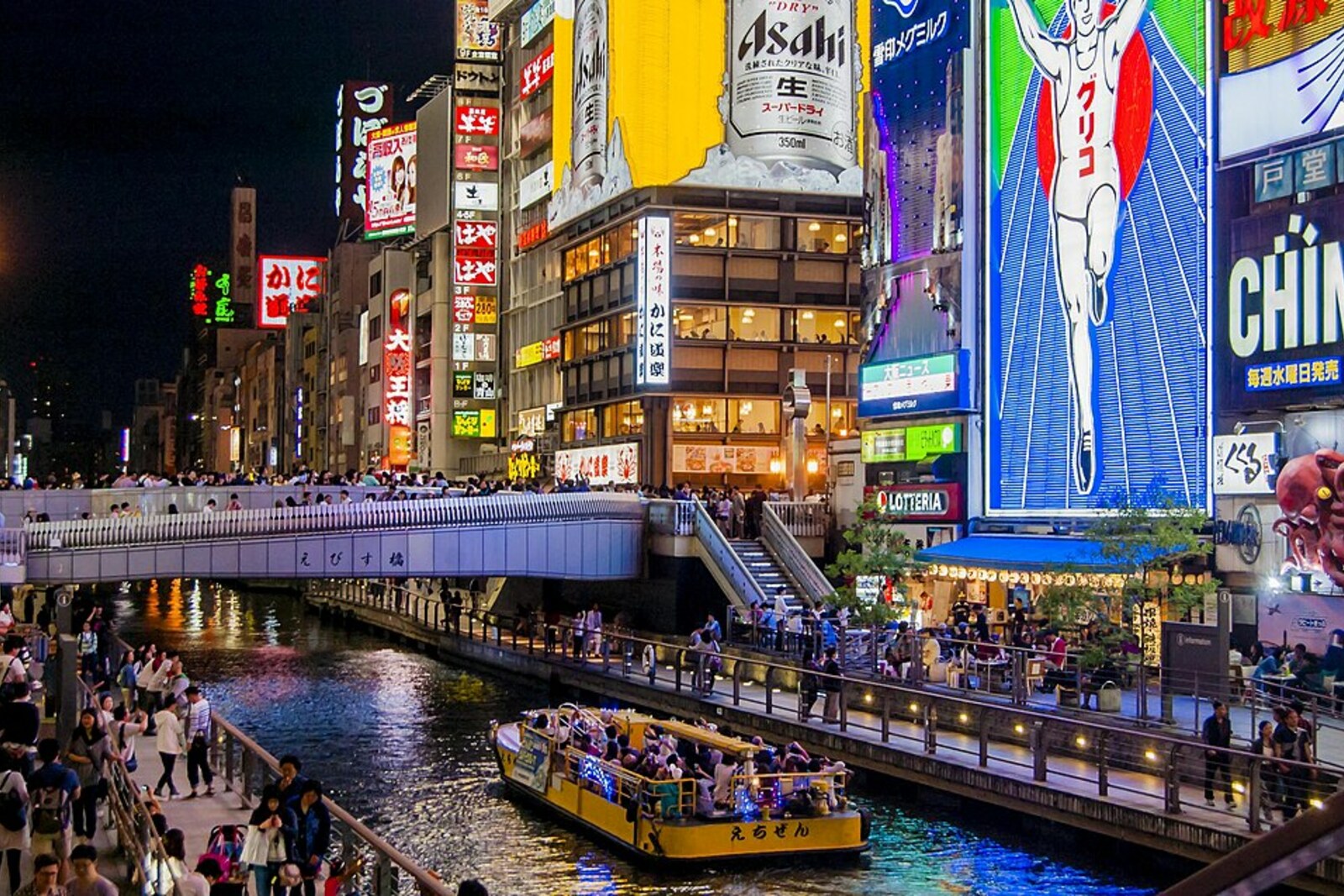
Look around first
What to notice
- The bridge’s circular center
- Stairways down to the waterfront
- Dotonbori Canal
- The Glico runner figure
The story of the place
From Ebisu Bridge, people photograph the Glico runner and the giant signs above the water. The bridge’s current circular center is convenient for photos, and the stairways lead down to the waterfront. Beneath them flows a canal dug by people. Its name belongs to a man who did not live to see the work completed.
In sixteen twelve, Nariyasu Doton was appointed to direct the construction of a new waterway along Osaka’s southern edge. Doton came from one of the seven wealthy families of the town of Hirano, whose members had held posts as town elders for generations. He did not make his living as a building contractor: his role in government and his ties to the Toyotomi clan gave him the right to manage a major urban project.
The canal was to carry cargo boats and supply water to fields and residents. The excavated earth was intended to fill in marshy areas and lay out neighborhoods on them. The romantic story that Doton alone put his entire fortune into the canal appeared later. In fact, he directed a project commissioned by Osaka’s rulers, together with several families of town administrators.
Three years later, the summer Siege of Osaka began. Doton remained on the side of the Toyotomi clan, to whom he owed his position. Work stopped, and he himself died in the castle in May sixteen fifteen. The Toyotomi clan was defeated.
Matsudaira Tadaaki, Osaka’s new ruler from the victors’ camp, was assigned to restore the city. He ordered Doton’s former assistants—the work supervisors Yasui Kuhei Doboku and Hirano Toji—to continue the construction. In November of that same year, they completed the canal. According to the accepted version, Tadaaki ordered it named in memory of the fallen enemy: Dotonbori literally means “Doton’s canal.”
Doboku also took charge of the banks. He moved the theatre district to the canal’s southern side. Owners opened theatres here, while restaurateurs opened establishments for audiences during long intermissions and after performances. This is how a place arose along a transport canal where the public came looking for a show and food. There are fewer theatres now, but restaurants, shops, and advertising screens facing the bridge now draw the same flow of people.
Even Doton’s surname had to be established in court. In nineteen sixty-five, Asao Yasui, a descendant of Doboku, demanded that the riverbed be recognized as his family’s property. He claimed that his ancestors had dug the canal on their own land and paid for the work. The city was preparing to reconstruct the channel at the time, so the dispute concerned actual real estate in central Osaka.
The case lasted eleven years. Researchers examined family documents and established that the founder was named Nariyasu Doton, while the familiar “Yasui Doton” was a later error. The court did not award the channel to the family, but it separately recognized that Yasui Kuhei Doboku and his relatives had brought the construction to completion and laid the foundation for the future district. Asao withdrew his appeal: he considered recognition of his ancestors’ achievements a sufficient outcome.
Ebisu Bridge appeared at about the same time the canal was completed. The exact origin of its name is unknown. The most likely version connects it with the road to Imamiya Ebisu Shrine: Ebisu was first venerated by fishermen and then by merchants. People used this crossing to reach the shrine, the cemetery, and the theatres, so long before electric signs, the bridge brought together different streams of people.
The wooden Ebisu Bridge from Doton’s time has long been gone. The current circular bridge was completed in two thousand seven on the site of the former crossing: Shinsaibashi-suji Shopping Street approaches it from the north, Ebisubashi-suji Shopping Street from the south, and beneath the people taking photographs runs the canal named for the dead work supervisor.
Useful on site
The bridge and waterfront are open as public space; restaurants, cruises, and signs operate on separate schedules. For light, plan your visit for after sunset.
Checked: June 29, 2026. Check the official source before visiting.For a better view, step away from the central flow and keep your belongings close. Do not linger by the edge or repeat the old tradition of jumping into the canal.