 Guide On Map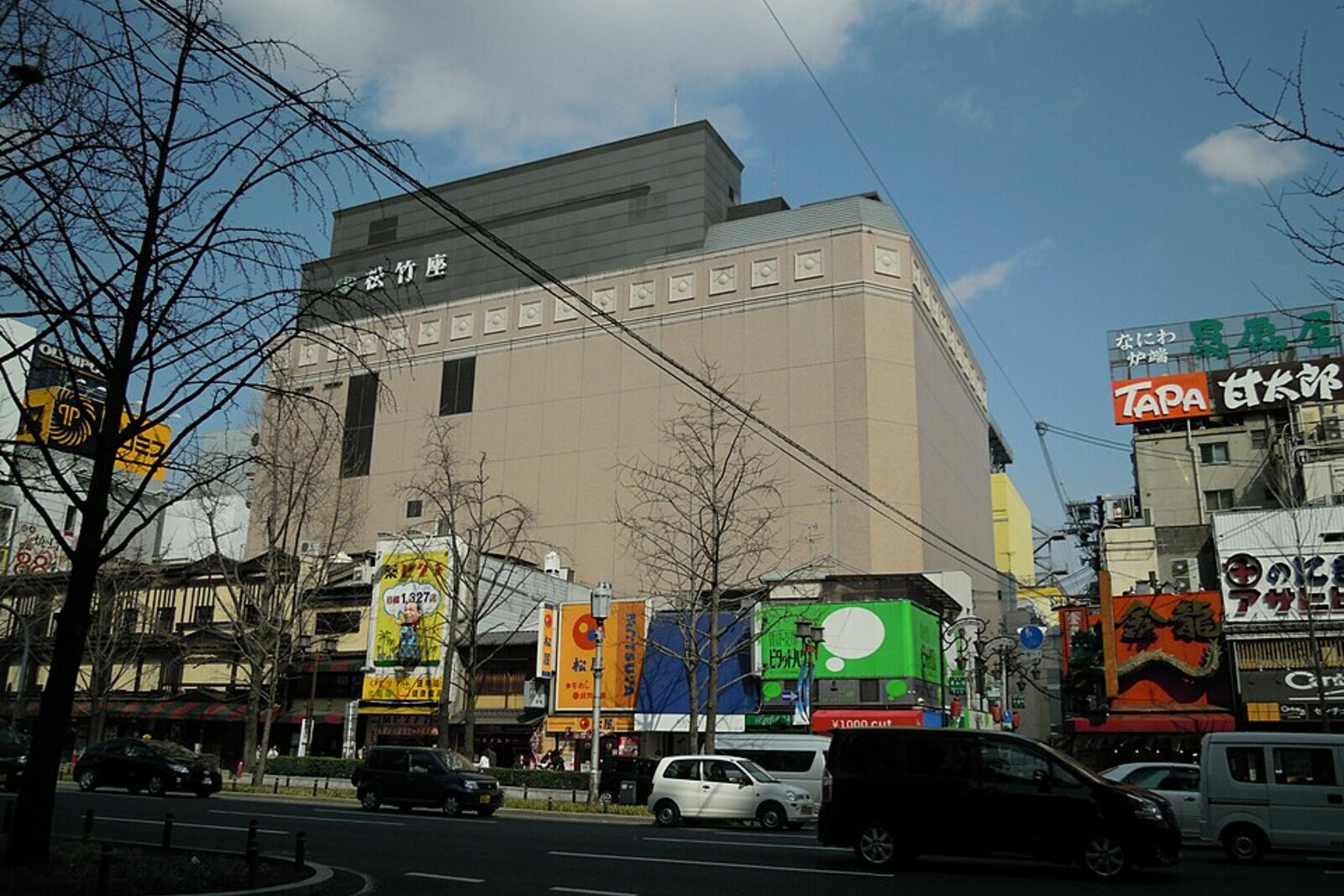
Look around first
What to notice
- Stone arch
- Neo-Renaissance facade
- The name “Shochiku” above the entrance
The story of the place
A stone arch cuts through the ornate facade in the style of the Italian Renaissance; a theatre auditorium lay hidden behind it for a long time. The street-facing wall of the former movie theater was preserved, while a new stage for kabuki, revue, drama, and concerts was created farther inside. From outside, the building held onto the memory of the old entertainment district, while an entirely different theatrical life continued behind that shell.
The name “Shochiku” remains above the stone arch. It is made from the names of the twin brothers and theatre entrepreneurs Matsujirō Shirai and Takejirō Ōtani: “matsu” means pine, from Matsujirō’s name, and “take” means bamboo, from Takejirō’s. At first, the two characters were read as “Matsutake,” but after the film company was established in nineteen twenty, the reading “Shochiku” took hold. The theatre was named after the brothers’ company.
Matsujirō wanted to combine cinema with stage revue, which was new to Japan. He opened a school for girls and, in May nineteen twenty-three, built a movie theater with a stage here. At its opening, the students performed “L’Arlésienne.” Their ballet numbers were then performed between the two films in a single screening. The all-female OSK Nippon Revue Company grew out of this troupe.
Three years later, Matsujirō devised an annual production for it, Haru no Odori—“Spring Dance.” The main tangible reminder of one of its earliest shows now appears in the troupe’s finales far from this building.
In the spring of nineteen twenty-nine, the invited French singer Lucienne Dufresne performed in the fourth “Spring Dance.” In the closing scene, she sang “Spring Song” while dancers whirled among paper cherry-blossom petals. Dufresne inhaled the paper confetti and lost her voice midway through the number. For a touring soloist, that meant she had no way to finish her own performance.
To keep the paper from getting into the singer’s face, an umbrella was opened above her. Dufresne continued the number beneath it, and the troupe’s directors turned the forced protection into a stage device. From the following year, dancers began appearing in the finale with umbrellas. Later, the umbrellas were made pink, like cherry blossoms, and paired with a new song, “Land of Cherry Blossoms.” The turning pink umbrellas still end OSK Nippon Revue Company performances; small copies are even sold to spectators so they can repeat the performers’ movements from the audience.
The old auditorium where Dufresne saved her voice with an umbrella is gone. In nineteen ninety-four, the movie theater closed, and three years later builders retained the neo-Renaissance facade with its arch and erected a new theatre auditorium behind it for kabuki, revue, drama productions, and concerts.
On May twenty-sixth, two thousand twenty-six, the final performance ended here. Because of worn-out equipment, the company closed the theatre and decided to dismantle the building. The next “Spring Dance” is scheduled for June two thousand twenty-seven at NHK Osaka Hall. There, the performers will again open pink umbrellas—the device devised here when paper cherry blossoms nearly derailed Lucienne Dufresne’s song.
Useful on site
As of the verification date, after the final May 2026 performances, no regular stable schedule has been confirmed on the official pages. Use this as an outdoor stop until a new program is published.
Checked: June 29, 2026. Check the official source before visiting.After the theatre closed in May 2026, treat this point as an exterior viewing stop. Do not plan to visit the auditorium without a new official announcement of access.