 Guide On Map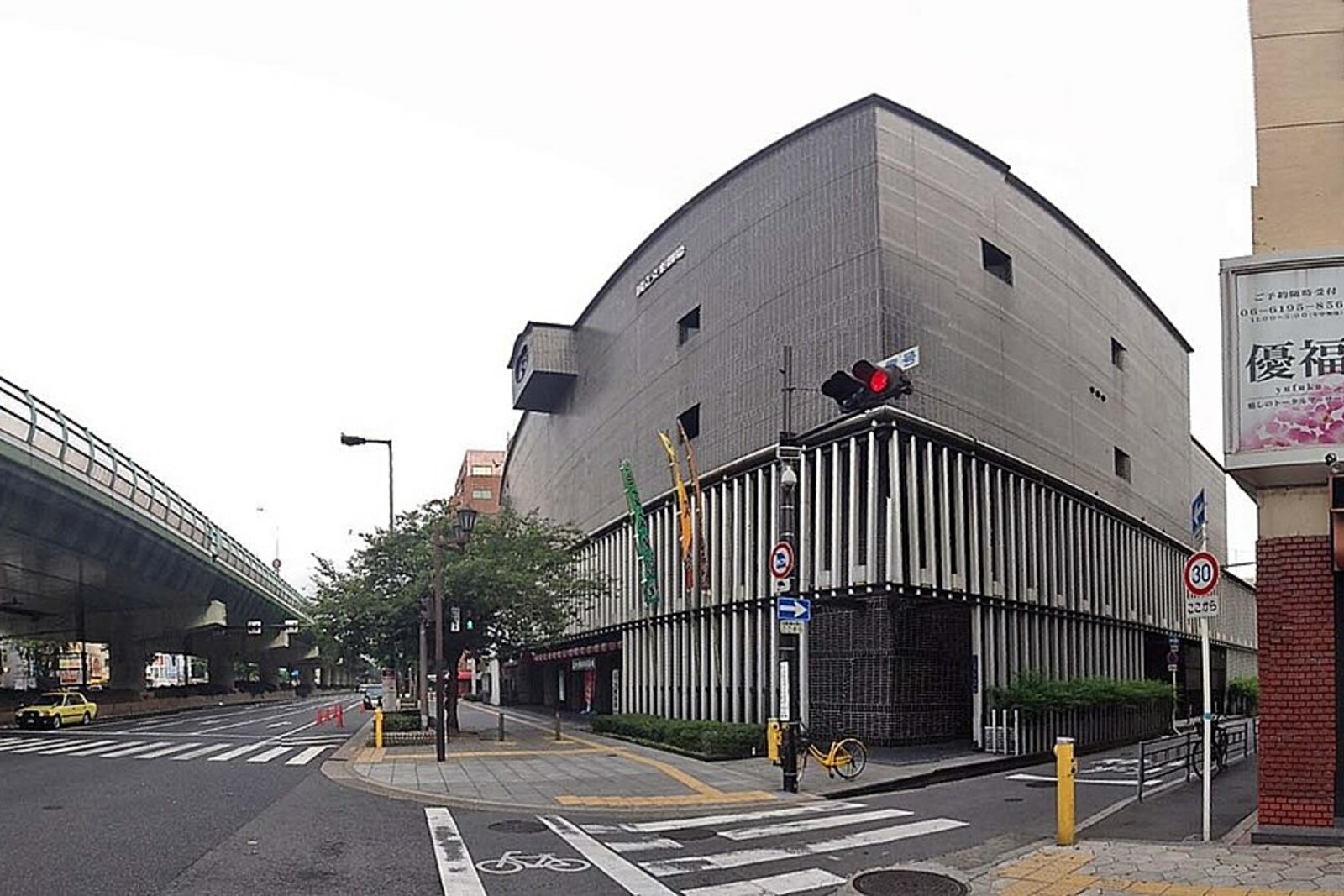
Look around first
What to notice
- The name “bunraku” on the facade
- The theatre's main entrance
- The side stage platform
- The lowered passage called funazoko
The story of the place
On April sixth, nineteen eighty-four, the first public season of the National Bunraku Theatre began on this stage. The festive play Kotobuki Shiki Sambaso was chosen for the opening. The puppets performed a ceremonial dance, while the people operating them performed in Osaka for the first time on a stage built by the state specifically for their art.
Isamu Saeki had been working to create such a theatre. He was chairman of the Bunraku Association and head of the Kintetsu Railway Company. The association was responsible for the performers and for preserving the repertoire, but it had no national hall of its own in the city: Osaka's main venue was the commercial Asahiza Theatre in Dotonbori. Saeki wanted to secure the troupe a place where its art had emerged. To do so, the major businessman used his political influence: he personally appealed to Prime Minister Takeo Miki and demanded that the theatre be built in Osaka. The prime minister passed the matter to Finance Minister Masayoshi Ohira; money appeared in the budget first for a study, then for a project. Osaka's authorities, the chamber of commerce and industry, and business circles repeated this demand for several years. Construction began in nineteen eighty-one, and three years later the troupe moved here from the Asahiza Theatre. Saeki lived to see the result of his campaign.
The word “bunraku” on the facade appeared thanks to a very different Osaka impresario. At the end of the eighteenth century, Uemura Bunrakuken, an amateur gidayu narrator from Awaji Island, earned money by teaching joruri—a drawn-out narrative form from which this theatre grew. By then, Osaka's large puppet stages had closed, and Bunrakuken set up a training room for amateur townspeople near the southern end of Kozu Bridge. It was about five minutes from here. He did not stop at lessons: Bunrakuken gathered narrators and puppeteers and began giving performances. Audiences came, his family continued his work, and in eighteen seventy-two his heirs put up the name “Bunrakuza”—the Bunraku Theatre. Gradually, the name of one troupe became the name of the entire art. The founder himself did not see this: he died in eighteen ten, long before the sign appeared.
Bunrakuken's old premises are gone. Kozu Bridge is gone as well: after the war, the canal it crossed was filled in, the bridges were dismantled, and a city expressway was laid over the former channel. The National Bunraku Theatre was built a little farther south, in the same district where Bunrakuken found his first students and audiences.
Inside the current hall, the activity he began can still be divided into three separate professions. A tayu narrator alone delivers the author's text and the lines of every character. A shamisen player sits beside the tayu; he carries the action together with the tayu rather than accompanying it in the background. A large puppet is operated by three people: the chief operator handles the head and right hand, the second the left hand, and the third the legs. The stage has a lowered passage called funazoko for them, while the tayu and musician have a special side platform. Above this arrangement stands the name of the man who once opened a private school for amateurs nearby: Bunrakuken.
Useful on site
Open according to the performance schedule and foyer access. The official calendar as of the date checked shows a summer program from 18 July — 9 August 2026 and an autumn program from 31 October — 23 November 2026.
Checked: June 29, 2026. Check the official source before visiting.Plan and book a performance separately according to the current repertoire. Without a performance, look at the entrance and posters, but do not count on free access to the auditorium.