 Guide On Map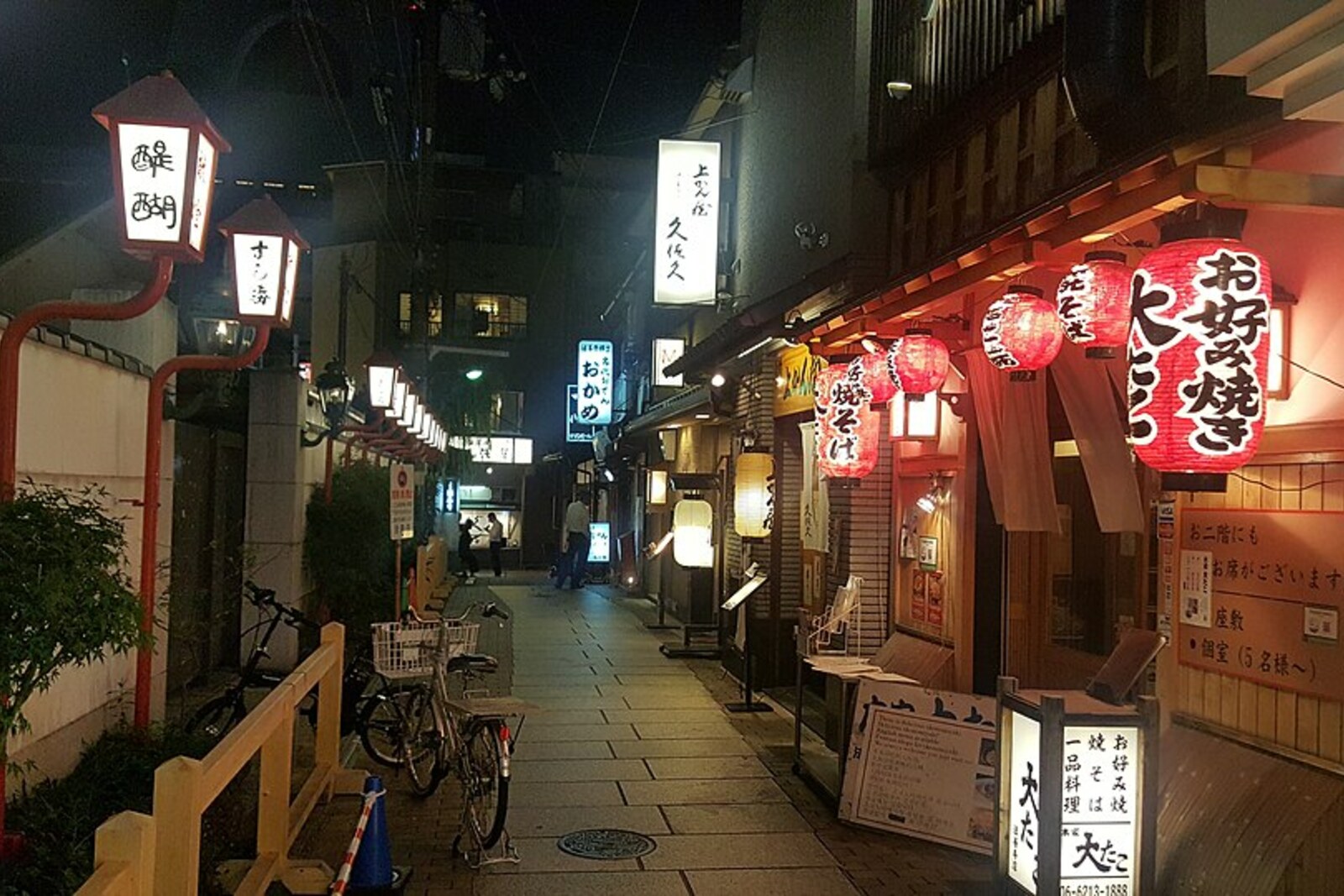
Look around first
What to notice
- Stone paving
- Entrance sign
- Closely spaced facades
- External evacuation balconies
The story of the place
Hozenji Yokocho Alley consists of two short streets with stone paving, restaurants, and bars beside Hozenji Temple. In Japanese, “yokocho” means a side alley. During the Edo period, merchants set up stalls right in the temple courtyard for worshippers. Over time, the trade became permanent, and sideshows and eateries appeared. That is how the temple passageways became a place to eat after prayer or a performance. There are now about sixty establishments here, from small bars to restaurants where the chef cooks behind the counter in front of the guests.
The present-day narrowness of these streets was deliberately preserved. On September ninth, two thousand two, a gas explosion occurred during the demolition of the former Nakaza Theatre. The fire spread to the northern side of Hozenji Yokocho Alley and destroyed a row of establishments. Their owners lost the premises whose counters and tables had provided their livelihood. Within just a few weeks, the fire victims formed a restoration committee. They sought the right to bring back the former small restaurants together with the narrow passage between them.
Building regulations stood in the way. The alley, about two point six meters wide, was legally considered a road. In new construction, the facades had to be set back by about seventy centimeters on each side in order to achieve the required four meters. For a large building, that is only a strip of land. Here, those centimeters held part of a counter, tables, or a section of a kitchen. If each owner had restored an establishment separately, the passage would have become wider, and some restaurants would no longer have fit on their former plots.
The committee needed the consent of all owners and tenants. Almost three hundred thousand people signed a petition supporting the old width. City specialists and the owners found a solution: on paper, the alley ceased to be considered an ordinary road, and the buildings along it came to be regarded as a single complex with a shared passage. In return, the owners accepted a joint building agreement. The buildings had to be constructed from fire-resistant structures and no higher than three stories; the upper floor was set back from the passage, external evacuation balconies were provided, and signs were forbidden to be placed on the stone paving. All participants undertook to conduct fire drills.
The approvals were completed in just over three months, and construction began in January two thousand three. In April, when the northern side was already being restored, a fire broke out in one of the establishments on the southern side. The committee had to extend the newly concluded agreement to the new area of destruction. The northern row was completed in July of that same year, and the southern one in February two thousand four. Restaurants reopened on both sides of the passage.
The charter adopted by the owners is still displayed on the reverse side of one of the entrance signs. Below it lies the stone paving restored after the fires, while the facades converge less than three meters apart—the width for which the owners agreed to build and take responsibility for safety together.
Useful on site
The temple precinct is usually accessible free of charge at any time; the Hozenji Temple office is open during the day, and the restaurants around it follow their own schedules.
Checked: June 29, 2026. Check the official source before visiting.Approach the statue one at a time, use the ladle carefully, and do not block the passage for a photograph. Do not stand in the doorways of narrow restaurants.