 Guide On Map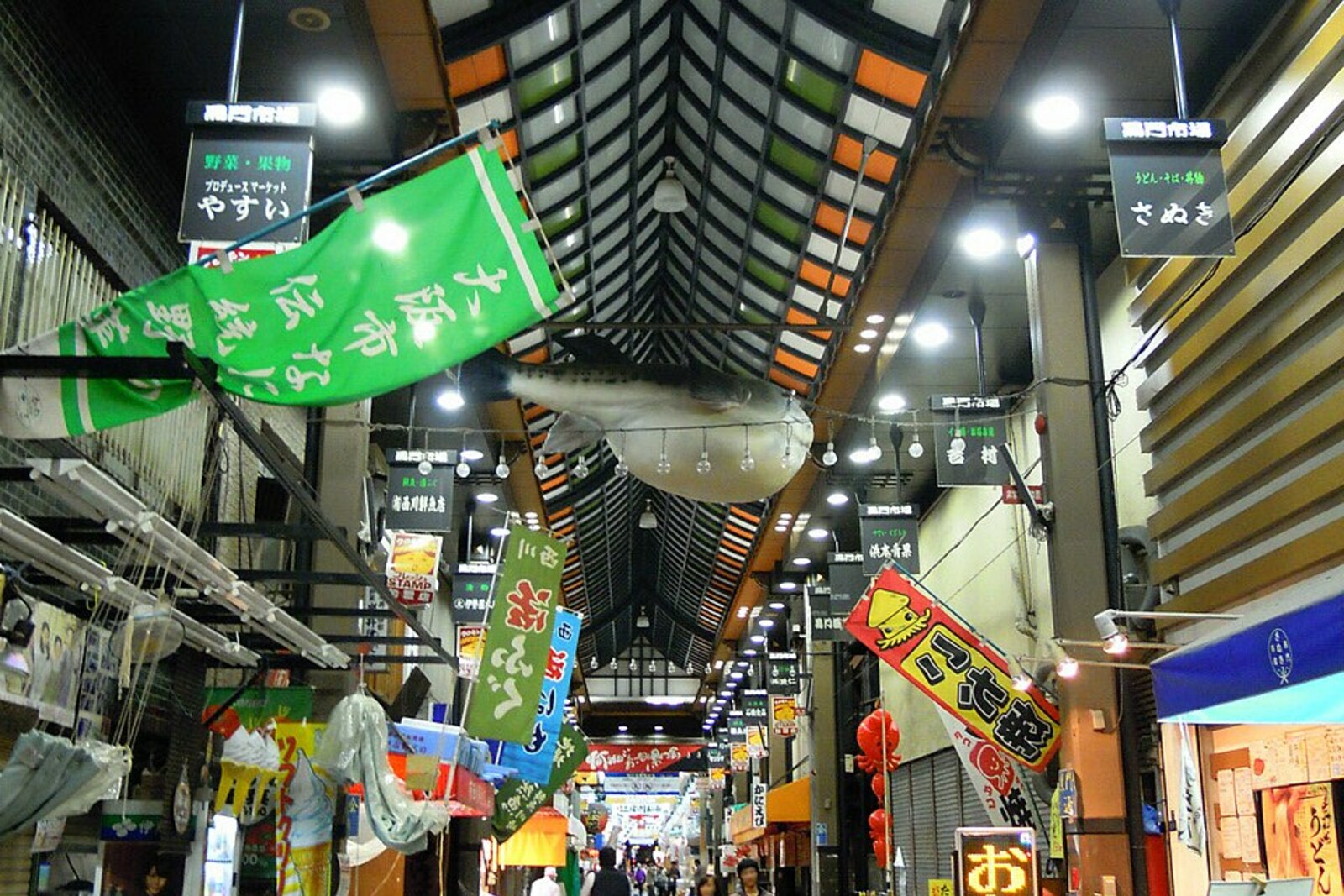
Look around first
What to notice
- Whole fish
- Ready-to-eat portions at food counters
- Giant figures of marine animals
- Covered arcade
The story of the place
The market's name preserves two words about gates that are no longer here. Trade on this street began near Enmyoji Temple, and the black gates became an agreed meeting place for peddlers, sellers, and customers. After the fire, the temple and gates disappeared; the monks later moved to another district of Osaka, while the trading rows did not change their name. Large figures of a shrimp and an octopus now hang beneath the arcade roof, but only the name survived from the black gates.
At Kuromon's fish counters, goods are sold in two ways: as a whole fish for cooking and as a small portion prepared right there. The second way seems like an old market habit, though it spread only quite recently—after a decision by the merchants themselves.
By the late two thousands, stall owners were losing their former customers. Many earned money by supplying restaurants and small family-run establishments, and residents of nearby neighborhoods also came here. When the number of such customers fell, foot traffic dropped to a record low after the financial crisis of two thousand eight. Yoshinori Yamamoto, chairman of the association of stall owners, worked to bring customers back and supported the bet on foreign visitors, whose numbers were growing in Osaka.
The merchants decided to turn the entire covered street into one large food court. They put up multilingual signs, printed maps, installed Wi-Fi, created a free rest area, and held weekly English lessons for sellers. The owners of several stalls began dividing fish and meat into small portions, preparing them in front of the customer, and serving them so the food would not have to be carried home. Others saw the result and copied the approach. Soon, ready-to-eat portions appeared at almost every food counter.
By two thousand seventeen, between twenty-six thousand and thirty thousand people came here every day; seven or eight out of every ten were foreigners. Revenue and customer traffic recovered, but some regular customers left: local residents found it harder to buy groceries among people who had come to eat and photograph the counters. So the merchants saved their stalls at the cost of changing what the street itself was for. A whole fish remained merchandise, while a piece of that same fish became a tourist dish.
Fish also explains why the market arose precisely here. According to an old city description, around eighteen twenty-two to eighteen twenty-three, peddlers began gathering by Enmyoji Temple. In the morning they sold fresh fish, and after noon they brought here what they had failed to sell elsewhere. Their earnings depended on selling perishable goods quickly. They bought fish in Sakai and Kii Province, which covered the south of present-day Osaka Prefecture and neighboring Wakayama Prefecture.
The meeting place was marked by the gates of Enmyoji Temple, painted black. So no address was needed in conversation: sellers and customers went to the black gates. At first, the trading rows were called Enmyoji Market, after the temple. In nineteen oh two, they were officially recognized as Osaka Kuromon Market—“Black Gates.”
Ten years later, a major fire in Namba destroyed the temple along with the gates. The monks later moved Enmyoji Temple to another district of Osaka, while the merchants kept the name. Beneath the present-day arcade hang huge figures of a shrimp, an octopus, and other marine animals, installed for the new tourist audience. The black gates themselves are not here: only two words above the fish rows remain from them.
Useful on site
Hours and days off depend on the stall; the official tourism registry lists a variable schedule. Plan a daytime visit, especially if fresh counters matter to you.
Checked: June 29, 2026. Check the official source before visiting.Do not stop in the middle of the passage, and do not try to taste everything at once. To get acquainted with the market, it is enough to choose one stall and take a calm look at its specialty.