 Guide On Map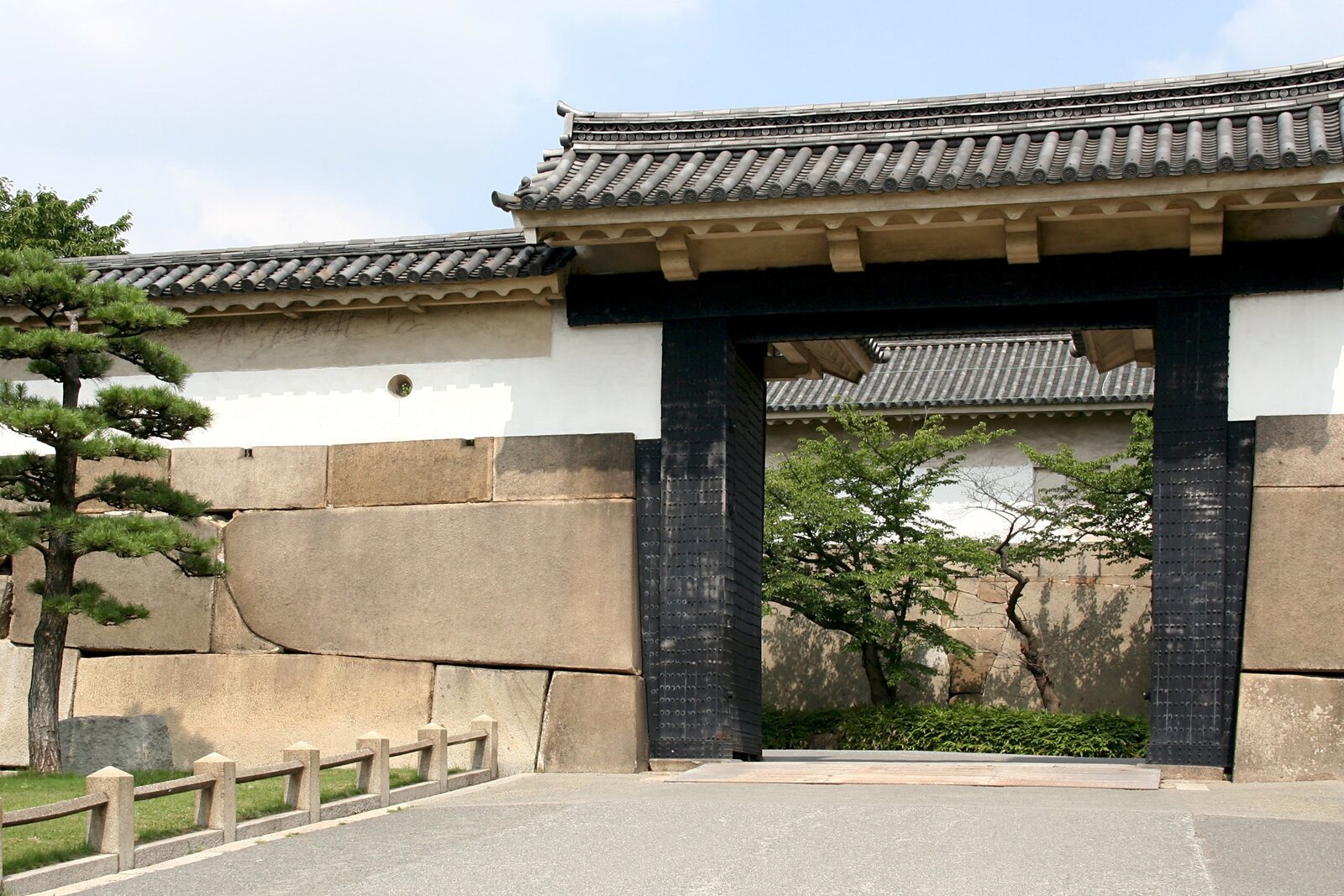
Look around first
What to notice
- The seam on the rear wooden post
- The lower insert above the stone
- The stone courtyard of the masugata
The story of the place
Under one of Otemon Gate's short side roofs, the rear wooden post has a seam about half a meter above the stone. On two faces, the lower insert joins the old wood with a dovetail; on the other two, with an angled wedge. It cannot be inserted from the side or from above along the outer lines. This carpentry joint was made here on June twenty-fourth, nineteen twenty-three.
Otemon means the castle's main gate. By order of the Tokugawa shogunate, craftsmen built it in sixteen twenty-eight. Thirteen years earlier, Tokugawa troops had destroyed the fortress of the previous owners, the Toyotomi clan; now the victors were building their own castle stronghold in its place.
Anyone entering through Otemon Gate found themselves in an enclosed stone courtyard and had to turn toward the next gate. The defenders could lock both leaves and fire from the galleries surrounding the courtyard. The name denoted a ceremonial entrance, while the layout delayed anyone trying to break inside.
In seventeen eighty-three, lightning burned the galleries around the courtyard, but Otemon Gate remained. It also survived the fire of eighteen sixty-eight, when a significant part of the castle buildings was destroyed. The Imperial Japanese Army then occupied the grounds. By the beginning of the twentieth century, the bases of the wooden posts had rotted from water, and one of the roofs was losing reliable support.
Army technician Wada Kumakichi was assigned to preserve the old post by replacing only its damaged base. The work was carried out by the master carpenter Fujii, a hired employee of the building contractor Ishihama-gumi. He had to join a new piece to an almost six-meter post so that the joint would support the roof while the old wood remained in place.
Wada calculated the joint, and Fujii cut four different surfaces and brought the new lower section in diagonally from below. It was then moved upward, and the hidden projections locked together inside the post. They wrote the names of the designer, contractor, and executor in ink directly inside the joint.
Restorers found the inscription when they completely dismantled the gate in nineteen sixty-six. Their study also showed that its main wooden parts date from the beginning of the seventeenth century: Fujii had indeed preserved part of a Tokugawa-era structure, not a later copy. Yet from the visible faces, the craftsmen still could not understand how the joint had been assembled. The answer came only in nineteen eighty-three, after X-ray imaging.
The old timber begins immediately above the seam; the new wood rests against the stone. Between them remains the work of a hired carpenter whose name was locked inside the support for more than forty years.
Useful on site
Examine the markings from the side, without lingering in the main flow by the passage. They are small and easier to see in side light.