 Guide On Map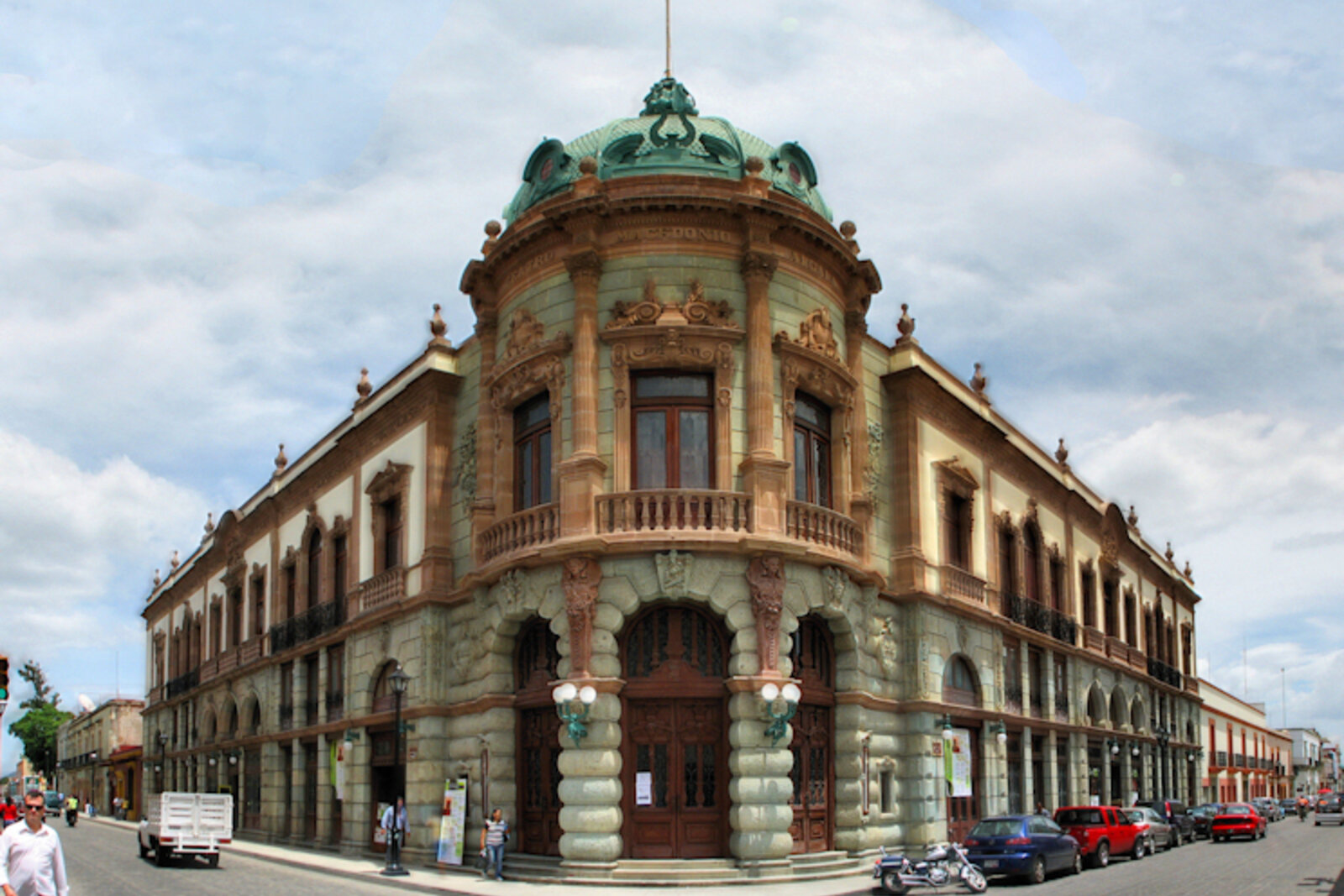
Look around first
What to notice
- Horseshoe-shaped auditorium
- Tiers of boxes
- Medallion above the stage
- Proscenium arch
The story of the place
In nineteen oh nine, the Theater-Casino opened its doors: wealthy families of Oaxaca wanted to see major foreign companies on its stage and meet one another. Tiers of boxes run along the horseshoe of the auditorium, while a medallion of the first patron remains above the proscenium arch. The first performance was Aida by an Italian company; later, plays, concerts, boxing, wrestling, and movie screenings were held here. Today, the auditorium again hosts plays, concerts, and dance evenings.
In March nineteen twenty-five, a newspaper columnist who signed himself Conde Oto came here for a Sunday movie screening. He took a box seat in advance: to write his column, he needed to watch the film through to the end. But a theater employee told him to vacate the box for three dozen children of some influential gentleman. There were no free seats left, and the columnist stood until the end of the screening. Later, in the newspaper, he described how a film loses its charm when the viewer's feet hurt.
The employee could act that way because the audience here was separated by tiers, ticket windows, and separate entrances. In nineteen twenty-five, a seat in the stalls cost sixty centavos—the same as a kilogram of beef. A ticket to the very top tier cost ten centavos, only slightly more than a kilogram of corn. Order was overseen by a special “theater judge.” Holders of cheap tickets saw the same film, but could not come down to the well-off viewers. The surviving horseshoe shape of the auditorium provided views from different levels and at the same time helped staff keep those levels separate.
The theater opened in nineteen oh nine as the Luis Mier y Terán Theater-Casino, named for a general and former governor of Oaxaca. Wealthy local families wanted to receive major foreign companies and meet one another here; on the first evening, an Italian company performed Aida. Plays, concerts, boxing, and wrestling were later staged here, and a movie screen was stretched in front of the stage. Now the auditorium has again been given over to plays, music, and dance.
A medallion with a portrait of Mier y Terán still remains above the stage, although his name disappeared from the facade long ago. During the Revolution, supporters of Venustiano Carranza named the theater after his brother, the military man Jesús Carranza. The former name was then restored, and in the autumn of nineteen thirty-three, Macedonio Alcalá was chosen.
Alcalá was an Oaxacan violinist, teacher, and director of musical ensembles. Music supported his family; when illness deprived him of the ability to work, he sold the sheet music and instruments that had formerly earned him a living. In eighteen sixty-eight, he wrote the waltz Dios nunca muere. The circumstances of its creation became surrounded by legends: in some versions, friends helped the ill composer; in others, the residents of Tlacolula commissioned the waltz. After Alcalá's death, his brother Bernabé tried to publish the work under his own name. The residents of Tlacolula declared that there had been a substitution and secured the restoration of Macedonio's authorship.
The composer died poor four decades before this building opened, but his waltz became the unofficial anthem of Oaxaca and gave the city's principal theater his name. When Dios nunca muere is performed in this auditorium, the audience rises in keeping with Oaxacan custom; above the standing viewers remains the medallion of Mier y Terán, the theater's first patron.
Useful on site
Mexican cultural listings give hours of Monday–Friday 09:00–20:00, with the caveat: according to current events. For a walk, consider the interior not guaranteed; the facade and corner can be understood from outside.
Checked: June 29, 2026. Check the official source before visiting.Plan primarily to view the facades. Access to the auditorium is usually possible only as part of an available program or a separate event, which is worth checking in advance.