 Guide On Map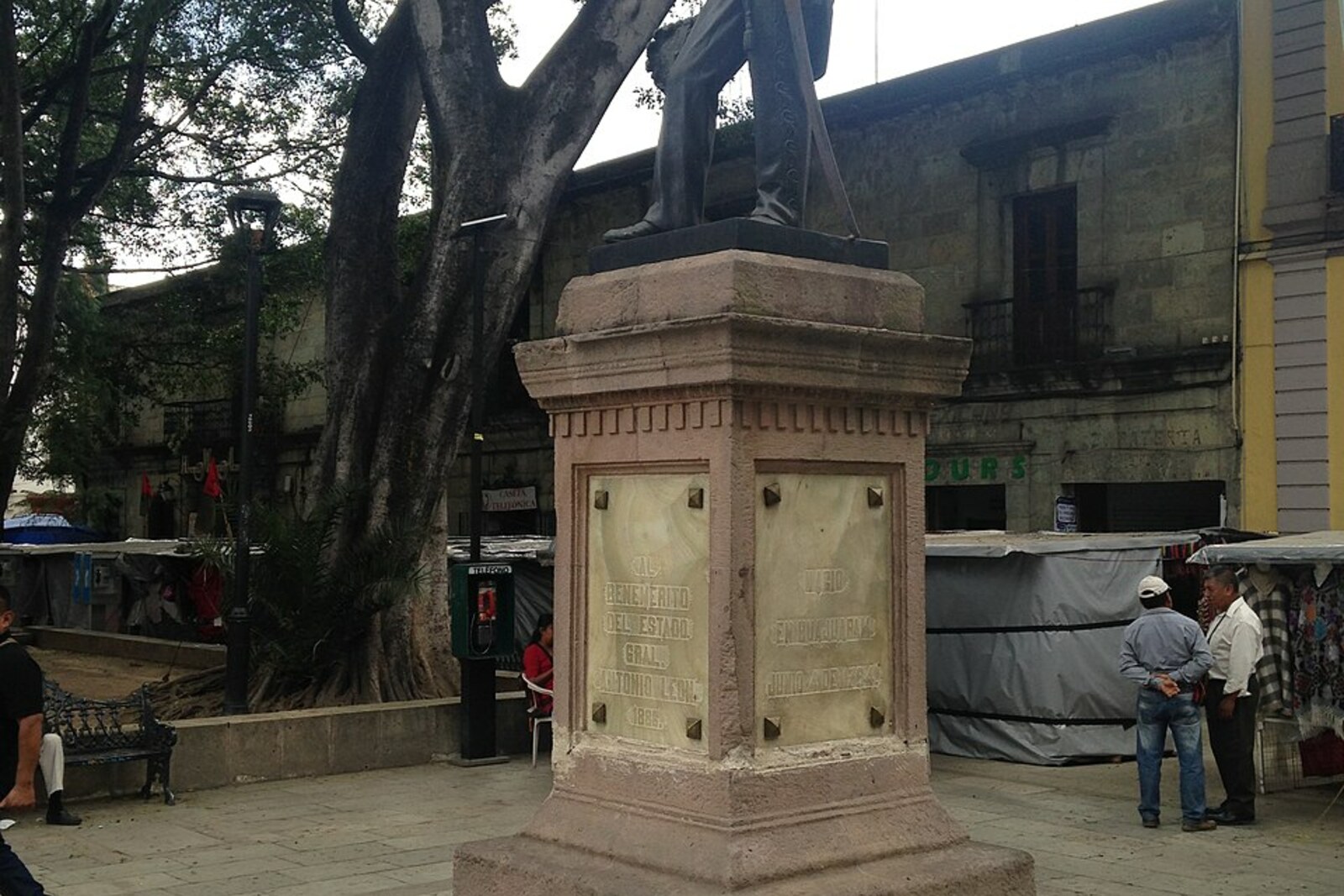
Look around first
What to notice
- Bronze statue of Antonio de León
- Hand at the saber
- Benches
- Trees
The story of the place
Benches beneath the trees stretch along the main façade of the Cathedral of Our Lady of the Assumption. In Mexico, a public garden for walking and rest like this is called an alameda. The plot was once set aside for a city hall, but no municipal building was ever built here. Paths were laid out through the garden and a fountain was installed, while the wooden fence that enclosed them disappeared long ago.
The bronze military figure in the center of the garden is General Antonio de León, governor of Oaxaca, who decided to remake this place beneath the windows of his own house. Before him, potters traded here for almost two centuries. They displayed vessels in front of the Cathedral of Our Lady of the Assumption’s main façade and made their living by selling this ware, so the square was called Plazuela de Cántaros—the square of pitchers.
This market arose almost by accident. In fifteen seventy-six, the plot was set aside for the city hall, but it was never built here. The empty space was occupied mainly by Indigenous artisans who came to sell earthenware. The cathedral square was a workplace for them, not a promenade garden.
In the early eighteen forties, de León lived in the house opposite. According to a widely told Oaxaca story, the idea of removing the market rows arose in a conversation he had with Benito Juárez—a young lawyer who served the governor as secretary and helped him reshape the city. What is reliably known is the main point: de León began turning the market into a garden.
For the potters, the decision meant losing their customary place of livelihood. They moved to Plaza del Marqués—to the place where Benito Juárez Market later appeared. Here, ash trees were planted, paths and a central fountain were laid out, and the whole garden was enclosed by a wooden fence. In Mexico, an alameda was the name for a public promenade garden; amusingly, the new garden had none of the poplars from which the word derives.
On October thirteenth, eighteen forty-three, de León opened the garden, named Alameda de León in honor of the man who created it. He got what he wanted: a place for walking and rest appeared in front of the cathedral. The merchants had to start over in another square.
Four years later, the former governor took military command again. The American army was advancing on Mexico City, and de León led a brigade defending the fortifications of Molino del Rey. On September eighth, eighteen forty-seven, he was killed in battle; Mexican units retreated toward Chapultepec.
Thirty-eight years later, on the anniversary of the general’s death, his statue was unveiled in the center of the garden he had created. The wooden fence and the potters’ rows are gone now. De León stands with his hand at his saber among benches and trees, while the artisans displaced from here for the sake of the Alameda must now be sought at the old city markets.
Useful on site
Open public garden beside the square. Access is unrestricted, but the condition of the paths, street vending, events, and work vary depending on the situation.
Checked: June 29, 2026. Check the official source before visiting.This is a convenient place for a pause, but keep the passageways clear and bear in mind that city events may take place around the monument.