 Guide On Map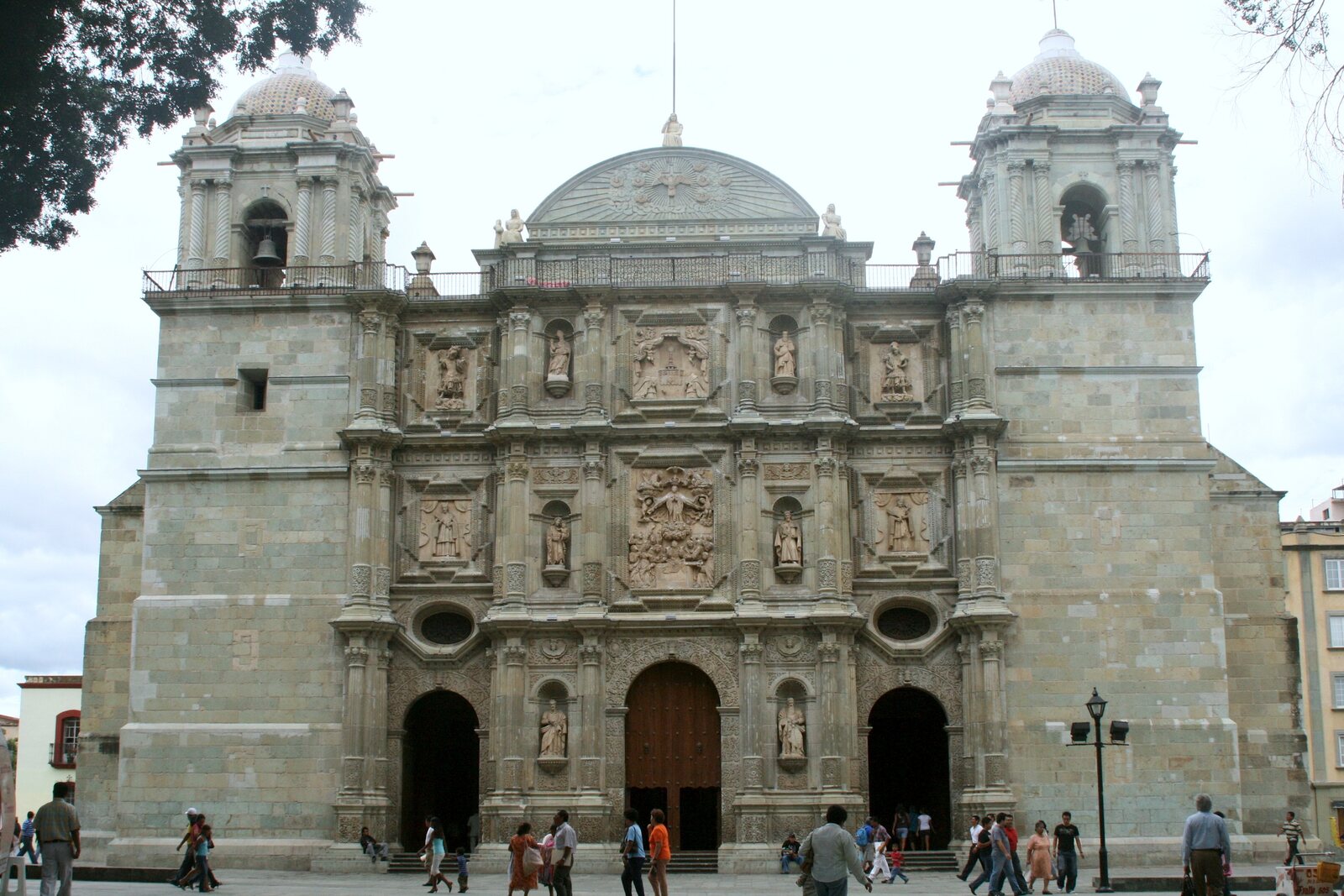
Look around first
What to notice
- Stone relief of the Assumption
- Central door
- Marble floor
- Bronze chandeliers
The story of the place
The marble floor, iron grilles, and bronze chandeliers appeared in the interior decades later than the stone façade. Under these vaults met the chapter, the council of the diocese’s senior priests, so the cathedral also served as a place for its collective decisions. The records did not preserve in which part of the vast space the table and chairs were set up for such meetings.
Above the central door, angels raise the Virgin Mary toward the Trinity. The stone relief explains the cathedral’s full name—the Cathedral of Our Lady of the Assumption. Catholics call the Assumption the completion of Mary’s earthly life and her taking into heavenly glory. What makes it a cathedral is the bishop’s chair, his cathedra; it became metropolitan after Oaxaca received its archbishop in eighteen ninety-one.
But once, the chairs inside were needed for something other than worship. On May thirty-first, eighteen thirteen, senior priests, members of the city council, officers, seminary teachers, and representatives of commerce were summoned here. The city was then called Antequera—the former name of Oaxaca—and had already been under the rebels of José María Morelos for half a year. This priest commanded an army that sought the separation of New Spain, the future Mexico, from the Spanish Crown.
The meeting was demanded by Carlos María de Bustamante, an Oaxaca lawyer and newspaper editor. He lost his secure profession after printing criticism of the reprisals against the rebels: his newspaper was banned, the publisher himself had to go into hiding, and then join Morelos. In occupied Oaxaca, Bustamante worked with a printing press again, publishing the rebel Correo Americano del Sur.
Victories gave Morelos cities and soldiers, but the leadership of the uprising remained divided. Several military leaders belonged to the Supreme National American Junta—a council meant to govern the lands under its control—and constantly argued among themselves. Bustamante proposed replacing it with a congress of provincial representatives. Such a body could manage the treasury, establish courts, negotiate with other countries, and demand accountability from commanders.
That is why Bustamante came specifically to the cathedral. The chapter met here—a council of the diocese’s senior priests. If the clergy, city councillors, military personnel, and merchants all signed an appeal to Morelos together, Bustamante would have a statement from Antequera’s leading institutions.
He read his draft aloud and invited those assembled to sign it. Canon Juan José Guerra, a member of the chapter, argued for something else: in his view, the clergy should not interfere in the organization of civil government. Almost all the canons supported Guerra and demanded that the matter be discussed separately. Most city councillors also refused to sign at once; only two agreed without reservations. The remaining participants disagreed so sharply that the secretary instructed each person to submit their own vote in writing.
Bustamante did not leave the cathedral with unified approval. By then Morelos himself was also considering a new assembly, in another city. Two months later, he told Bustamante that his proposed draft constitution had been accepted in its main provisions, and summoned the author to Chilpancingo. The Congress of Anáhuac opened there in September. Bustamante prepared Morelos’s opening address, signed the act of independence, and took part in drafting the constitution. Two years later, Morelos was captured while covering the relocation of the deputies of this congress and was shot. After the rebels’ defeat, Bustamante spent more than a year in a fortress prison.
The record does not say in which part of the cathedral the participants’ table and chairs stood. The present marble floor, iron grilles, and bronze chandeliers appeared decades later. The stone façade was completed earlier: the scene of the Assumption was already above the doors behind which Bustamante gathered signatures for a congress.
Useful on site
SIS, record updated 2026-05-20, gives the Mass schedule: Monday–Saturday 08:00, 12:00, 18:00, 19:00; Sunday 08:00, 10:00, 12:00, 17:00, 18:00, 19:00, 20:00, 21:00. This is a schedule of services, not a guarantee of tourist access.
Checked: June 29, 2026. Check the official source before visiting.The building’s main proportions are already visible from outside. Enter silently, and only if doing so does not interfere with a service; do not treat chapels with venerated images as display cases.