 Guide On Map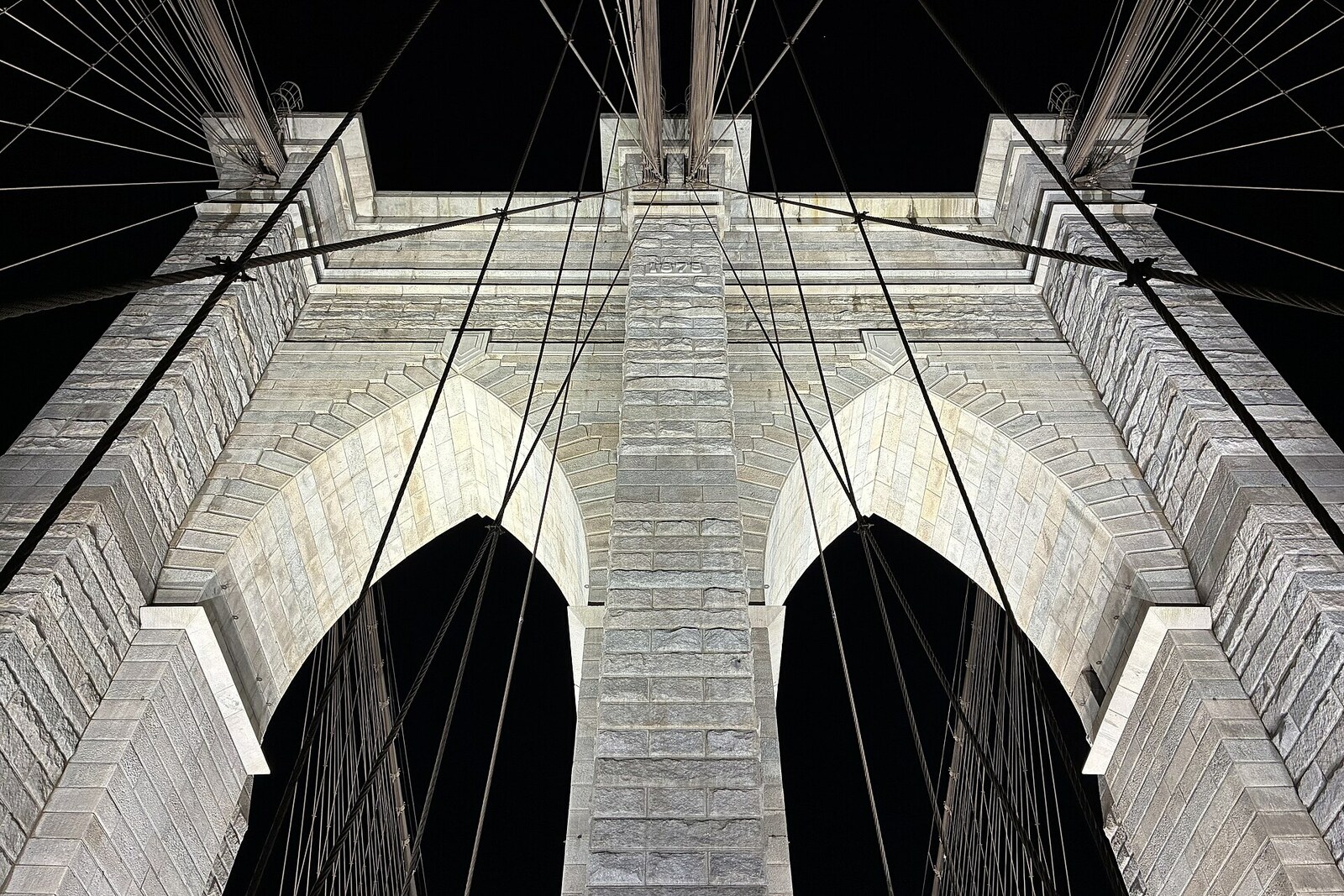
Look around first
What to notice
- Four main load-bearing cables
- Vertical suspenders
- Stone arches of the towers
- Bronze plaque with the Roeblings' names
The story of the place
The bridge was built as a permanent crossing between New York City and Brooklyn, when they were still two independent cities. The stone towers rise straight out of the river, and the pedestrian deck passes through their high arches. A bronze plaque bearing the names of the people whose work remains in the very structure of the bridge is mounted on the western side of the Brooklyn tower.
Four main load-bearing cables are slung across the tops of the stone towers. The span is supported from them by vertical suspenders, and the towers transfer its weight to the foundation. Each tower begins deep underwater, with a huge bottomless wooden box—a caisson—that the builders lowered through the riverbed soil.
The bridge was designed by the engineer John Roebling, who sought a permanent crossing between the two then-separate cities of New York City and Brooklyn. He died before the main construction began, and the position of chief engineer went to his thirty-two-year-old son, Washington Roebling. His father's drawings were only the beginning: Washington had to calculate for himself how to set two towers on the bottom of the East River.
Compressed air was pumped into the caisson's working chamber. It displaced the water, people removed the soil, and the stone masonry above lowered the entire structure under its own weight. Beneath the Brooklyn tower, solid bedrock was reached about fourteen meters below the high-water mark. On the Manhattan side, the caisson went down almost twenty-four meters, but iron probes showed that about nine more remained to the bedrock.
The deeper the chamber descended, the higher the pressure required. It is now known that returning to the surface too quickly causes nitrogen bubbles to form in the blood. At the time, people were only beginning to understand the cause. Over several months of eighteen seventy-two, the bridge company's doctor recorded one hundred ten cases of so-called caisson disease. Three men died.
After the third death, Washington Roebling stopped the descent of the Manhattan caisson. The bridge was his paid work, and the position of chief engineer was a continuation of the family trade; if the foundation had settled, he would have lost both the project and his professional reputation. Roebling studied the samples and decided that the densely packed sand and gravel would support the tower. On his orders, the working chamber was filled in and concrete was poured into it, leaving it about nine meters above bedrock. The Manhattan tower was built on that foundation.
Roebling himself also became seriously ill after descending into the caissons. From December eighteen seventy-two onward, he no longer appeared at the construction site and never fully recovered. From his home in Brooklyn Heights, he watched the work through a telescope. His wife, Emily Roebling, first wrote down his instructions, then learned cable-curvature calculations, the strength of materials, and the bridge's specifications. She conveyed her husband's decisions to the engineers, brought him questions from the construction site, and took on the work there. Before the opening in eighteen eighty-three, Emily became the first person to cross the completed bridge in a carriage.
A bronze plaque bearing the names of John, Washington, and Emily Roebling is mounted on the western side of the Brooklyn tower. Beneath the Manhattan tower, the concrete-filled wooden caisson still lies in place; its bottom rests on the sand where Washington Roebling ordered the descent to stop.
Useful on site
Open around the clock; the same promenade as at the entrance.
Checked: June 17, 2026. Check the official source before visiting.For a long look, choose a spot outside the main flow; up on the bridge, the wind and lack of shade are especially noticeable.