 Guide On Map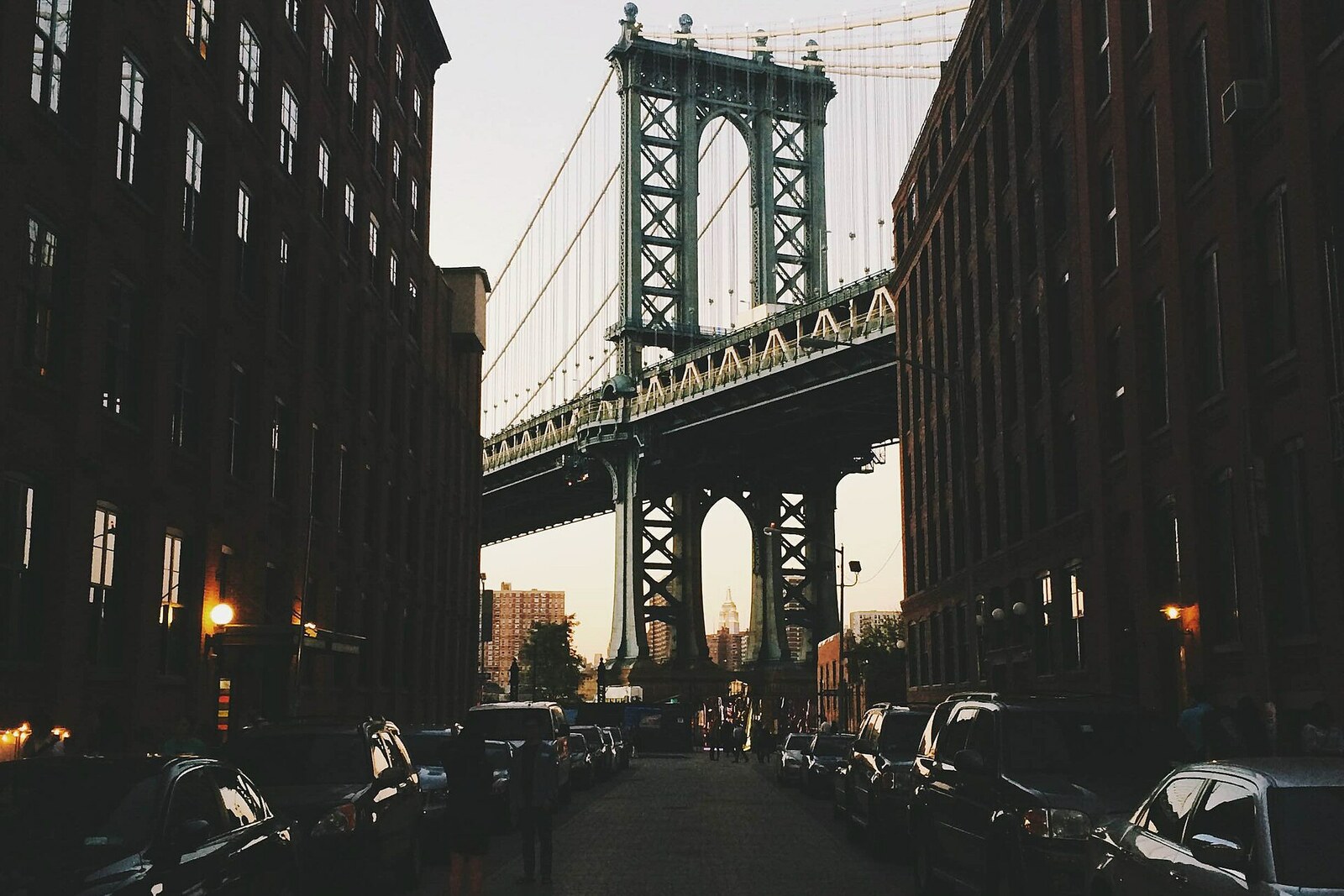
Look around first
What to notice
- The span of Manhattan Bridge
- Reinforced-concrete factory buildings
- Former loading openings
- Stone inscription bearing the company’s name
The story of the place
Washington Street is named after George Washington—the commander-in-chief of the Continental Army, who became the first president of the United States. The name DUMBO appeared much later and describes the neighborhood’s location beneath Manhattan Bridge. Today, people line up on this stretch of the street for a photo: the bridge span fits precisely between the former factory buildings.
These buildings appeared thanks to Robert Gair, the owner of a paper-packaging business. He made money from bags, printed labels, and folding boxes that a machine cut out and scored for folding at the same time. By eighteen eighty-eight, orders no longer fit in his Manhattan workshop. Gair moved the equipment across the recently opened Brooklyn Bridge and took over the corner of Washington Street and Water Street: nearby, his friend John Arbuckle roasted and packaged coffee, and the waterfront made it convenient to receive raw materials and ship finished boxes.
When Gair needed a new multistory factory, he planned to build it from brick and heavy wooden beams. His nephew James Beatty, who was responsible for finding suitable timber, went to the South and could not find trunks of the required size. But in Jacksonville, he saw buildings being rebuilt in reinforced concrete after a major fire. Beatty told George Gair, the manufacturer’s son, about it, and George convinced his father to change the material.
For a business filled with paper, inks, and heavy printing presses, the choice was both risky and entirely practical. Reinforced concrete promised to withstand fire, heavy loads, and the vibration of machinery, but New York City officials still would not agree to issue a permit for a tall factory made of that material. They required tests with fire, water, and loads. The project was prepared in nineteen oh four, but permission to build was granted only the following year.
Engineers from Henry C. Turner’s young firm proved that the structure would hold up. The completed building became the largest reinforced-concrete building in the country. Gair immediately ordered a second section of the same size to be added; by nineteen oh eight, the factory occupied the entire block. The commission gave Turner a reputation as a reinforced-concrete specialist, while Gair continued putting up such buildings on both sides of Washington Street. In nineteen thirteen, his business was the largest American producer of paper boxes and employed one thousand seven hundred two people. The neighborhood was then called Gairville.
In nineteen twenty, Robert Gair’s sons, George and Robert Gair Jr., took over the company. Seven years later, they moved production out of Brooklyn. The loading openings were later converted into entrances for stores and offices, the clock was removed from the facade, but the stone inscription bearing the company’s name remained.
In the early nineteen eighties, Sergio Leone filmed a boys’ gang passing through here for Once Upon a Time in America. Manhattan Bridge was in the background of the shot, while Gair’s buildings formed its side boundaries. The image was placed on the film’s poster. Now people pose in the same strip between the former factories; Robert Gair’s name still stands above one of the entrances.
Useful on site
The street is open around the clock; it is a public space without restrictions.
Checked: June 17, 2026. Check the official source before visiting.Take photos only from the safe pedestrian area and watch for street crossings; the block remains residential and working.