 Guide On Map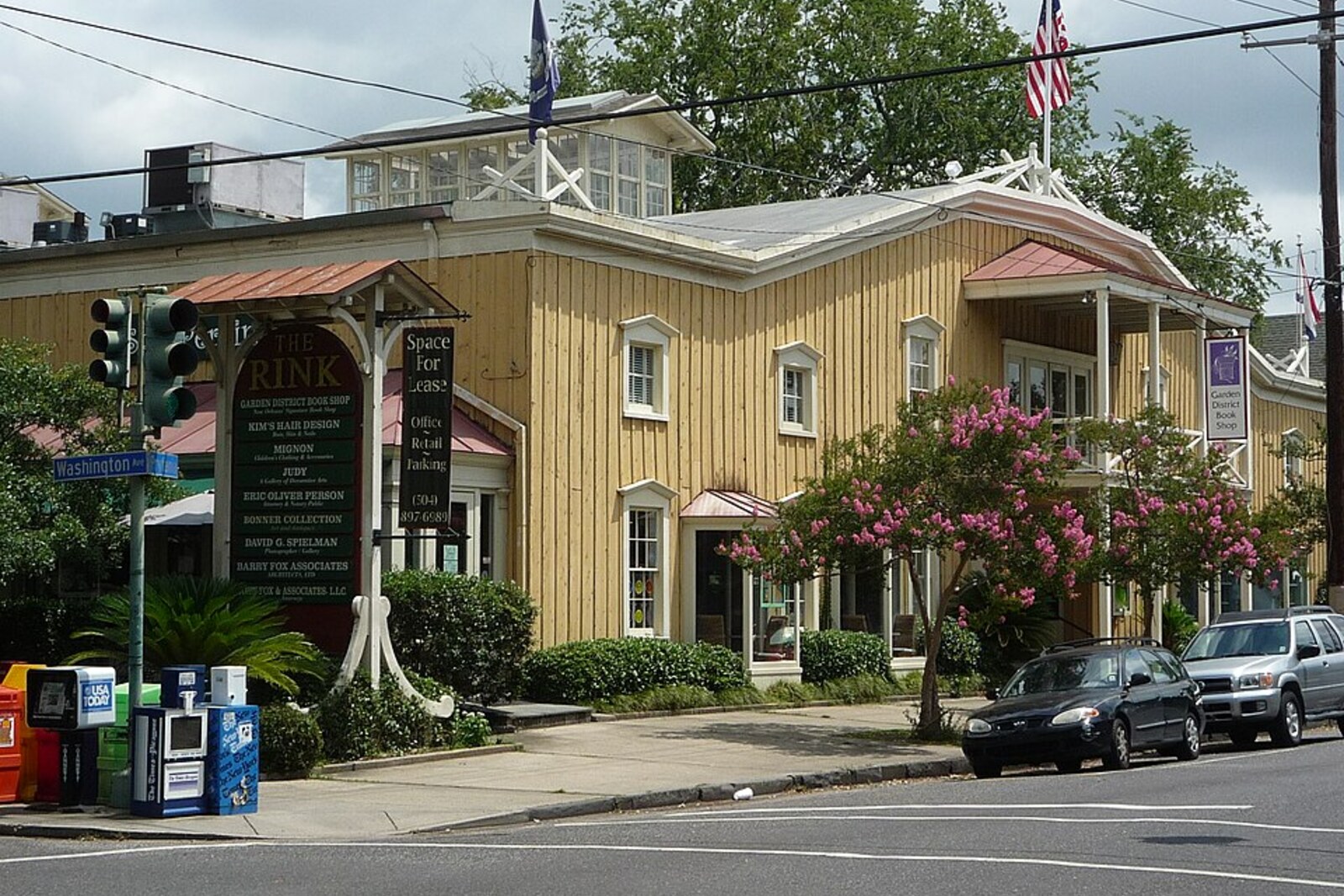
Look around first
What to notice
- Wooden trim
- Exposed rafters
- Intermediate floor
- Central passage
The story of the place
The exposed rafters beneath the roof and the wooden trim remain from the large roller skating hall. In late eighteen eighty-four, Clara Hagan built Crescent City Skating Rink here, hoping for visitors from the nearby World's Industrial and Cotton Centennial Exposition. Four-wheeled skates rolled across the dried maple floor, while spectators watched figure skaters, private parties, and carnival balls from tiers of seats. Later, these walls housed a stable, a laundry, and a grocery store; today, the central passage leads to a bookstore, a café, and small shops.
By nineteen seventy-eight, the building at the corner of Prytania Street and Washington Avenue was almost unrecognizable. Openings had been cut through its walls for gas pumps, and a shoe repair shop and part of a supermarket had been attached to its facades. Separate shops and a Texaco gas station fit under one roof.
The property was bought by real estate agents George Farnsworth Jr. and Martha Ann Samuel. They wanted to bring the cut-up structure back together as a single commercial complex. Architect Barry Fox had to find a way to preserve the huge old hall while also making the project profitable. Its appearance was restored from an advertising engraving from eighteen eighty-five.
It depicted Crescent City Skating Rink, the predecessor of today’s The Rink. The client, Clara Hagan, built it in late eighteen eighty-four, when New Orleans was hosting the World's Industrial and Cotton Centennial Exposition. Passenger trains stopped nearby, and Hagan counted on a stream of visitors. Her investment was meant to pay back through twenty-five-cent admission and membership fees.
Ira Daniels, a manager brought in from New York, received a hall with a ceiling about nine meters high and a large floor of dried maple. People skated here on four-wheeled roller skates; there was never any ice at The Rink. Several tiers of seats were installed for spectators, musicians were given a separate balcony, and anyone interested could take free lessons. The hall hosted performances by professional roller figure skaters, private parties, and carnival balls.
Hagan’s calculation worked for only a short time. The rink closed after just a few years. Afterward, the same volume housed a livery stable, a funeral business, a warehouse, a laundry, a barbershop, and a grocery store. Each new owner needed different doors, partitions, and driveways; by the seventies, the former hall had disappeared inside these alterations.
Farnsworth, Samuel, and Fox restored its overall form, but a historic facade alone was not enough: shoppers and tenants needed parking. Fox inserted an intermediate floor into the tall volume and accommodated forty-five cars below. In nineteen eighty, the partners received a federal tax benefit with accelerated depreciation. Lower taxes during the first five years helped pay for the renovation. Farnsworth then lived for many years in the complex he had created.
Today, a bookstore, a café, small shops, and offices operate upstairs; the central passage hosts author events and neighborhood gatherings. Fox had to replace the roof, but some of the wooden trim and exposed rafters remain from the roller skating rink. Above them, the name “The Rink” remains, and directly beneath them is the parking garage without which the real estate agents could not have restored the hall from the old engraving.
Useful on site
Public commercial building; hours depend on the particular shop or café.
Checked: June 28, 2026. Check the official source before visiting.Do not look for an ice rink: there has never been one here. The interior spaces may operate independently of one another.