 Guide On Map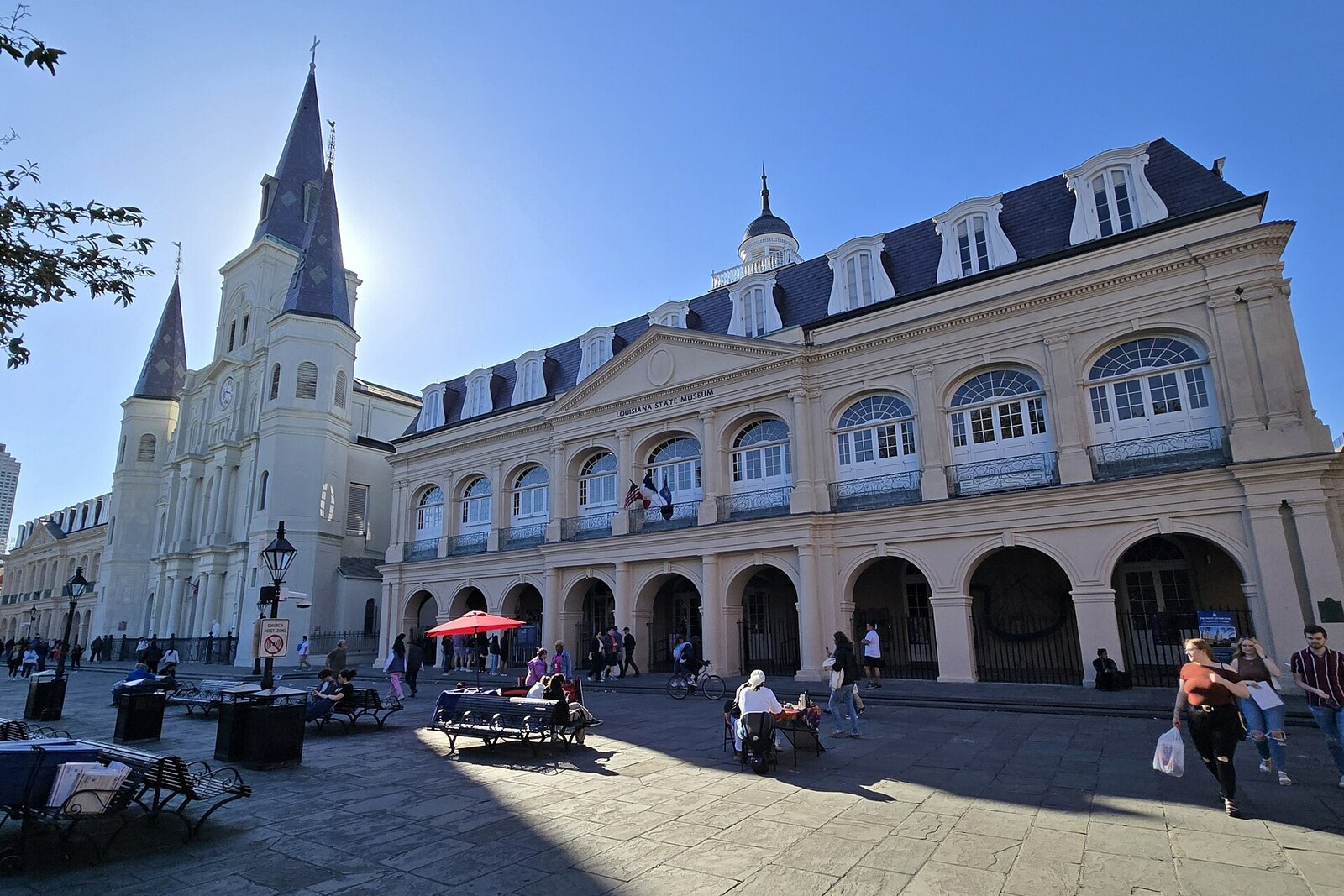
Look around first
What to notice
- Equestrian statue of Andrew Jackson
- Flagpole
- The Cabildo
- Cathedral
The story of the place
The Cabildo and the cathedral stand side by side, with a broad open parade ground left between them in front of the city administration. It was created for public city affairs, when the authorities and garrison had to assemble in full view of the whole city. A bronze horse now stands in the middle of the square; the square was given Andrew Jackson's name in eighteen fifty-one, and the statue was installed five years later. A flagpole has also been preserved beside it, so the former openness of the parade ground has not disappeared behind the monument.
In January eighteen eleven, a column of enslaved workers from sugar plantations moved along the Mississippi River toward New Orleans. They took weapons, freed people from neighboring estates, and drew others into following them. Sources have preserved no precise overall plan; the direction is known for certain—the city, where the barracks, arsenal, and port were located. For a person who belonged to a master along with the fruits of their labor, simply leaving the plantation already meant risking death.
The column never reached this square. Federal soldiers, planter militia, and volunteers came out to meet it. The rebel detachment was defeated, and the fugitives were hunted through swamps and plantations. Nearly one hundred people died in the battle or in the reprisals that followed. Slaveholding judges held three proceedings, one of them in New Orleans. Eleven defendants were sentenced to death here; three were publicly hanged at Place d'Armes. Along the levee to the city gates, the heads of those killed and executed were displayed on poles, so that those for whom the uprising had begun would see the outcome of the march.
The execution was assigned to this place because Place d'Armes had been created as an open parade ground in front of The Cabildo, the city administration building, and the cathedral. Soldiers formed up here, governors received oaths, and the condemned were displayed at the pillory with a plaque bearing their name and offense. For several years, a wooden gallows stood roughly in the center of the square. The sentence had to be carried out in view of the garrison and the townspeople.
The same arrangement was used when states changed hands. On November thirtieth, eighteen three, the French prefect Pierre-Clément de Laussat received Louisiana from Spanish officials. At The Cabildo, he was given the keys to the city's fortifications, and before the people gathered in the square, the Spanish flag was replaced with the French one. Laussat had been sent to restore French rule, but Napoleon had already sold Louisiana to the United States.
Laussat was the French ruler for twenty days. On December twentieth, he received the American commissioners William C. C. Claiborne and James Wilkinson in the same The Cabildo, handed them the city keys, and released the inhabitants from their oath to France. The French flag was lowered and the American one raised. Claiborne, appointed to govern the new territory, announced in English, French, and Spanish that the inhabitants now owed allegiance to the United States, and promised to preserve their property, faith, and civil rights.
Andrew Jackson's name appeared here later. In December eighteen fourteen, the general gathered local units on the old parade ground before the British army's advance. At one of the reviews, about six thousand men marched past him; his assistant Edward Livingston translated the general's speech into French because many of the city's defenders did not understand English. After the victory outside New Orleans, Jackson returned here: on January twenty-third, eighteen fifteen, he passed through a temporary triumphal arch to a thanksgiving service in the cathedral.
In eighteen fifty-one, the city authorities renamed Place d'Armes Jackson Square, and five years later placed an equestrian statue of the general in its center. The bronze horse now stands roughly where old accounts place the wooden gallows; beside it stands a flagpole in memory of the two flag changes over twenty days.
Useful on site
The park, cathedral, and museum buildings have their own access rules. Do not disturb worshippers during services; plan separate visits to The Cabildo and The Presbytère.