 Guide On Map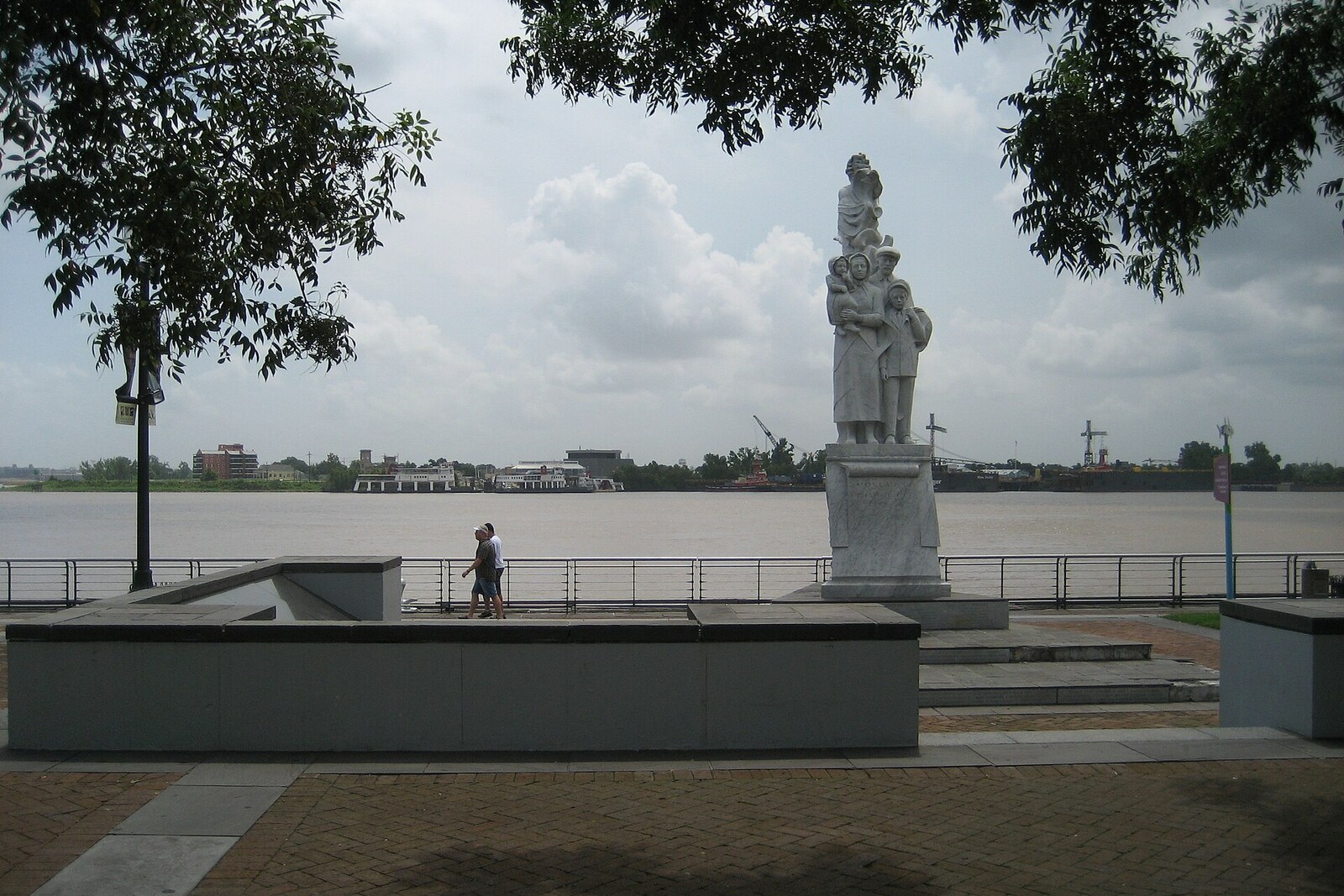
Look around first
What to notice
- Lawns above the pier foundations
- Brick path
- Bronze bench with two figures
- Mississippi River
The story of the place
The park’s name preserves the names of Dorothy and Malcolm Woldenberg: their foundation invested five million dollars in the new city riverfront. A brick path leads from the aquarium to Jackson Square, and the lawns stretch along the Mississippi River. Concerts and festivals take place here during city celebrations; Woldenberg and a boy sit beside each other on a bronze bench.
The lawns of Woldenberg Riverfront Park lie where port warehouses stood until recently. Part of the land beneath them is light fill laid over the concrete foundations of former piers. In the nineteenth century, trading companies occupied this shoreline with warehouses, sugar warehouses, and railroad tracks. The Mississippi River sustained New Orleans, but residents of the old city could scarcely get to it.
In nineteen eighty-six, City Council member James Singleton, who was seeking a new family space by the river, and representatives of the Audubon Commission proposed building a large aquarium at the beginning of Canal Street and laying out a park along the water. Preservationists and some French Quarter residents demanded that the project be moved upstream, onto former railroad land: they feared that the aquarium would bring even more visitors into the old quarter. Two attempts to stop construction through the courts failed.
First, the city’s residents had to be persuaded to pay for the plan. A special tax backing twenty-five-million-dollar bonds was put to a referendum. Seventy-one percent of voters agreed. Then the city, the port, the exposition authority, and the Audubon Commission exchanged parcels of land to free up this very stretch of shoreline. In the autumn of nineteen eighty-seven, builders dismantled three French Quarter piers.
The park itself cost six and a half million dollars. Five million came from the charitable foundation of Dorothy and Malcolm Woldenberg—hence the name on the map. Malcolm Woldenberg made his money in the wholesale trade of beer, wine, and spirits: in nineteen forty-four, he and Stephen Goldring founded the Magnolia company in New Orleans. After Woldenberg’s death, Goldring headed the foundation left by his partner and directed its money toward the new riverfront park.
Woldenberg died in nineteen eighty-two and did not see what came of his foundation’s donation. Construction began six years after his death. In the autumn of nineteen eighty-nine, people first stepped onto the finished riverfront, and a year later the aquarium opened beside it. A brick path connected the aquarium to the promenade section by Jackson Square; the former port area became a venue for city festivals, the Zulu celebration on the eve of Mardi Gras, and concerts of the French Quarter Festival.
In the park, Woldenberg sits on a bronze bench beside a boy. The real Woldenberg died seven years before the opening. Beneath the feet of his sculpture, the concrete of the warehouse piers remains, while above it grows a lawn paid for with money from the trade in spirits.
Useful on site
Audubon listed 06:00-22:00 Sun-Thu and 06:00-00:00 Fri-Sat as of 2026-06-25; check for events and temporary restrictions.
Checked: June 25, 2026. Check the official source before visiting.Stay on open paths and behind barriers; do not enter service areas or tracks. Wind, heat, and water level can noticeably change conditions by the river.