 Guide On Map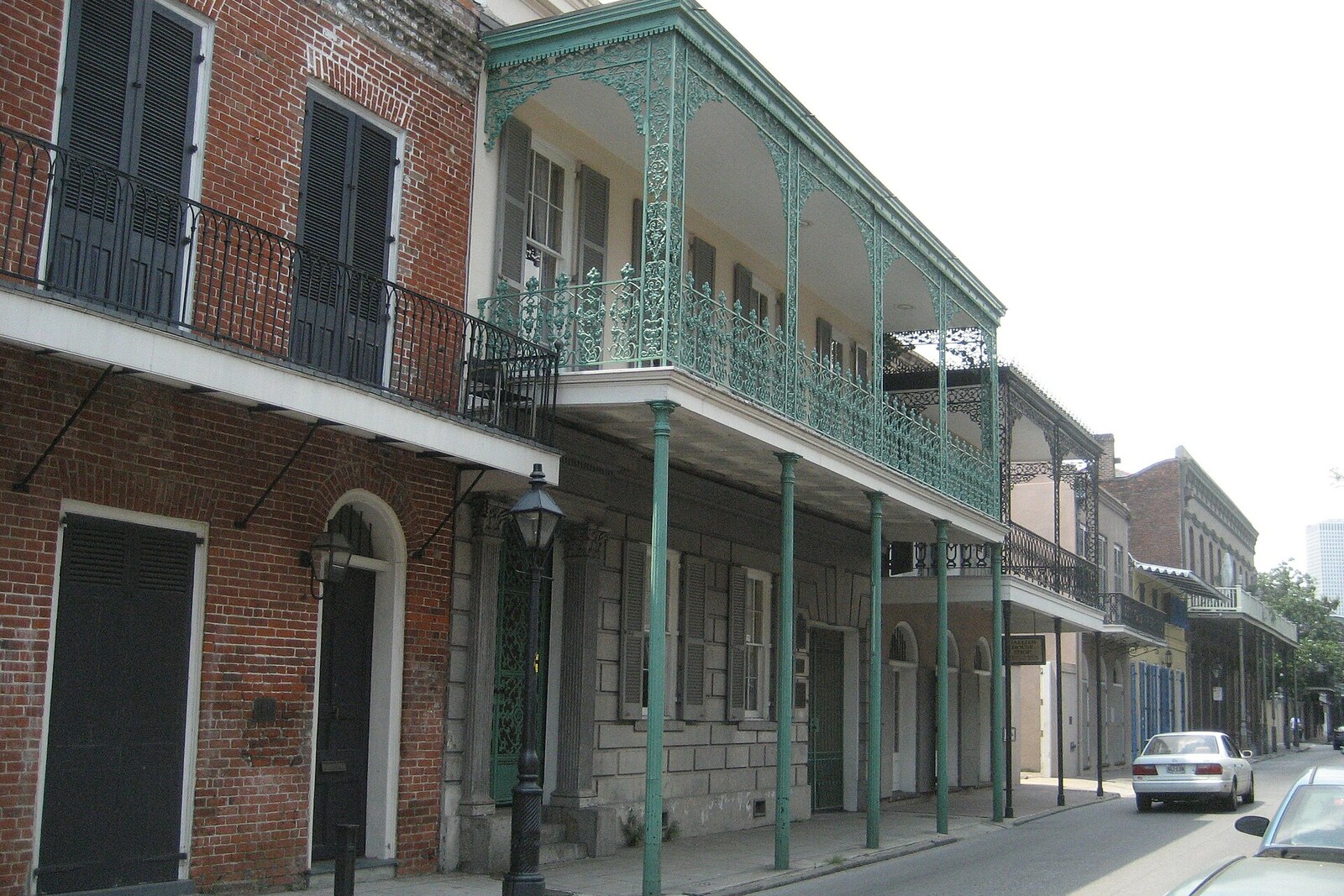
Look around first
What to notice
- Plastered corner facade
- Iron balconies
- Number 1140
The story of the place
This plastered corner house with iron platforms stands on lot number eleven forty. The present walls were erected only after the former house on this site had disappeared, so the old address outlived the building itself. The iron platforms on the quarter's facades are often called balconies, but a gallery is built differently: it runs above the sidewalk, is roofed, and stands on columns. On narrow streets, it served the upper floors as a veranda, while shops could fit beneath it.
The name Royal Street appeared before most of its houses. In seventeen twenty-four, under the French king Louis XV, the city's main street was named Rue Royale—Royal Street—in honor of the family ruling in France. Under the Spanish, it became Calle Real, with the same meaning; the modern name translates the original one.
The iron platforms on the facades here are often indiscriminately called balconies. A balcony projects from the wall and needs no supports at the sidewalk. A gallery is wider, roofed, and supported by columns along its outer edge. If an iron platform covers almost the whole sidewalk, what is above your head is a gallery. On the narrow streets of the old city, it served residents of the upper floors as a veranda, while leaving space below for shops.
At the corner of Royal Street and Governor Nicholls Street, then called Hospital Street, stands a plastered mansion with iron balconies. It is known as LaLaurie House, and stories are told of ghosts living inside. The documented history is more terrible than the legends, but it took place in a different building.
Delphine LaLaurie, a wealthy property owner and enslaver, bought an unfinished house here in eighteen thirty-one. On the morning of April tenth, eighteen thirty-four, a fire began in the kitchen. Rescuers found a seventy-year-old enslaved cook chained by her ankle to the stove. Newspaper reports did not preserve her name. According to a confession recorded at the time, she started the fire herself: the woman feared that she would be taken to an upper room from which other enslaved people did not return. She risked burning along with the house, but the fire forced outsiders to enter.
Jean-François Canonge, a criminal-court judge, sought access to the locked rooms in order to bring out the people who remained there. LaLaurie and her husband refused to hand over the keys. Canonge and other townspeople broke down the doors and found seven emaciated people in chains, with severe signs of torture. They were taken to The Cabildo. Crowds came there to see for themselves what had happened; reliable records do not trace the later fate of those rescued.
Delphine LaLaurie, meanwhile, left the city in a carriage. By way of Mobile and New York, she reached France, settled in Paris, and died there in eighteen forty-nine. She never stood trial in New Orleans. Enraged townspeople wrecked the abandoned house, and for several years empty walls remained on the busy street.
The present building was erected around eighteen thirty-eight by Pierre Trastour for its new owner, Charles Caffin. As early as eighteen eighty-five, a guidebook called it the “Haunted House on Royal Street”; later, stories of ghosts and increasingly fantastical tortures became attached to the name. These details belong to legend. At Royal Street, number eleven forty, the corner and the lot number remain; the house where seven people were rescued has not survived to the present day.
Useful on site
All the main details are visible from the public sidewalk. Most houses are private: do not enter courtyards or entryways, and do not linger in front of residents' entrances.