 Guide On Map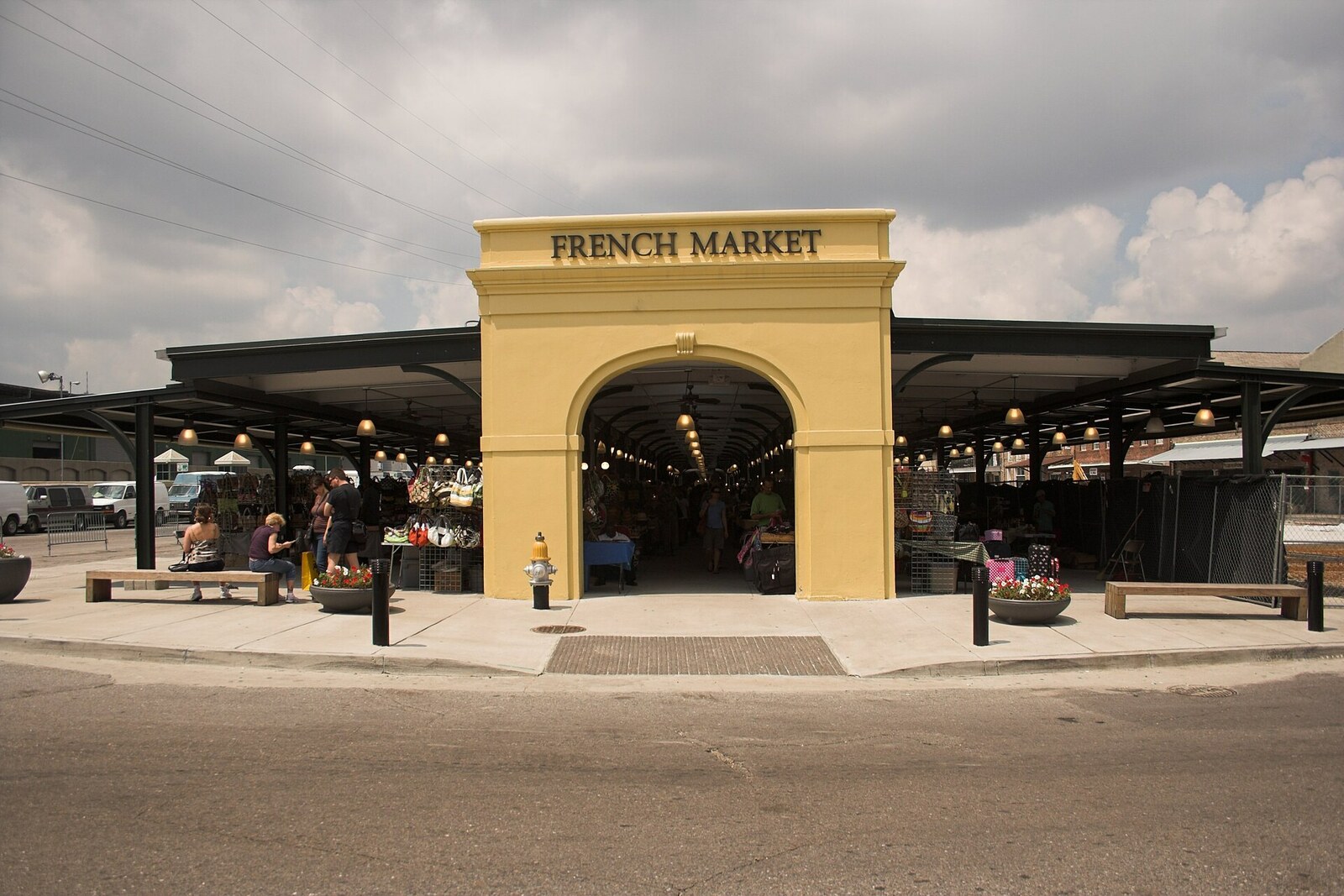
Look around first
What to notice
- The arch bearing the words “French Market”
- Steel canopies
- Brick buildings along Decatur Street
The story of the place
The steel roof beyond the arch continues along the river side of French Market Place: it is part of a large market row. Farmers and vendors at the daily flea market now sell here, while the old brick buildings survive farther along Decatur Street, toward Jackson Square. On this site, Spanish authorities built the city's first permanent market building in the late eighteenth century. Later, trade spread to the fish rows, the Red Stores, and several wholesale sites.
In August nineteen thirty-two, entrepreneurs from the market district established the French Market Corporation. They sought a city concession—the right to manage the municipal market and collect fees for vending spaces. Their income depended on the shoppers the market brought here, while the old buildings already needed more money than individual shopkeepers had.
At that time, there was no neat row of identical pavilions beyond the arch. After the hurricane of nineteen fifteen, damaged structures were all that remained of the bazaar. Nearby stood the Red Stores, fish rows, and wholesalers selling fruit and vegetables in several different places. The city proposed giving this entire cluster to a single operator, on the condition that it put it in order. Two years later, the entrepreneurs received the concession.
They decided to rebuild the market thoroughly. The money was raised by the corporation itself, neighboring merchants, the city, the Orleans Levee Board, and the federal Public Works Administration, which funded construction during the Great Depression. In nineteen thirty-six, contractors dismantled the remains of the bazaar and the Red Stores. On the river side of Gallatin Street, now French Market Place, they demolished the former buildings and erected long steel canopies. They brought wholesale fruit and vegetable trade together beneath them, while adapting the old premises to new sanitary requirements and refrigeration equipment.
The renewed market was ceremonially opened on March nineteenth, nineteen thirty-eight. Yet the nine directors now had to answer not only for their own stalls: the bills for the entire complex fell on them. The income was not enough. The following year, the city paid off the corporation's debts and became its sole owner, after which it leased the market back to the same organization for management. The merchants kept their jobs, but their independent experiment in management ended with city financial oversight.
The name French Market did not arise because this version of the market was built by the French. The first permanent market building on this site was erected by the Spanish administration in the late eighteenth century. Later, English-speaking residents of the new neighborhoods called the old city “French” or “Creole,” without distinguishing the origins of every merchant and every building. People of French, African, Spanish, Caribbean, German, and Sicilian descent worked behind the counters, and the general nickname became attached to the market.
The arch on Ursulines Avenue marks the entrance specifically to the pavilions that grew out of the reconstruction of the nineteen thirties. Beneath them, the food-selling farmers section and the flea market with daily vendors are now separate. The oldest surviving brick buildings stand farther along Decatur Street, closer to Jackson Square. One old name remains above the opening, and beyond it are the steel canopies for which the entrepreneurs took the market under management and, just one year after the opening, handed its debts over to the city.
Useful on site
French Market Corporation listed retail hours of 10:00-17:00 and farmers market and flea market hours of 10:00-18:00 as of 2026-06-25; check current hours.
Checked: June 25, 2026. Check the official source before visiting.View the arch from the street; no separate entrance is required. Choose a spot away from the passageway and the flow of shoppers.