 Guide On Map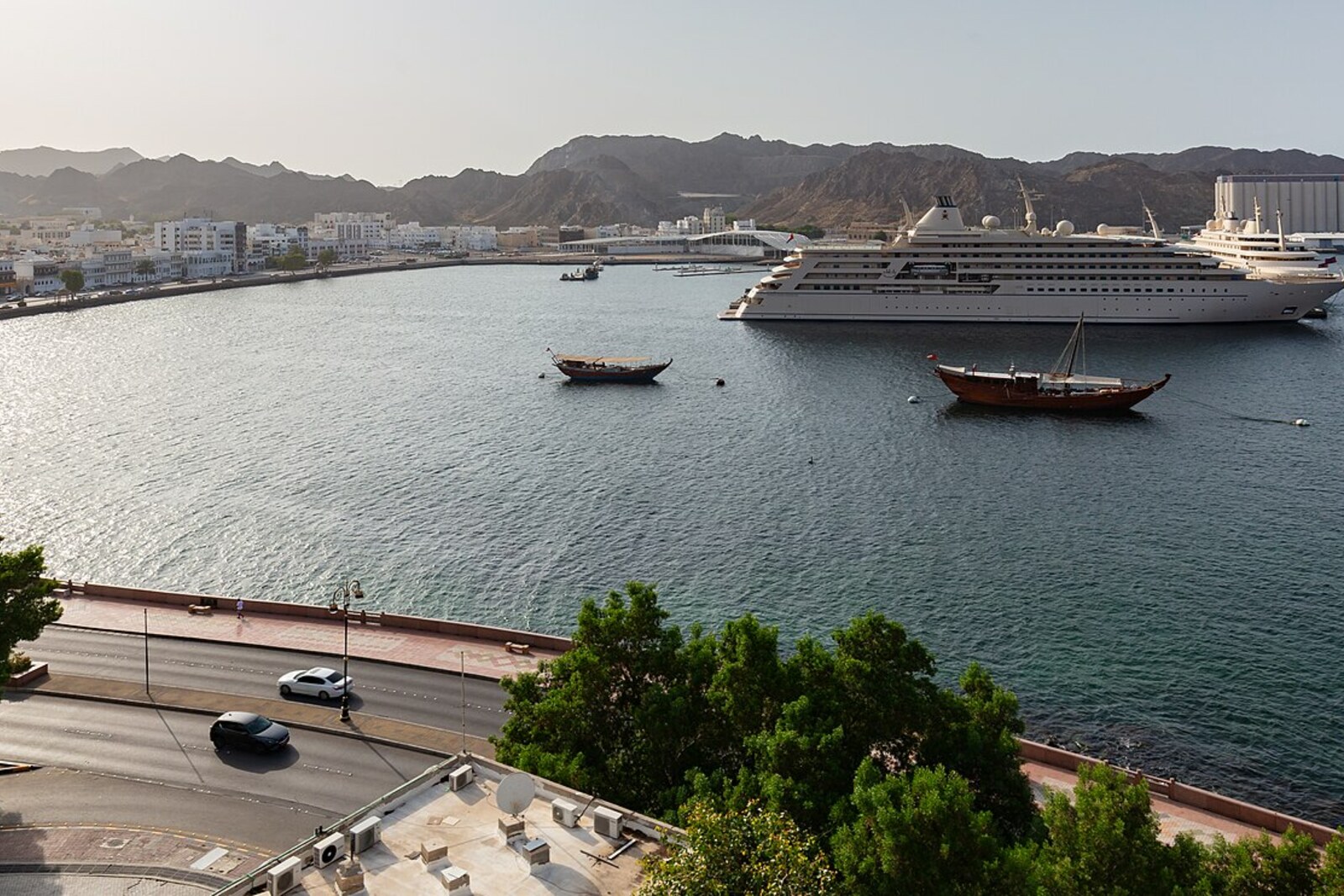
Look around first
What to notice
- Deep-water berths
- Stone breakwater
- Storage yard
- Cruise ships
The story of the place
The Mutrah Corniche runs along a strip that was once the beach in front of Mutrah. To create a deep-water harbor here, builders blasted the cliffs at the edge of the bay, built up a storage yard from millions of tons of stone, and extended a seven-hundred-meter breakwater out to sea. Behind it stand the thirteen berths of Port Sultan Qaboos: Sohar now handles most commercial cargoes, while cruise ships more often call here.
In April nineteen twenty-six, the trade representative Charles Wills proposed moving the steamships of the British India Steam Navigation Company here. They called at neighboring Muscat, then the country’s seaport, although the largest merchants lived in Mutrah. Wills hoped to spare them the extra transshipment of goods and expand exports from Oman.
The British political agent Cyril Johnson Barrett, acting as consul, surveyed Mutrah merchants. All considered this bay more convenient than Muscat, but with one condition: the customs wharf had to be enlarged. Mutrah was better sheltered from seasonal winds, and the gorges behind the town led directly to roads into the interior. Caravans came here; the surrounding cliffs cut Muscat off from these routes.
Yet a steamship port is determined by more than a bay alone. The Mutrah quay was so small that goods delivered on a single voyage from Bombay and Karachi could not be unloaded and stored there at the same time. Most of the merchants surveyed, although they were the ones paying for the repeated transport of cargo from Muscat, asked for nothing to be changed for the time being.
Bertram Thomas, the sultan’s financial adviser responsible for the nearly empty treasury, opposed the project. A new quay required major expenditure. The treasury and other institutions would then have to be moved to Mutrah. Thomas calculated that merchants would save on transshipment, but the overall volume of trade would not grow, while Muscat would lose its port revenues for good. The sultan also objected. Wills’s proposal was postponed, the steamships continued to call at Muscat, and goods for Mutrah shops still covered the extra leg of the journey.
They were able to return to the same task almost half a century later, when oil revenues made it possible to pay for a deep-water harbor. Builders blasted away part of the cliffs at the northwestern edge of the bay, laid millions of tons of stone as the foundation for a storage yard, and extended a seven-hundred-meter breakwater out to sea. In November nineteen seventy-four, Port Sultan Qaboos opened with thirteen berths. At the same time, the former beach in front of the town was turned into the Mutrah Corniche, and the waterfront houses faced the cargo harbor.
Today, Sohar handles the main commercial cargoes, while the Mutrah berths serve chiefly cruise ships. On the northern side of the bay, thirteen deep-water berths remain—where in nineteen twenty-six the treasury lacked the money even to enlarge a single customs pier.
Useful on site
The Mutrah Corniche is accessible as a public promenade. The port area is restricted; the route can be viewed only from outside.
Checked: June 24, 2026. Check the official source before visiting.Observe from the public promenade, and do not enter the port gates or service driveways.