 Guide On Map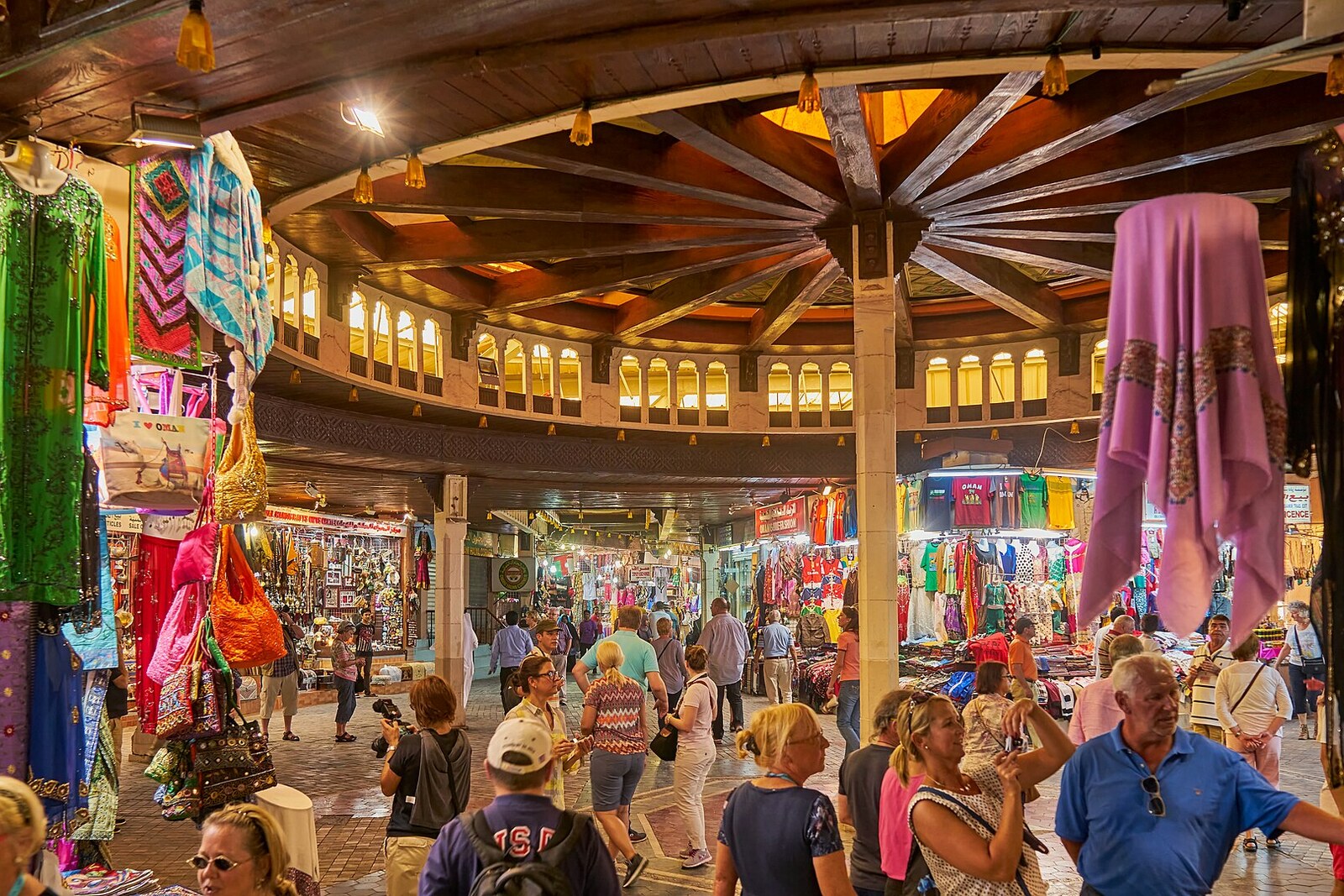
Look around first
What to notice
- Arch on the waterfront side
- Covered passage
- Wooden ceiling
- Shops on both sides
The story of the place
The oldest part of Mutrah Souq grew out of rooms where trading families kept goods by the wall of the Sur al-Lawatiya quarter, beside the small bay of Khawr Bimbah. Later, doors were cut into these walls, and the former storerooms became shops facing narrow outer corridors. They were covered with palm leaves, and farther in the light almost disappeared, which is how the market acquired its local name. Today, the former narrowness is revealed by the wooden ceiling and the counters set on both sides of the passage, although the market was modernized in the nineteen seventies.
The present-day arch on the waterfront marks the sea entrance to the Mutrah market. From here, a covered passage leads deep into the quarters and branches toward exits into the old town. Goods from the pier passed through this threshold; from the opposite side, residents of Oman's interior regions approached the market.
In nineteen sixty-three, there was no way to lock the entire market. The documents state plainly: there were no gates here that could be opened in the morning and closed in the evening. Behind the open passages were shops and storerooms containing grain, textiles, and consignments of goods brought by sea. For a merchant, these were invested money and future earnings.
The major merchants agreed to entrust the guard to Khalid bin Abdullah Al-Khanjari, the commander of the market guard, who was to block every entrance that could not be locked with men. The rules were approved by Ismail Al-Rasasi, the governor of Mutrah at the time. Khalid recruited twenty guards. They began their shifts one hour before sunset and remained until one hour after sunrise; the merchants themselves raised the funds to pay the guards. Five years later, the merchants made a new contract with Harib bin Sulaiman Al-Khanjari. The night guard became a permanent service for the entire market.
The name “market of darkness” arose from a different arrangement of the same passages. It referred to the oldest section between the wall of the Sur al-Lawatiya quarter and the small trading bay of Khawr Bimbah. At first, trading families used the rooms by the wall as storerooms. Then they cut separate doors into them, turned the rooms into shops, and opened them onto the outer corridors. The corridors were covered with palm leaves, and the shops were set opposite one another. Before electricity appeared, sunlight barely reached the middle of the passage; on cloudy days, shoppers needed lamps. Hence the local name Al Dhalam Souq—“market of darkness.”
The main part of the market was rebuilt in the nineteen seventies. The palm-leaf roof over the entrance is gone; electric lamps and a modern wooden ceiling have appeared. The very line of the old arrangement remains: a sea opening, immediately behind it a narrow covered corridor, and shops on both sides.
Useful on site
The passage is open; shops usually operate in the morning and evening, and many close in the middle of the day. Friday, holidays, and the season change the schedule.
Checked: June 24, 2026. Check the official source before visiting.Do not block the entrance, and keep in mind that some shops may close for a daytime break.