 Guide On Map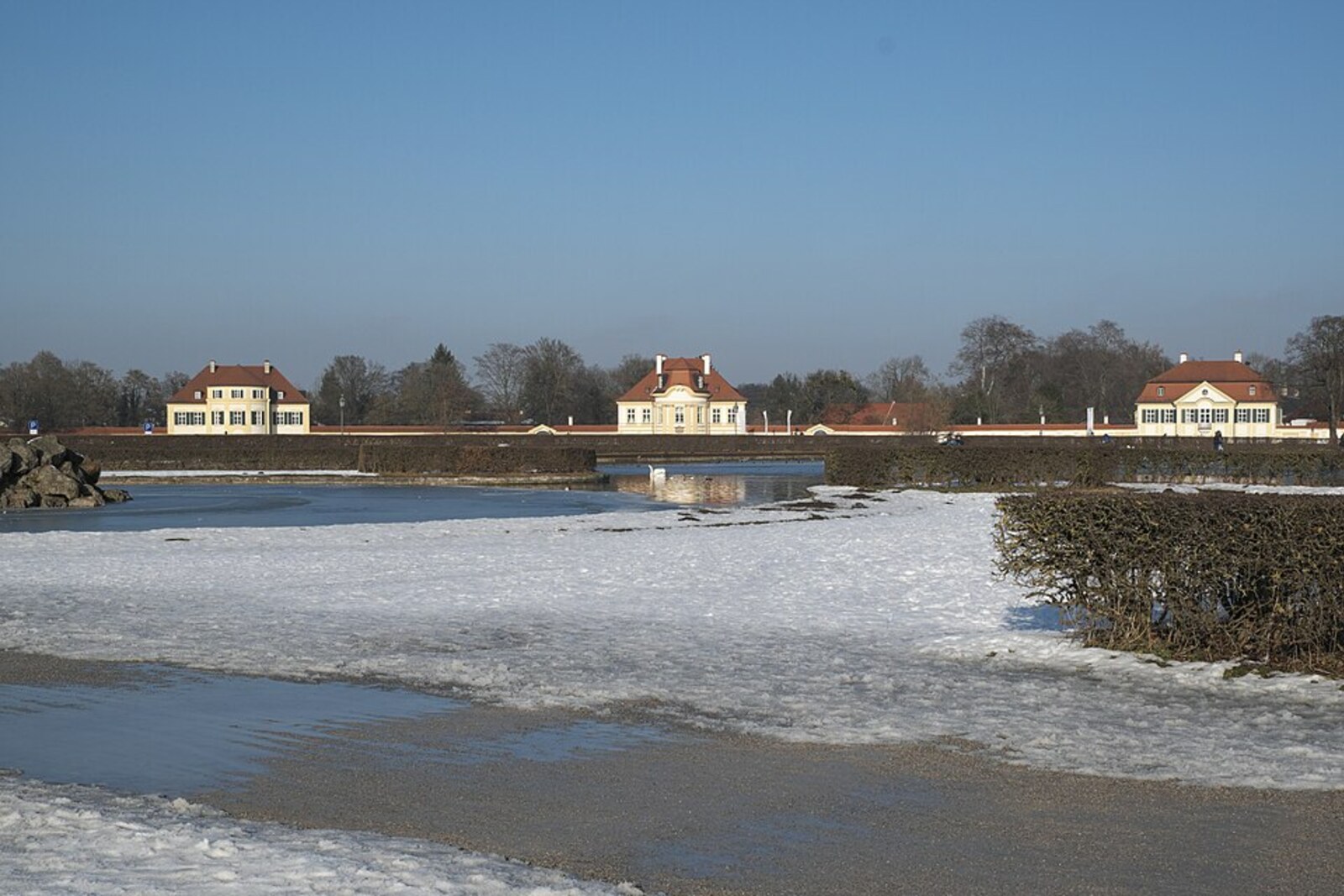
Look around first
What to notice
- Ten pavilions
- Low connecting walls
- Northern façades of the rondell
- Water canal
The story of the place
In the northern arc of the semicircle, work continues behind the even façades of the Nymphenburg Porcelain Manufactory. Separate buildings were prepared for it near the palace, and the canal’s water powered machines that crushed quartz and feldspar for porcelain paste. When artistic porcelain fell into decline, the same workshops produced laboratory vessels, insulators, and hotel mugs. Now the canal still turns the drums and mixers through a small turbine, and the paste is prepared in them.
The semicircle in front of the palace is formed by ten pavilions connected by a low wall. Charles Albert assigned them the role of the first district of Karlstadt. The city never appeared, but the rondell housed services without which the country residence could not manage: an inn, a tavern, a mill, and utility rooms. Porcelain has been made in its northern part for more than two and a half centuries.
Charles Albert’s son, Elector Maximilian III Joseph, hoped to establish his own production of an expensive commodity and improve Bavarian finances. In seventeen forty-seven, he opened a porcelain workshop at Neudeck Castle in Au, a suburb of Munich. The first experiments consumed money, but the craftsmen had not mastered consistently producing quality porcelain. The Elector stopped funding it.
The manufactory was saved by Count Sigmund von Haimhausen, head of the minting and mining department, who sought to establish Bavaria’s own porcelain production. He invested almost ten thousand gulden of his own money in the experiments and hired Joseph Jakob Ringler, a specialist in the composition and firing of porcelain paste. In seventeen fifty-four, Ringler achieved controlled production of genuine hard-paste porcelain. The Elector became interested in the enterprise again, court orders appeared, and the workshop began to grow.
It became too cramped at Neudeck. In seventeen sixty-one, Maximilian III Joseph ordered production moved to specially prepared buildings in the northern part of the rondell. The main customers—the court and the Elector—were nearby, and the water of the Würm Canal could power mills that crushed quartz and feldspar. Haimhausen directed the manufactory until his death in seventeen ninety-three; during that time, Nymphenburg porcelain began to be sent far beyond Bavaria, as far as Venice.
By the middle of the nineteenth century, artistic production had fallen into decline. It was halted, and the workshops switched to laboratory vessels, insulators, sanitary ware, and sturdy mugs for hotels. The old models had been poorly preserved, and some paste and glaze compositions would have had to be recreated from scratch.
In eighteen eighty-eight, the merchant Albert Bäuml leased the manufactory, intending to restore its artistic porcelain. He invested money in equipment, invited craftsmen, and searched for old Nymphenburg pieces in museums, private collections, and from antique dealers. The cups, dishes, and figurines he bought served as models for recreating lost forms. The collection he assembled became the basis of today’s Museum of Nymphenburg Porcelain, and craftsmen still use the archive of models created through this search.
Bäuml directed production here until his death in nineteen twenty-nine; then his three sons continued the business. The manufactory still operates behind the northern façades of the rondell. Water from the same canal still turns milling drums and mixers through a small turbine, and porcelain paste is prepared in them.
Useful on site
The rondell can be viewed from outside free of charge. There is no separate visitor exhibition in the little buildings; some of the buildings are used for official purposes or privately, so do not plan to enter.
Checked: June 29, 2026. Check the official source before visiting.Do not hurry straight to the central entrance: walk along part of the arc and watch how the panorama changes. It is best to read the residential and service buildings as a single ensemble, without entering the closed courtyards.