 Guide On Map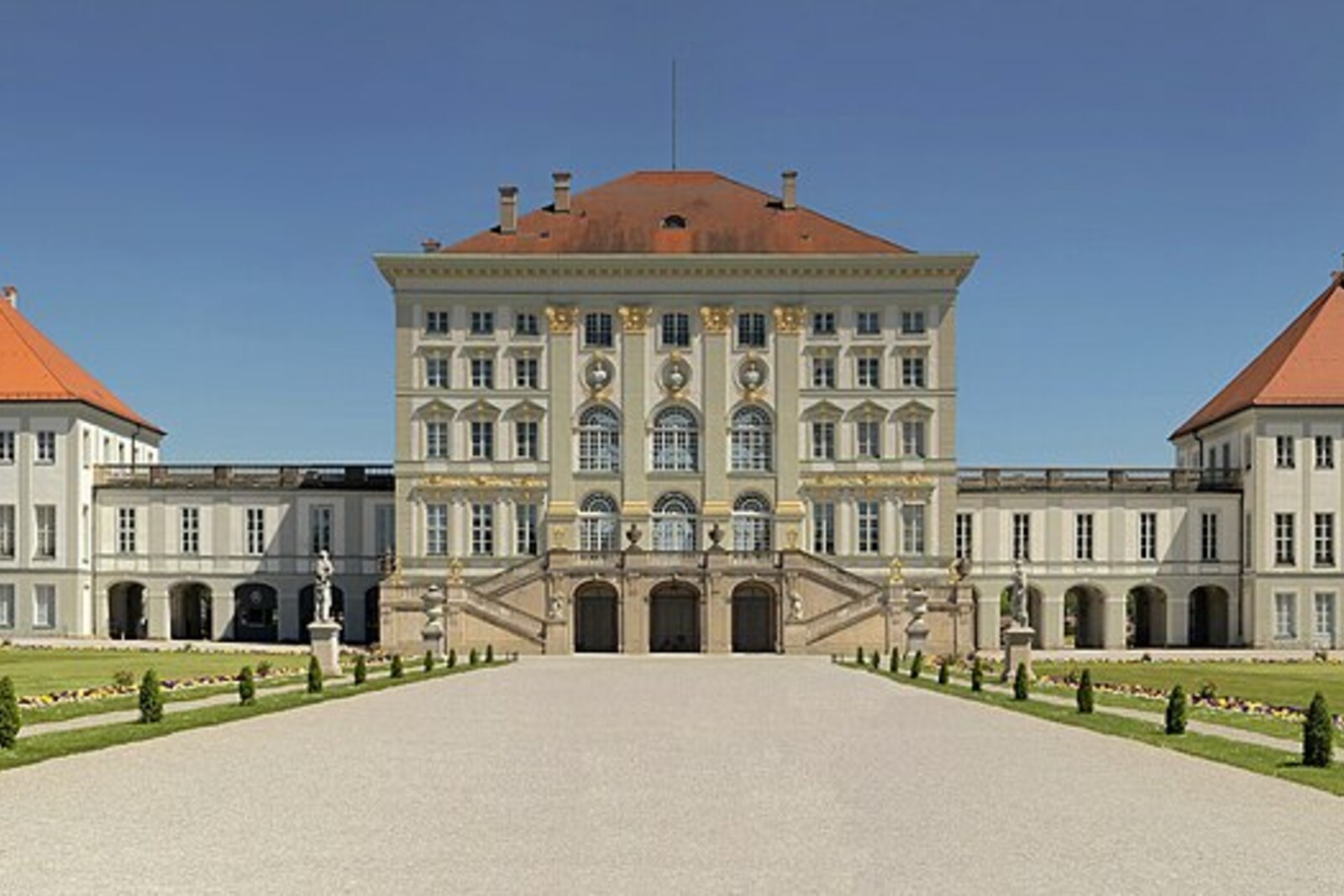
Look around first
What to notice
- Central pavilion
- Connecting galleries
- Side wings
- Long stepped façade
The story of the place
The long façade was assembled around a small country house where the Electress's family and part of the court came in summer. Its core was a tall central pavilion, with a formal garden and service buildings beside it. Connecting galleries, residential pavilions, and side wings were added later, so the old summer house is now concealed within a grand palace composition.
This palace arose from anxiety over who would inherit Bavaria. Henriette Adelaide of Savoy was fourteen when she was married to the Bavarian Elector Ferdinand Maria. The marriage linked two ruling families, and the young Electress's position at a foreign court depended on the continuation of the dynasty.
Eight years later, their daughter Maria Anna was born. She was a welcome child for the family, but the court continued to await a son and heir. Henriette Adelaide underwent treatment at the springs in Bad Heilbrunn and made a vow to Saint Cajetan: if a boy was born, a church dedicated to the saint would be built in Munich. She sought help from doctors and from a heavenly patron at the same time.
On July eleventh, sixteen sixty-two, Henriette gave birth to Max Emanuel, the future Elector. The couple fulfilled the vow and began building the Theatine Church. Ferdinand Maria prepared another gift for his wife: he bought the Kemnat estate west of Munich and gave it to Henriette. At the time, it took about two hours to get here across open fields.
Henriette commissioned a country palace here, modeled on villas she had known since childhood in the surroundings of Turin. In summer, the Elector's family and part of the court could come here. The first palace occupied what is now the central block: a tall cubic pavilion, with a small geometric garden and service buildings beside it.
The name “Nymphenburg” means “Castle of the Nymphs.” Documents do not make it possible to establish exactly who coined it. Perhaps Henriette herself; perhaps her mother, Christine of France, whom her daughter asked to choose a name for the new residence. By sixteen seventy-five, the name had already appeared in correspondence. The nymphs referred to the nature of a country retreat, not to members of the Bavarian family.
In sixteen seventy-nine, Max Emanuel inherited the throne. Beginning in seventeen oh one, he started enlarging the small residence given to his mother for his birth: he ordered the central block to be linked by galleries to new residential pavilions. Later generations continued the construction, and Henriette's summer house ended up in the middle of a long palace façade.
The central pavilion facing the courtyard is her Nymphenburg. The galleries and the stepped side wings appeared on the orders of her son, for whose birth Ferdinand Maria had once bought the estate here.
Useful on site
The palace is open daily from 1 April to 15 October, 9:00–18:00, and daily from 16 October to 31 March, 10:00–16:00. Last entry and ticket sales are 30 minutes before closing. Closed on 1 January, Shrove Tuesday, and 24, 25, and 31 December. The Lacquer Cabinet is closed for restoration until autumn 2026; the other state rooms are listed as open.
Checked: June 29, 2026. Check the official source before visiting.From outside, the palace's growth from a small core into a long ensemble is easy to see. The Great Hall, royal apartments, and portrait gallery are accessible only when visiting the interiors; check in advance which rooms are open.