 Guide On Map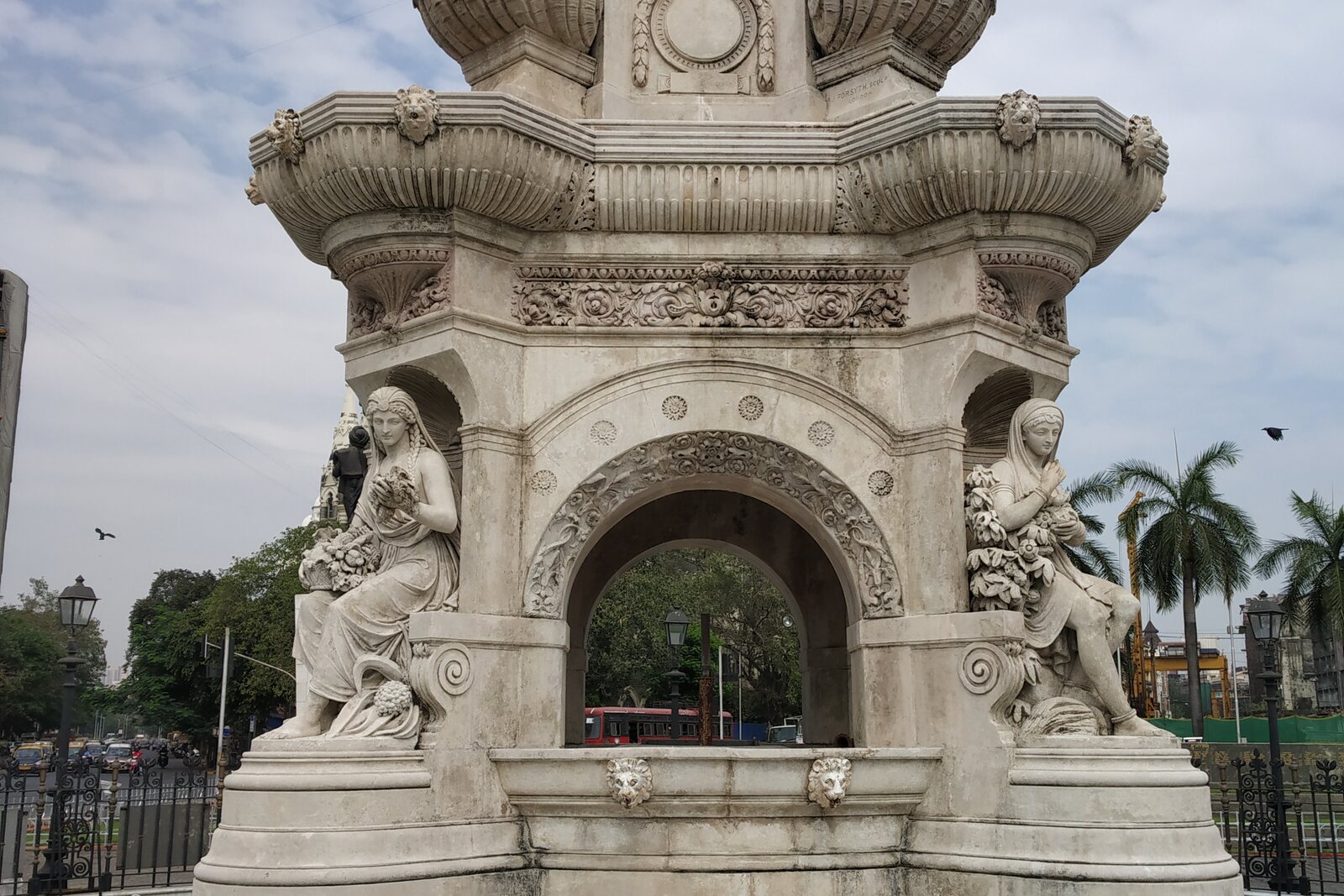
Look around first
What to notice
- The figure of Flora
- Lion heads
- Plaque with Kershetji Parekh's name
- Monument with two figures and a torch
The story of the place
Several streets converge here in memory of old Bombay Fort: the road to St. Thomas' Cathedral once ran through the only Church Gate. The site was occupied by a wall and a moat, and later a business intersection rose in their place. Amid the stream of cars stands an ornate stone fountain with lion heads, fish, and female figures; at its top, the statue of the Roman goddess of spring is visible.
This intersection has two names and two monuments. In Marathi, “Hutatma” means “one who fell for a common cause.” The square was given this name in memory of participants in the Samyukta Maharashtra movement: they sought the creation of a separate Marathi-speaking state with Bombay as its capital and died during this campaign in the mid-nineteen fifties. Their monument, with two figures and a raised torch, stands nearby. The stone fountain has kept another name—Flora.
Until eighteen sixty-two, this site was occupied by a fort moat, a wall, and Church Gate—the Church Gate of old Bombay Fort. Bombay is present-day Mumbai. The road to St. Thomas' Cathedral ran through this gate. That is why streets still converge here: the intersection inherited routes that once passed through the only opening in the wall.
Bartle Frere, the colonial governor of Bombay, pressed for the expansion and sanitary redevelopment of the cramped city. The old fortifications no longer protected the port, the high wall obstructed air circulation, and the moat, filled with dirty water, was seen as a source of disease. Frere gave the final order to demolish the fortifications. Over the next several years, workers dismantled the walls, filled in the moat, and laid out roads. Part of the freed land was sold; the proceeds covered the cost of dismantling. Where the gate had stood, a hub of the new business district emerged.
At the same time, the local Agro-Horticultural Society commissioned a decorative fountain in England in Frere's honor. It was first intended for Victoria Gardens in Byculla, but was then moved to the cleared intersection. The dedication was exact: a monument to the man occupied the site of the wall he had ordered removed.
Kershetji Fardoonji Parekh—a Parsi shipowner and merchant whose ships sailed to Europe and China—provided almost half the cost. His money accounted for twenty thousand five hundred rupees out of a total of forty-seven thousand. For Parekh, it was a gift from a fortune earned through port trade, yet at the same time he was risking enormous sums in an overheated stock market.
During the American Civil War, American cotton almost disappeared from the British market. Bombay merchants rushed to replace it with Indian cotton, prices and share values soared, and transactions were made with borrowed money. Parekh bought securities on credit at the very peak. After the war ended, American cotton returned and the speculative boom collapsed. In eighteen sixty-six, Parekh could no longer pay his creditors, and his property was transferred to trustees to settle his debts.
The fountain was opened only three years later. At the top stood Flora, the Roman goddess of flowers and spring; below were female allegorical figures, fish, and lion heads that released water. The structure continued to be depicted in engravings as Frere Fountain for a long time, but townspeople called it after its most prominent statue. The governor's name gradually disappeared from use.
On the western side of the base, a plaque bearing the amount of Kershetji Parekh's donation is still fixed in place. Flora stands above the name of the ruined shipowner, while the name of Frere, for whom the fountain was commissioned, is no longer in the name of the intersection.
Useful on site
Open city square. You can visit at any time, but traffic around it is heavy; it is better to choose a safe perimeter rather than the center of the traffic flow.
Checked: June 30, 2026. Check the official source before visiting.View the compositions from a safe pedestrian area: traffic around them is heavy. Do not expect a working or nonworking fountain to determine the impression—the proximity of stone and bronze matters more.