 Guide On Map
From Station to Harbor: Bombay Within Mumbai
From Chhatrapati Shivaji Terminus through Fort and Kala Ghoda to Gateway of India
Guide On Map on your phone
Open the walk like a regular app
It takes about 10 seconds to install. No app store needed.
The whole path
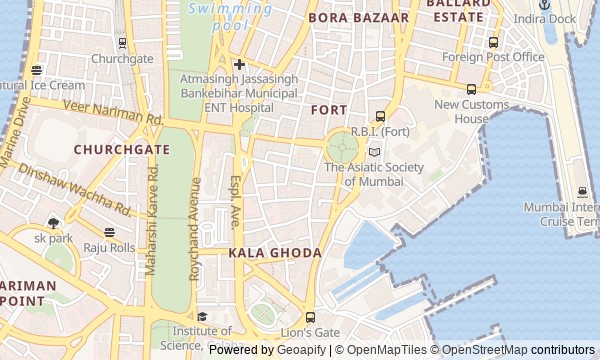
Route map
About the walk
You will walk from the main railway facade through the commercial Fort to the sea—where Bombay once received official guests and Mumbai now sends out ferries.
The road will change along with the city. The station will give way to a square on the site of a fortress gate, then a cathedral, a circle of banking arcades, an arts district, and a museum. At the end, there will be the harbor and a great stone arch.
There will be no parade of dates in these stories. Instead, human details will guide you: a voice from a dark cabin, a name on a stone plaque, a sermon that brought consequences, an empty place on a bronze horse, hospital beds in a museum gallery, and a silver copy of the gates. You will learn why these things ended up here at the stops along the way.
By the end of the walk, you will be able to read the old Fort as a chain of renamings and new purposes—from Victoria Terminus to Gateway of India, from Bombay to Mumbai.
Why this order
The station will be the starting point not only geographically: from here, the route heads through the former Fort toward its seaward edge. At the site of Church Gate, a fountain shows what appeared after the walls came down; the next street follows the old path from the gate to the cathedral that gave it its name. From the cathedral, the route leads straight to Horniman Circle Gardens, where the former trading ground and the newsroom of the commercial city stand beside the church. Next, banking arcades give way to Kala Ghoda, where you can see how official monuments yielded to city names. The black horse leads to the museum, where the same change of names joins a change in the building's purpose. The final stretch continues toward the sea and ends at Gateway of India—a ceremonial entrance that became the site of a ceremonial departure.
Those who want to understand the historic center through the stories of particular places Those interested in the renaming of Bombay as Mumbai Those who prefer human episodes to an overview of architectural styles
Those looking for a walk through markets and modern street food Those who want to spend the route away from commercial streets Those who only need a short overview of the city's best-known postcard sights
Before you go
Expect a busy urban setting: comfortable shoes, water, and sun protection will be more useful than formal clothes. The station remains a working transport hub, the cathedral an active place of worship, and the library and museum independent institutions with their own rules. Do not treat interiors as a guaranteed part of every stop: the facades and surrounding spaces already carry the story. If you want to explore the museum thoroughly, check its official notices in advance and set aside separate time for it. At the harbor, be ready for crowds and security screening; a boat trip is not part of this route.
When to go
For seven stops, leave several hours without a hard deadline at the end. The outdoor route moves faster, while entering the cathedral, library, or museum changes the pace and can easily add substantial time. For an unhurried reading of the facades, choose a part of the day with plenty of daylight left; treat a museum visit as a separate substantial block, not a short pause between stops.
Backup plan
If your energy runs low, use Horniman Circle Gardens for a break and reduce the number of interiors while keeping the walk's sequence. A closed cathedral can be understood from outside through its position in the former Fort and its connection to the name Church Gate. In Kala Ghoda, it is enough to see the horse, the library, and the neighboring facades from the street. If time is short, save the museum for another day, but take in its dome, turrets, and stone screens. If Gateway of India is too crowded, do not force your way to the piers: the final turn of the story can be read from a spot where both the arch and the harbor are visible.
Route conditions
Surface. Paved — 2.2 km (data covers 66% of the route)
Facilities. Toilets — 5; drinking water — 4
Elevation. Ascent — 26 m; descent — 37 m
OpenStreetMap extract of June 18, 2026: database data, not a check on the ground. Data © OpenStreetMap contributors, ODbL licence
Walk plan
Open in maps ↗- 1
Chhatrapati Shivaji Maharaj Terminus
Here the route begins with the moment when a familiar station announcement became a way of leading people out of danger. - 2
Hutatma Chowk and Flora Fountain
The square will show how the demolition of the fort wall made room for a new city and a new dispute over names. - 3
St. Thomas' Cathedral
A personal conflict will explain the price Bombay paid to gain its first separate Anglican church. - 4
Horniman Circle Gardens
This stop links the banking circle with the newsroom that could not be silenced by removing its leaders. - 5
Kala Ghoda
Here you will see why a city symbol can outlast its own monument. - 6
Chhatrapati Shivaji Maharaj Vastu Sangrahalaya
The museum serves the route as an example of a building whose original purpose was delayed by the war. - 7
Gateway of India
The finale will bring together the grand maritime entrance and the ceremony after which it became the gateway to another country.
Route features
Everything you need stays in the browser
Progress, saves and your trip plan are stored on this device.
Add Guide On Map to your home screen so the walk opens outside the browser.
How we handle sources, maps and corrections: our editorial standards