 Guide On Map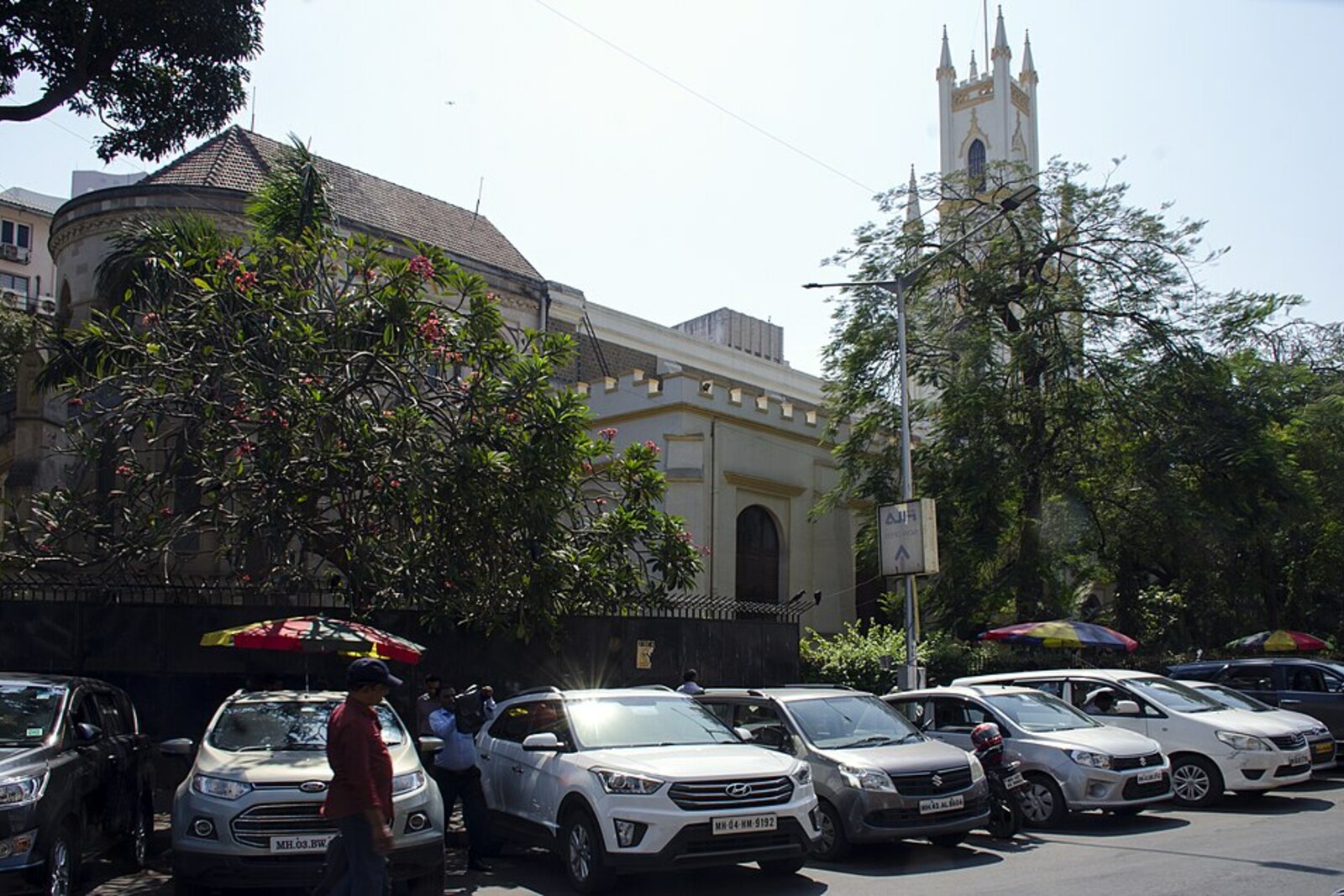
Look around first
What to notice
- The cathedral façade
- The stained-glass window with St Thomas the Apostle
- The memorial to Richard Cobbe
The story of the place
The church received the name of St Thomas from the Christian tradition about the Apostle who brought the faith to India. In the cathedral's southwest section, he is depicted in a stained-glass window between the archangels Michael and Gabriel. Later, the seat of the first Bishop of Bombay was placed here, and the church became a cathedral; the Diocese of Mumbai of the united Protestant Church of North India now holds services in it.
On June nineteenth, seventeen fifteen, Richard Cobbe, chaplain to the East India Company, preached about the unfinished church. A chaplain was a priest the company hired for its employees and soldiers. Cobbe received his post and salary from it, yet he was ashamed that the English in Bombay worshipped in two connected rooms inside the fort. He wanted to move worship out of the enclosed Bombay Fort and into a separate church open to the entire English community.
By then, walls about fifteen feet high had already stood on this site for more than thirty years. They had been begun by Governor Gerald Aungier, who pressed for the construction of Bombay's first Anglican church. In sixteen seventy-six, the foundations were laid for a building for one thousand worshippers, though there were fewer than three hundred English people in the settlement. Aungier died, leaving five thousand rupees for the work to continue. His brother, who managed the inheritance in England, did not hand over the money. The project was too large for the small community, and a roof was never put over the walls.
After Cobbe's sermon, Governor William Aislabie agreed to resume construction and ordered a subscription book to be opened. The East India Company contributed ten thousand rupees. Cobbe sent requests for donations to English trading posts from Persia to China; church ministers in Madras refused, but the other collections made it possible to continue the work. At Christmas in seventeen eighteen, the governor, council members, merchants, and military men came here from the fort. A girl named Susanna was baptized in the new church that day. For the time being, the building was simply called Bombay Church.
Two years later, Cobbe learned how insecure his position was in the church he had completed. Braddyll, a member of the Bombay Council, hired people to repair his house on Sundays. Cobbe considered Sunday work a violation of the commandment and first admonished Braddyll in private. Braddyll continued the repairs. Then, during a service, Cobbe named him from the altar, demanded repentance, and threatened excommunication.
Braddyll complained to his colleagues. The company council ordered Cobbe to apologize publicly to him in the same church on the following Sunday, after communion. The priest acknowledged that he could have chosen another place for the rebuke and agreed to ask forgiveness outside the church. He refused to recant at the altar what he had said from the altar: after that, Cobbe explained, the parishioners would stop taking his instructions seriously. The council suspended the chaplain and sent him back to England. There Cobbe received a parish in Dorset and, many years later, published his own account of the construction of Bombay Church.
The name of St Thomas appeared only after he was gone. Immediately after its opening, Cobbe asked the Bishop of London to consecrate the church and give it a name, but received no answer. Only in eighteen sixteen did Bishop Thomas Middleton dedicate the church to St Thomas the Apostle. According to Christian tradition, Thomas brought Christianity to India; the name refers to that tradition, not to an event that took place in Bombay. In a stained-glass window in the cathedral's southwest section, the Apostle is depicted between the archangels Michael and Gabriel.
The church became a cathedral in eighteen thirty-eight, when the seat of Thomas Carr, the first Bishop of Bombay, was placed here. Services of the Diocese of Mumbai of the united Protestant Church of North India are now held here. Inside, a memorial to Richard Cobbe has survived: the parishioners left on its wall the man whom the East India Company removed from the church he had built.
Useful on site
An active cathedral. The exterior can be viewed at any time; access inside depends on services, events, and the current arrangements on site.
Checked: June 30, 2026. Check the official source before visiting.The cathedral functions as a church. Enter only when appropriate, keep quiet, and do not turn a service into sightseeing; if the entrance is closed, focus on the building and its position in the old layout.