 Guide On Map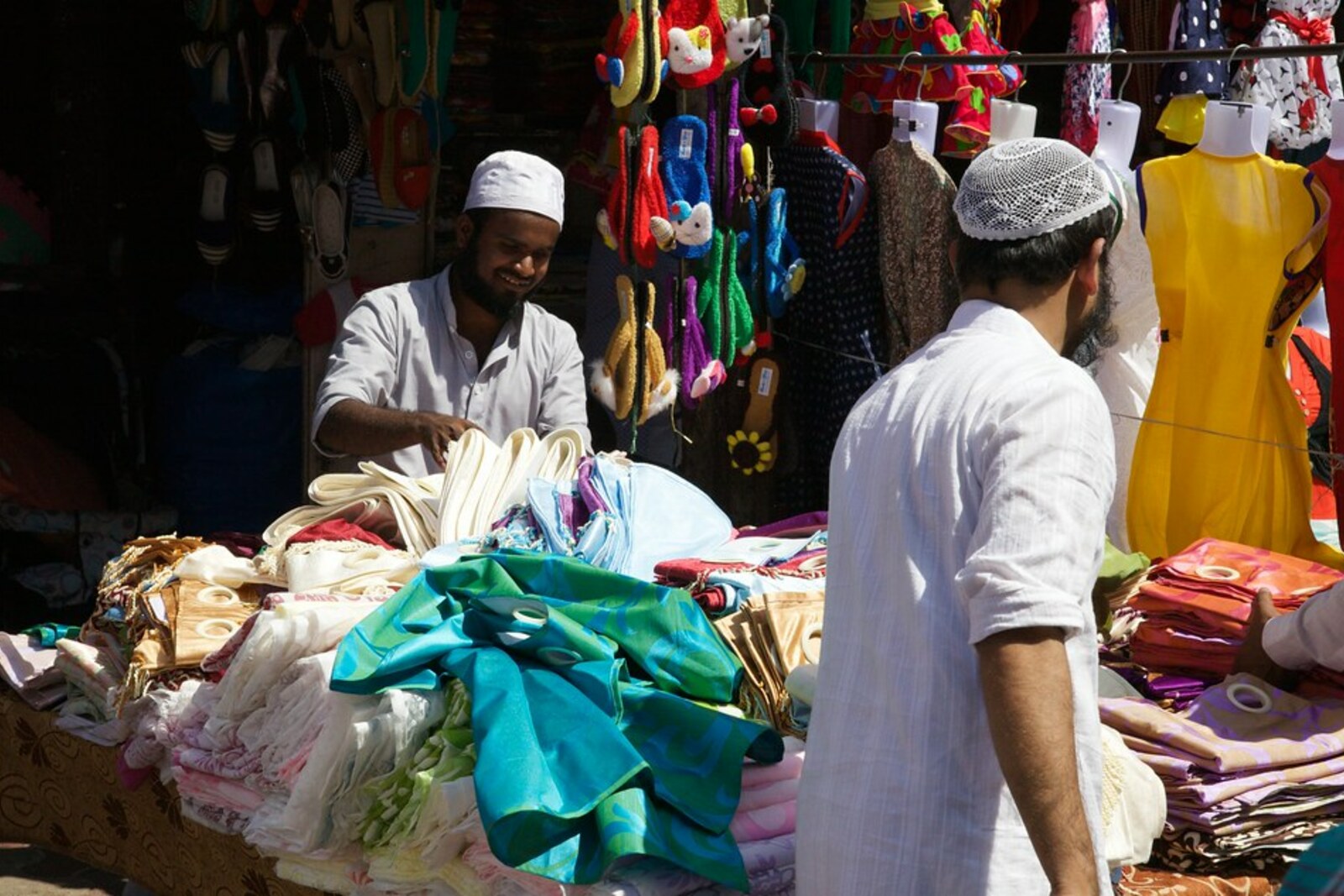
Look around first
What to notice
- Shops with white mattresses
- Fabric samples
- Narrow trading passageways
The story of the place
In the narrow passageways, the shops are more like negotiating rooms: fabric samples are spread out on white mattresses instead of filling the room with all the goods at once. The name Mangaldas remains from the landowner, while Mulji Jetha recalls the founder of the neighboring market. The merchants chose this quarter because it was convenient to send heavy bales from here to the port and railway terminals. Behind today's samples and counters stands the company created to manage this trading real estate, and it is still active.
After Mahatma Jyotiba Phule Mandai (Crawford Market), the trading quarter created by the merchants themselves begins here. The two neighboring markets have different roles. At Mangaldas Market, people more often choose fabric at retail and buy cut lengths. At Mulji Jetha Market, wholesale deals are made: the seller shows samples, while whole bales may be kept in a warehouse outside the market.
Mangaldas is the name of the landowner on whose land the first of these markets was established. Sir Mangaldas Nathubhoy traded in cotton and managed a Bombay spinning mill. Mulji Jetha is the name of the founder of the second market. In the early eighteen thirties, the young merchant Mulji Jetha Aasher made money from raw cotton, yarn, and ready-cut lengths of standard size. Such goods were then called piece goods: they were bought not for a single dress, but in batches for resale.
Mulji Jetha sent cotton and yarn to Britain. Together with two partners, he invested the profits in a wholesale market—about six lakh rupees, nearly six hundred thousand. To manage the real estate and accounts, they established the New Bazar Piece Goods Company. On July twentieth, eighteen seventy-one, it was entered in the Bombay register as number four. About four years later, the market was given Mulji Jetha's name.
The merchants chose this quarter because trade had already taken shape on Sheikh Memon Street. From here, it was convenient to send heavy bales to the port and railway terminals. Retail shopkeepers came here to stock their own shops, and by nineteen oh nine, almost all of Bombay's wholesale fabric trade was concentrated in Mulji Jetha Market. Small rooms with white mattresses served as negotiating rooms: a buyer needed a sample, a price, and the seller's name, not a warehouse packed with the entire order.
Because of the market's structure, its traders once nearly acquired a new owner. According to the recollections of longtime residents, in nineteen fifty-five an outside buyer tried to purchase the market from the Jetha family. People whose livelihoods depended on wholesale deals in these passageways depended on premises and conditions that a single owner could change. Then the merchant Navnit Shah brought together an association of shopkeepers. Instead of a single buyer, the market participants themselves bought a large stake from the family.
Immediately after the buyout, they discussed rebuilding, but the traders did not agree, and the project stopped. Mulji Jetha's descendants lost the controlling stake and remained among the minority owners. The company registered in eighteen seventy-one continues to be listed as active; its directors still include representatives of the Jetha family. Behind the fabric samples spread out in cramped shops still stands the enterprise that its founder created for wholesale trade more than a century and a half ago.
Useful on site
Private textile shops with daytime hours; Sunday is often closed or shortened; check specific hours on site.
Checked: June 28, 2026. Check the official source before visiting.These are working wholesale rows, not an exhibition: keep to the edge of the passageway and do not unfold fabric without the seller's involvement. It is best to photograph inside a shop only after the owner's consent.