 Guide On Map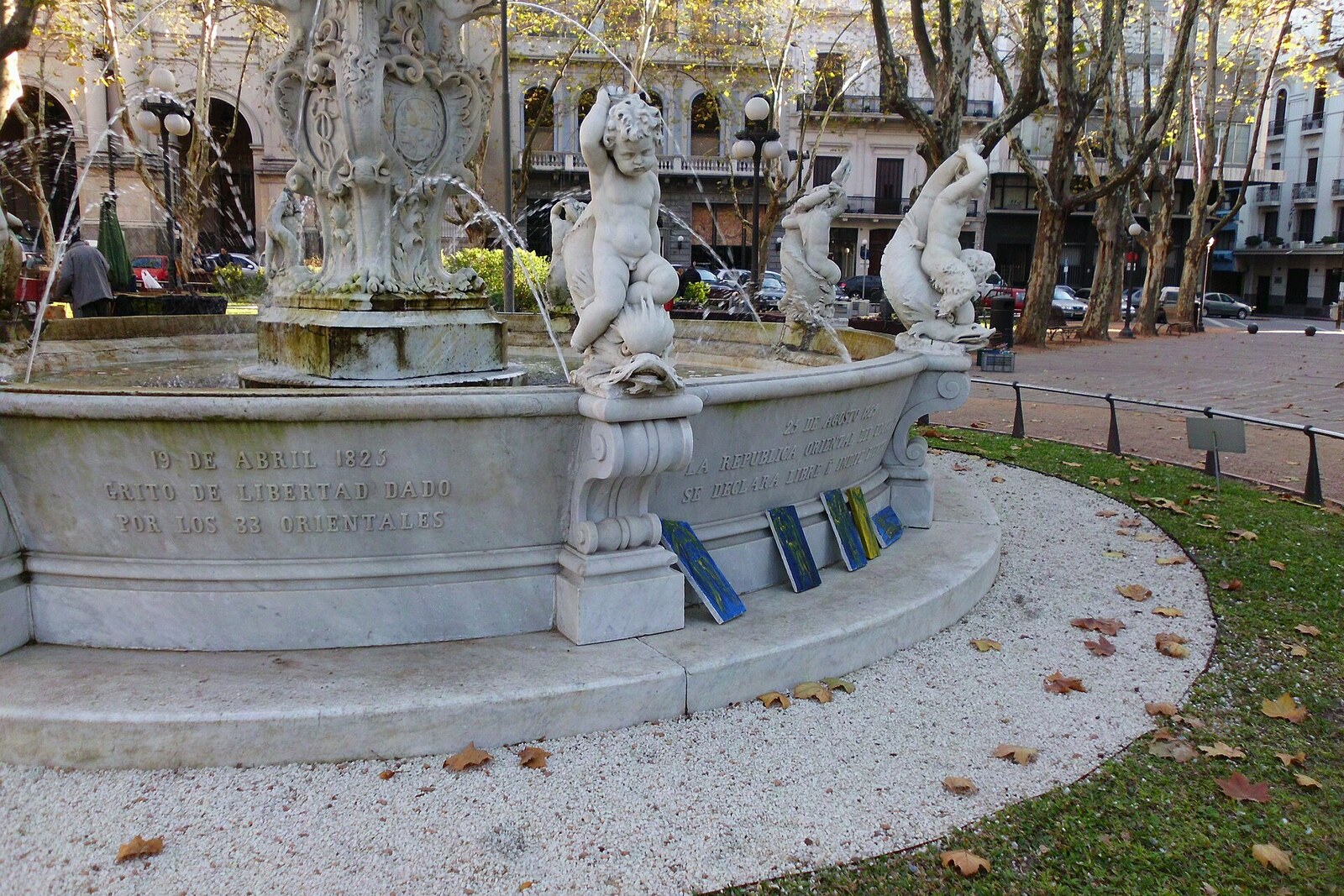
Look around first
What to notice
- The fountain's marble basin
- The inscription about the Oath to the Constitution
- The concession holders' surnames on the rim
- The repeated date
The story of the place
Two inscriptions, separated by forty-one years, stand on the fountain's marble rim. The first explains the square's official name; the second explains why this basin appeared at its center. Both refer to July eighteenth.
It was once Plaza Mayor, the main square of colonial Montevideo. The first attempt to call it Plaza Matriz came after the oath to the Spanish Constitution of eighteen twelve. Spanish rule soon ended, and the name did not catch on: residents called it Plaza Matriz, after the main church nearby.
The current name is connected with another oath. For two years, deputies of the new Eastern State had been drafting its first constitution. On July eighteenth, eighteen thirty, the interim governor Juan Antonio Lavalleja, who was seeking recognition of the new rules by the army and the population, administered the oath to officials and military commanders. The ceremony was then moved here. A platform was erected in front of the Montevideo Cabildo; first army units climbed onto it one after another, then civilians were invited up. People swore to observe the constitution and defend the representative republic it had established.
In the crowd was fifteen-year-old Isidoro de María. He was already earning a living as a typesetter at the state printing house, setting lines of official texts by hand from individual type pieces. De María pushed his way to the platform's western stairs, climbed up with the adults, and also answered, “Yes, we swear.” Many years later, he became a historian and recorded how, as a boy, he had added his voice to those of full citizens.
The constitution came into force and remained the basic law for eighty-nine years. In eighteen forty-three, the city head Andrés Lamas, who at the time was in charge of both the police and municipal services, drew up a new plan for street and square names. He restored the name Plaza Matriz to this square with a precise explanation: to commemorate the fact that the constitution had been solemnly sworn to be observed here on July eighteenth, eighteen thirty. The official name remained, but the familiar Plaza Matriz did not disappear from everyday speech.
Forty-one years later, the same date was chosen for the opening of the city water system. After the severe drought of eighteen sixty-seven, the government was looking for a way to supply Montevideo with fresh water continuously. Before that, prosperous homeowners used cisterns, while everyone else bought water from water carriers. They filled barrels at springs outside the city and charged half a real for forty liters; their livelihood depended on those trips and sales.
The Uruguayan entrepreneur Enrique Finn sought a concession to supply water through pipes. For the costly construction, he brought in the Argentine investors Ambrosio Plácido Lezica and Anacarsis Lanús. Their project was selected from among eight proposals. Steam pumps were installed on the Santa Lucía River, fifty-six kilometers from here, and the contract included a separate condition: the concession holders had to install a marble fountain at the center of the square where residents could draw water.
On May thirteenth, eighteen seventy-one, at six fifty in the morning, river water reached Montevideo through pipes for the first time. At that point it was only settled; full purification did not yet exist. The official opening was held on July eighteenth at the fountain completed by Juan Ferrari. The water carriers gradually moved to the outskirts, while Finn and his partners held the concession for only eight years: unable to repay the bank, they sold the enterprise to an English company.
Both “Oath to the Constitution” and the surnames of Lezica, Lanús, and Finn are still carved into the basin's rim. Beside them, one date is repeated: July eighteenth.
Useful on site
The square is open around the clock. On Saturdays, an antiques and crafts market usually operates; the schedule depends on the city and the weather.
Checked: date not specified. Check the official source before visiting.Walk all the way around the fountain to see it at once as an ornament and a former public water point. On market and event days, it is easier to listen from the edge of the square.