 Guide On Map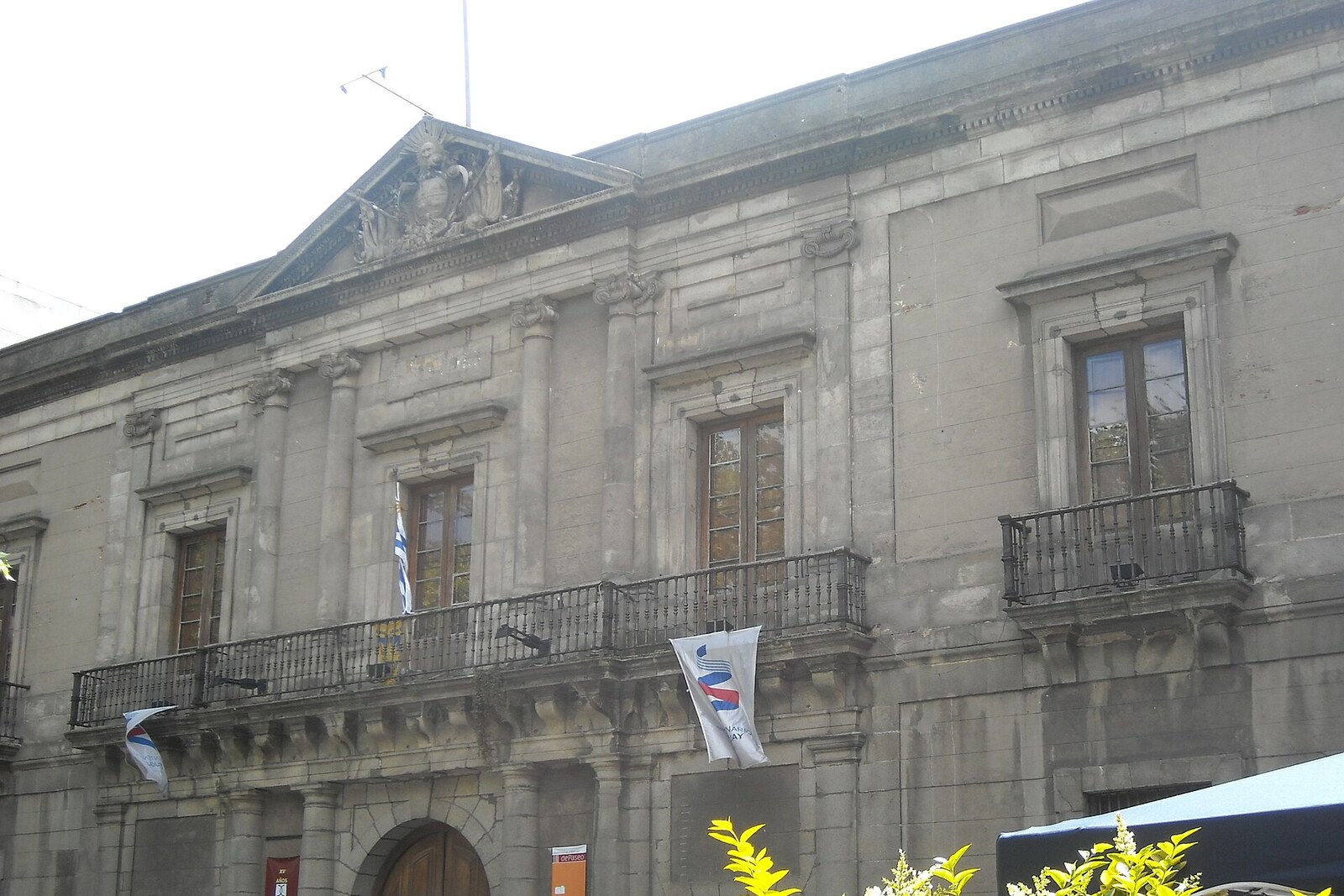
Look around first
What to notice
- Triangular pediment
- Municipal council chambers
- Interior courtyards
- Former prison quarters
The story of the place
The triangular pediment above the square belongs to the building where municipal authority, the court, and royal cells came together within the same walls. It was built opposite the church on the main square so that administration, the parish, and prisoners would remain at the center of Montevideo at the time. Behind the facade, the halls and inner courtyards remain, although the present form took shape later and looks nothing like the unfinished building of the early nineteenth century. When the rooms of the former council, court, and prison were transferred to the city, the historical collection of objects from everyday life in Montevideo moved here.
On the night of September twenty-first, eighteen oh eight, soldiers and townspeople gathered at the Montevideo Cabildo. They demanded an open meeting of the city council. The occasion was the arrival of naval captain Juan Ángel Michelena: the viceroy had sent him from Buenos Aires to replace the governor of Montevideo. Michelena never took office—the people gathered forced him to leave the city.
Behind this hasty replacement was news from Europe. Napoleon forced the Spanish kings to abdicate and placed his brother on their throne. Santiago de Liniers, viceroy of the Viceroyalty of the Río de la Plata, who governed the provinces from Buenos Aires, was born in France. Shortly before, he had won fame in battles against the British, but now his French origin became grounds for suspicion.
The Spanish officer Francisco Javier de Elío, the acting governor of Montevideo, sought Liniers's removal while also defending his own post. He made a career in service to the crown and expected to rise through it; disobedience to the viceroy put his salary, career, and freedom at risk. Liniers ordered Elío removed—that was how Michelena came to Montevideo.
They came here to sort out this conflict because the Montevideo Cabildo originally meant the city council, and only later the council building. Here officials managed Montevideo's affairs, heard cases, and held prisoners in royal cells. The Montevideo Cabildo was built beside the main square, opposite the church: municipal administration, the court, the prison, and the parish occupied neighboring sides of one public center.
An Open Cabildo was an expanded meeting on an extraordinary matter, though not all residents were admitted. According to witness testimony, about two hundred men stood outside—military personnel, less well-off townspeople, and enslaved Black people. Fifty-five participants entered the hall, including nineteen representatives chosen by those assembled.
Elío demanded that he remain governor and that a separate Montevideo Junta be created. The participants found an old legal formula for this: Liniers's order was to be “obeyed, but not carried out.” Thus they preserved loyalty to the Spanish king while at the same time refusing to obey his viceroy. Elío headed the Junta.
There was no agreement in the hall. Joaquín Ruiz Huidobro, commander of the royal fleet, who was invited to join the Junta, refused to recognize it as lawful. Elío's supporters forced him to leave Montevideo. Michelena, too, was left without a post, and Liniers's order was never carried out here.
The Junta lasted nine months. Its members permitted trade with allied and neutral countries and directed local revenues to city administration and the troops, but after the break with Buenos Aires, they lost revenue from Upper Peru. On June thirtieth, eighteen oh nine, the new viceroy, Baltasar Hidalgo de Cisneros, arrived in Montevideo, dissolved the Junta, and restored the former subordination. Elío soon left for Spain.
The building was still under construction then. Work had begun four years before the Open Cabildo, while its present form and triangular pediment appeared much later. A section of the city council and the layout itself—with halls, prison quarters, and inner courtyards—survive from the event, although the facade of eighteen oh eight looked different.
The historical museum was initially located far from here. In nineteen fifteen, the educator and museum organizer Alberto Gómez Ruano secured the creation of a municipal historical collection at Quinta de Sierra. After his death, the historian Horacio Arredondo headed the museum and for thirty years acquired and accepted as donations furniture, clothing, ceramics, drawings, and engravings from the life of Montevideo. When the former rooms of the council, court, and prison were transferred to the municipality, the collection moved here. The museum opened in the Montevideo Cabildo on September twenty-first, nineteen fifty-eight—exactly one hundred fifty years after that Open Cabildo.
Useful on site
Museum: Mon–Fri 11:00–17:45; Sat and working holidays 11:00–17:00; free admission. Usually closed on Sundays.
Checked: date not specified. Check the official source before visiting.If the museum is open, pay attention not only to the official portraits but also to the furniture, fabrics, and ceramics. If entry is closed, the story can still be read through the building's proximity to the cathedral and the square.