 Guide On Map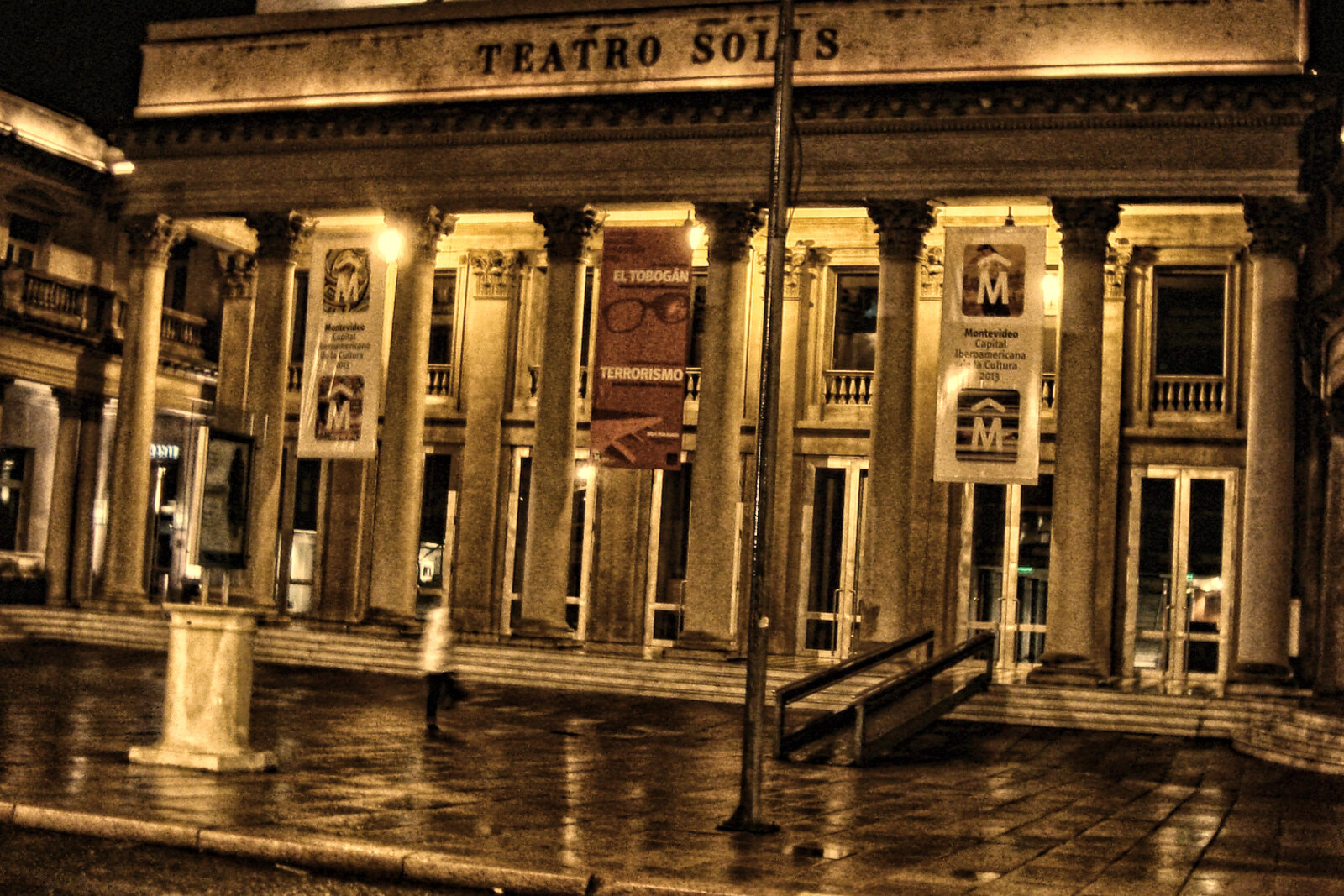
Look around first
What to notice
- Red signal lamp
- Main façade
- Side wings
- Marble bust in the foyer
The story of the place
A red signal lamp hangs above the main façade of Solís Theatre. On performance days, it was lit so that residents of distant neighborhoods would know about the evening show. The building stands at the junction of old Montevideo and the streets that appeared after the city fortifications were dismantled; behind the façade stretch the side wings and the foyer. Comedia Nacional and the Montevideo Philharmonic Orchestra now perform here, and the theater received its name in honor of the explorer of the River Plate, who had no connection with the stage.
Juan Miguel Martínez and Antonio Rius decided to build this building during an intermission at another theater. Both were entrepreneurs from Montevideo’s commercial elite and wanted to create a large stage that could be rented out to visiting companies. The old Casa de Comedias remained the city’s only permanent theater; it had no seats, and spectators brought their own chairs.
Martínez and Rius assembled a company of one hundred fifty-six shareholders—wealthy merchants and prominent townspeople. They contributed one hundred fifty thousand patacones, the silver coins of the time. The theater was conceived both as a profit-making venture and as a place where the public could be seen by one another. The site was chosen at the junction of old Montevideo and the neighborhoods that grew up after the fortifications were dismantled.
Construction began in eighteen forty-two. A year later, the siege of Montevideo halted the work: the builders were taken into the opposing armies, some shareholders left the country, and the site was left with foundations, low walls, and expensive materials brought from Europe. They could be stolen or ruined in the open air.
Martínez continued to find money to guard the purchases. Esteban Tiscornia and Vicente Gianello, board members who remained in the besieged city, leased the unfinished site to a family. The tenants provided a constant presence, and the rent went toward preserving six thousand six hundred sixty-three Genoese roof tiles. In this way, the shareholders tried to protect their investment while the outcome of the war remained unknown.
After the siege ended, they conducted an inventory. Some Siberian timber, marble, and roofing slate had to be pulled from the mud, but much of it was still usable, and the foundations were unharmed. Rius joined the new board, Martínez became its chairman, and work resumed in eighteen fifty-two.
On August twenty-fifth, eighteen fifty-six, Giuseppe Verdi’s Ernani was performed in the hall. The venture, begun with a conversation during an intermission and having survived an eight-year halt, finally received the public. After Martínez’s death, the shareholders ordered a marble bust of him to be placed in the foyer.
The same owners chose the name. They discussed “Progress,” “Peace,” “Harmony,” “Freedom,” and “Theater of the Venture,” but approved “Teatro de Solís” by a majority vote. Juan Díaz de Solís was a Spanish navigator whose expedition entered the River Plate in fifteen sixteen. He had no connection with the theater: the shareholders dedicated the name to him as the first European explorer of that river. Later, the particle “de” was removed, leaving the present-day Solís Theatre.
Income from performances was often insufficient. The owners rented out rooms in the side wings, the cloakroom, costumes, and opera glasses, and in difficult years they even bottled and sold water from a spring beneath the stage. When movie theaters and radio dramas took away part of the audience, the venture stopped bringing in its former profit. In nineteen thirty-seven, the shareholders sold the building to the municipality. After renovations, it reopened as a public theater; Comedia Nacional and the Montevideo Philharmonic Orchestra now work here permanently.
A red signal lamp still stands above the façade. On performance days, the first owners lit it so that residents of distant neighborhoods would know that a show was being performed at Solís that day.
Useful on site
Tours: Wed–Fri 11:00, 12:00, 16:00; Sat–Sun 15:00, 16:00. On the third Saturday of the month there are no regular tours; there may be an open house from 14:30–17:00. Tickets: free on Wednesdays; usually 200 Uruguayan pesos for residents with identification and 400 for foreigners, with a 50 percent discount through a digital tourist tax refund.
Checked: date not specified. Check the official source before visiting.You can hear the building’s story in front of the façade. The hall and service areas are accessible only as part of a separate visit or a performance, so check this possibility in advance.