 Guide On Map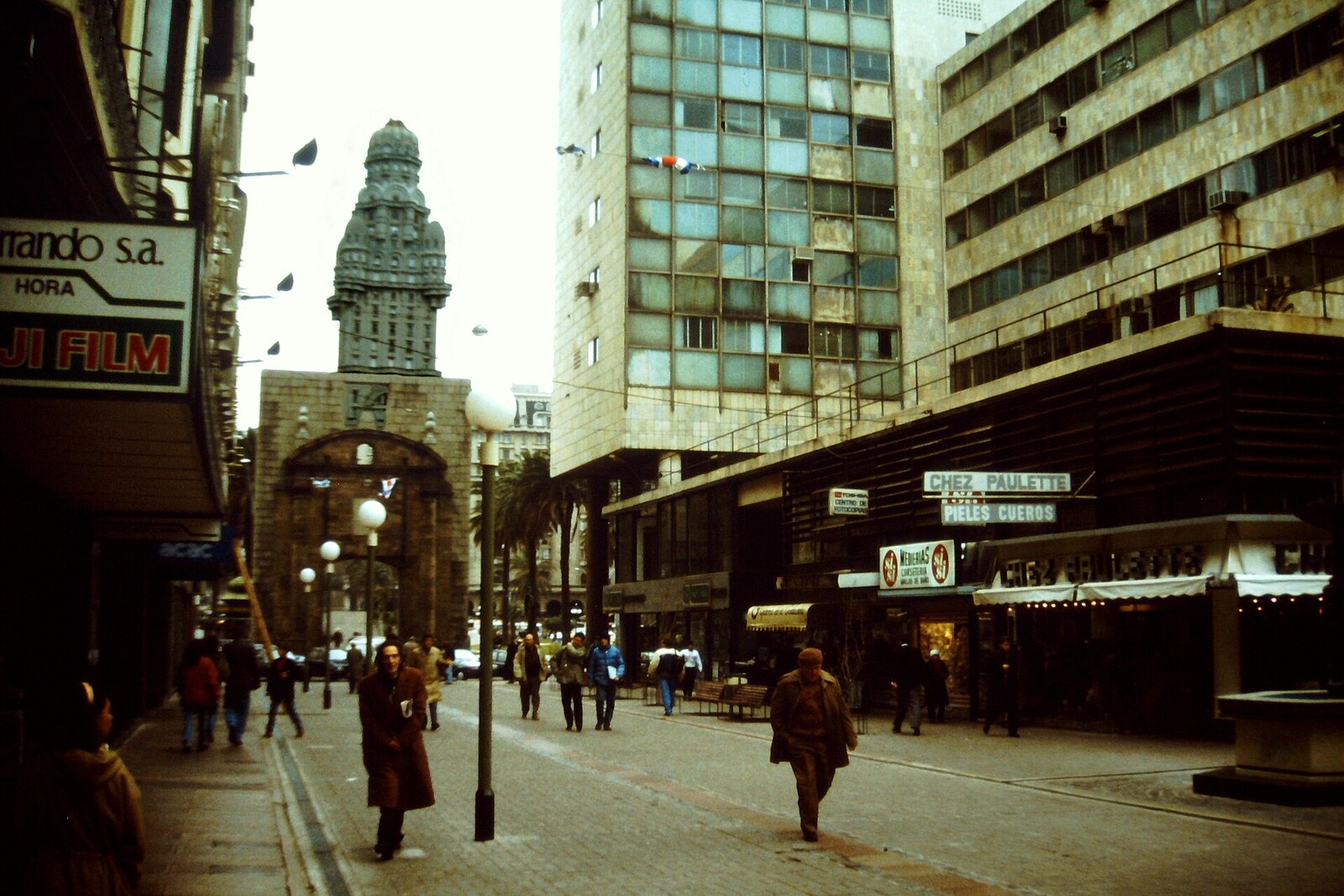
Look around first
What to notice
- Granite bands in the pavement
- Old cobblestones
- Benches
- The façade of Club Uruguay with loggias
The story of the place
The granite bands, cobblestones, and benches appeared on Sarandí Street after the street was made pedestrian-only in nineteen ninety-two. But its direction remained the same: this straight line connects the gate of the former Citadel of Montevideo with Plaza Matriz and passes the cathedral, Montevideo Cabildo, and Club Uruguay. That is why official processions traveled here between the cathedral and the presidential residence near Plaza Independencia.
Originally, the street was called Sarandí Street, then Sarandí Street. Andrés Lamas, chief of the city police during the long siege of Montevideo, gave it its present name in eighteen forty-three. He replaced colonial names honoring saints with names from local history. Sarandí is a stream in what is now Florida Department, where on October twelfth, eighteen twenty-five, Juan Antonio Lavalleja, commander of the Eastern Province rebels, tried to stop the combined detachments of the Empire of Brazil. When the Brazilian cavalry launched an attack, Lavalleja ordered the carbines put behind their backs and the sabers drawn. His horsemen won in hand-to-hand combat and took the central part of the province. Twelve days later, the congress in Buenos Aires voted for its incorporation into the United Provinces of the Río de la Plata. The final emergence of an independent Uruguay required another war and negotiations, but Lamas chose the name of this victory for the main street.
Fifty-four years later, the only murder of a sitting president in Uruguay's history took place on Sarandí Street. The country was going through a civil war: detachments of the National Party were fighting the government of President Juan Idiarte Borda, and he also had irreconcilable opponents within his own Colorado Party. One of them was twenty-three-year-old Avelino Arredondo. He worked as a clerk—a salesperson and the owner's assistant—in a shop on the nearby Buenos Aires Street and wanted to kill the president because, as he later told investigators, the president governed the country badly.
On August twenty-fifth, eighteen ninety-seven, Idiarte Borda attended a thanksgiving service in the cathedral on the anniversary of the proclamation of independence. After the service, the president led a procession along Sarandí Street toward Estévez Palace. Arredondo waited in the crowd opposite Club Uruguay. He put a note with his name and address in his pocket: he expected the guards to kill him on the spot.
Arredondo did not recognize the president by sight and asked a person standing nearby which of those passing was Idiarte Borda. He was told: the one wearing the sash. From a distance of about two and a half meters, Arredondo fired at the presidential sash. The wounded man was carried to Montevideo Cabildo, where he died. The shooter did not run and put up almost no resistance when he was detained. The court sentenced him to five years in prison; he was released in nineteen oh two and later worked in the customs administration. Juan Lindolfo Cuestas, the president of the Senate, took the place of the dead president, resumed negotiations with the rebels, and less than a month later the sides made peace.
House number three hundred thirty-one, near which Arredondo waited, belongs to the old numbering system. Opposite it, however, Club Uruguay still stands—a tall palace with loggias at the intersection of Sarandí Street and Ituzaingó Street. Between its façade and the present pedestrian pavement walked the president whom the assassin could identify only by the sash.
Useful on site
The street is open around the clock and free; the activity of shop windows, cafés, and artisan outlets is mostly during the day.
Checked: date not specified. Check the official source before visiting.Listen to this stop after moving to the edge of the pedestrian flow. The house connected with the attempted assassination remains part of an ordinary street, rather than a separate memorial space.