 Guide On Map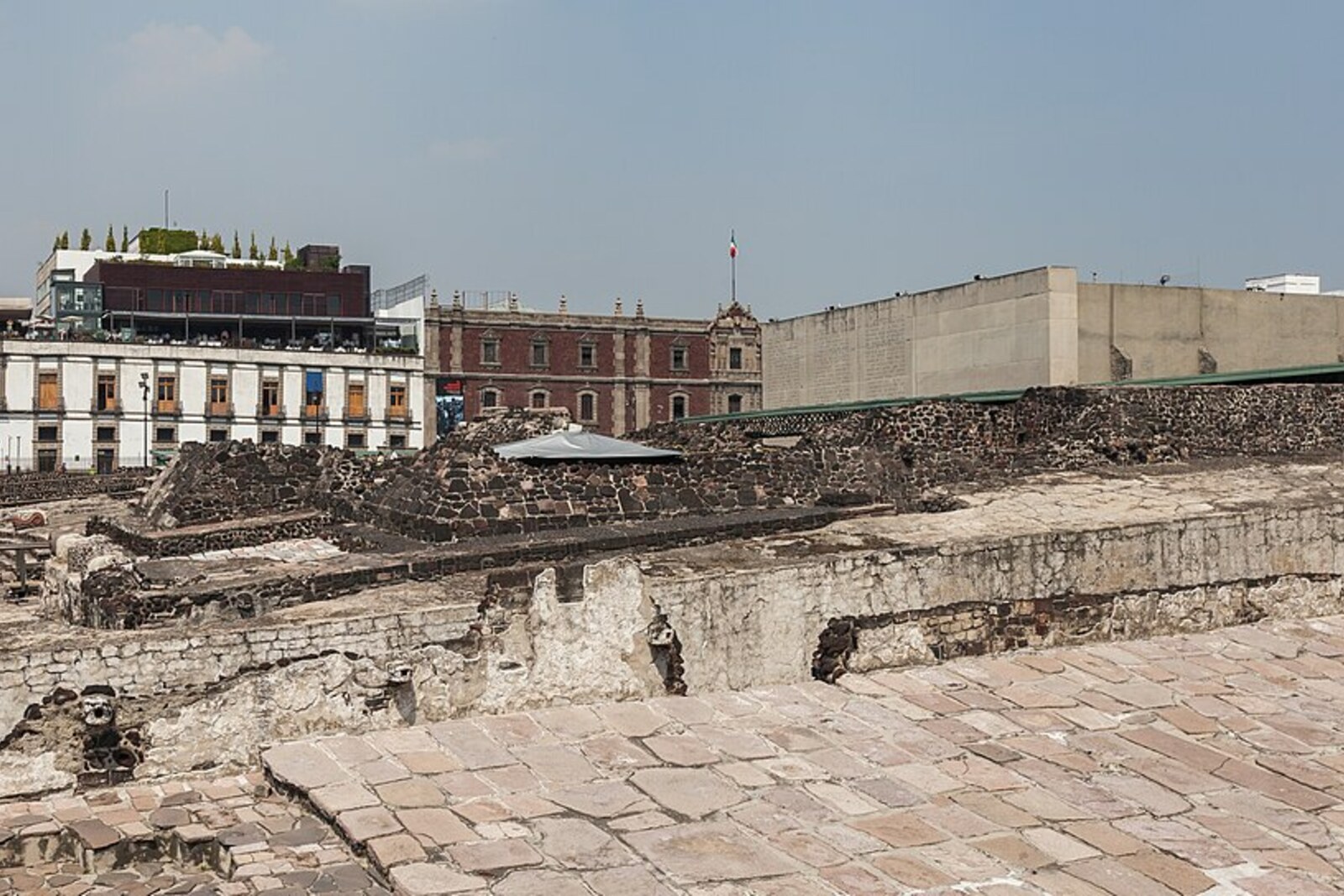
Look around first
What to notice
- Low steps from the early layers
- Two staircases of the temple foundation
- A copy of the Coyolxauhqui monolith
The story of the place
The Templo Mayor of Tenochtitlan, the capital of the Mexica people, once rose to almost forty-five meters; its upper part was dismantled after the conquest. The low stone steps in front of the museum survive from the pyramid's early layers, which later builders covered with new, larger outer shells. Two ascents led to different sanctuaries and linked the pursuits on which the capital depended: war, which brought captives and tribute, and agriculture, waiting for rain. A copy of an ancient relief is visible on the southern side, while the original is kept in a museum gallery.
On the night of February twenty-first, nineteen seventy-eight, a city power-company crew was digging a trench here. The workers were on the night shift, and hard stone beneath the street was preventing them from continuing the earthworks. They cleared away the dirt and saw a relief. The stone could have been broken up and the work finished, but the crew stopped and reported the discovery to archaeologists.
Beneath the pavement lay a round monolith three meters twenty-five centimeters in diameter and weighing almost eight tons. Carved on it was a woman with her head, arms, and legs separated from her torso. Bell-shaped ornaments made it possible to identify Coyolxauhqui—her name means “adorned with bells.”
The place where the slab lay explained more than the relief itself. It was found at the foot of the southern staircase of the Templo Mayor, the Spanish name for the main temple of Tenochtitlan, the capital of the Mexica, a people often called the Aztecs.
According to the Mexica myth, Coyolxauhqui led her brothers to kill their mother, Coatlicue. Coatlicue was pregnant with Huitzilopochtli. He was born armed, killed Coyolxauhqui, dismembered her, and threw her down Mount Coatepec. This is a legend about gods, not the biography of a woman who once lived.
The builders turned the southern half of the temple into a stone recreation of this story. At the top stood the sanctuary of Huitzilopochtli, patron of war; below lay the image of the fallen Coyolxauhqui. Written sources report that priests, attendants of the sanctuary, sacrificed captive warriors at the top, and their bodies were thrown down the steps. Their fall repeated the goddess's fate. Here the captive lost his life, while the victorious warrior fulfilled the duty for which he had been trained to capture enemies alive.
Beside it rose a second staircase, leading to the sanctuary of Tlaloc, on whom rains and the harvest depended in Mexica belief. The Templo Mayor brought together the two pursuits on which the capital lived: war, which brought captives and tribute, and agriculture, which required water. That is why two sanctuaries stood at the top and the facade was divided into two staircases.
Archaeologists had known part of the temple foundation since nineteen fourteen, but the slab indicated the exact position of Huitzilopochtli's side. Archaeologist Eduardo Matos Moctezuma led the excavations. Over the following years, his team uncovered the pyramid's nested reconstructions: the Mexica enlarged the temple by raising a new outer shell over the old one, and repeated this at least seven times. This is how the open archaeological zone and the museum appeared.
The upper temple, about forty-five meters high, was dismantled after the conquest. The low steps in front of the museum belong to earlier layers, which subsequent builders had enclosed inside the pyramid. A copy of Coyolxauhqui now lies by the southern staircase, in the place for which it was carved. The original, which made the night crew stop work, is in a museum gallery.
Useful on site
Part of the ruins can be seen from outside through the fence. For a close look at the excavation and the monolith, separate entry to the archaeological zone is required.