 Guide On Map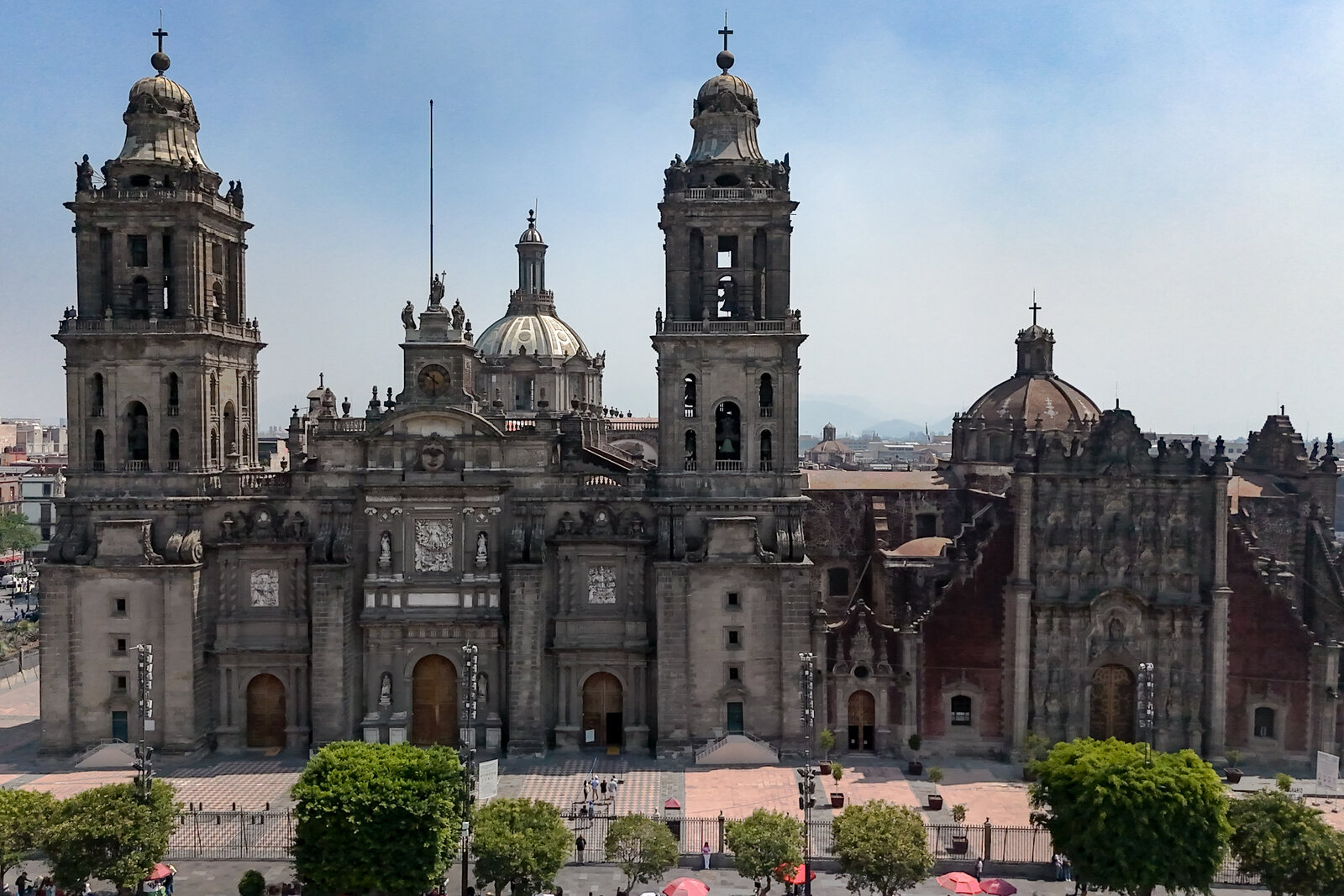
Look around first
What to notice
- Main façade
- Two bell towers
- Southern atrium
- Archaeological windows
The story of the place
The word “cathedral” is connected with the archbishop's cathedra, his official place in the church. The present cathedral was built beside an older active church: it stood where the southern atrium in front of the façade is now. Beneath the atrium, archaeologists excavated part of its walls, rooms, chapels, and altars; some remains are visible through archaeological windows. The two bell towers framing the main façade appeared later.
On January fifteenth, sixteen twenty-four, Indians from the construction site of this cathedral took work ladders and carried them across the square to the viceroy's palace. They set the ladders against the windows while other participants in the uprising set fire to the palace's main doors.
A chronicle contemporary with the events calls these people exactly that: “Indians from the construction site of the main church.” Historians link them to work crews from the districts of San Juan Tenochtitlan and Santiago Tlatelolco. The residents of these districts worked on city construction projects in exchange for exemption from tribute. A document drawn up five years later assigned a cathedral worker two reales per day. Taking part in an attack on the royal governor exposed them to trial for rebellion.
The present massive structure was still under construction at the time. To the south, on the site of today's atrium in front of the façade, stood the old active cathedral. It contained the archbishop's cathedra—his official place in the church. That is where the word “cathedral” comes from: the size of a building alone does not give it that name.
The Archbishop of Mexico City was Juan Pérez de la Serna. He sought to ensure that church courts and the right of asylum in a monastery were not subject to the orders of the royal governor. The viceroy Diego Carrillo de Mendoza, Marquis of Gelves, governed New Spain—the name of the Spanish viceroyalty centered in Mexico City. He wanted to hand over to a secular court the official Melchor Pérez de Varaiz, accused of illegal dealings and grain fraud. Varaiz took refuge in Santo Domingo Monastery, and the dispute over his arrest became a clash between two judicial systems.
The viceroy ordered the archbishop expelled from the city. Pérez de la Serna responded by excommunicating the governor and ordering religious services suspended in the churches of his diocese. Such a ban was called an interdict: for city residents, the usual order of church life was suspended. The names of those excommunicated were posted on doors, and bells announced the punishment. The archbishop's exile and the closed churches became the immediate cause of the uprising. When the viceroy forbade people to gather in the square, two Indians were seized and publicly whipped for disobeying the order to disperse.
A few days later, a crowd surrounded the palace. Workers brought the cathedral ladders, the attackers smashed the windows, freed the prisoners, and reached the governor's rooms. The Marquis of Gelves took off his official robes and glasses and tied a white handkerchief around his hat—a sign by which the participants in the uprising recognized their own. In this guise, he left through a side door and reached the Franciscan monastery. The palace was taken, and authority passed to the royal court.
The victors did not retain their offices either. The Marquis of Gelves was replaced by a new viceroy. Pérez de la Serna was summoned to Spain; later he received a bishop's see in Zamora and never returned to Mexico City. During the investigation of the uprising, more than one hundred people were arrested, and artisans, merchants, students, and clergy were given fines and prison terms. In sixteen twenty-seven, the king pardoned all the accused without exception and officially restored their good name.
The old cathedral was dismantled soon after the uprising. Beneath the southern atrium, archaeologists found its walls, rooms, chapels, and altars; part of the remains is visible through archaeological windows. The present towers and the bells hanging in them appeared later. From that day, what remains here are the underground walls of the first cathedral and the exact distance across the square that the workers crossed with ladders to the palace windows.
Useful on site
From outside, the cathedral's scale and its position in relation to the square are easy to see. Inside, keep quiet and do not disturb services; access to some areas may be restricted.